

Audio By Carbonatix
Embodied intelligence enables the physical manifestation of AI. Embodied intelligence has been in the news in recent times, adding to the AI-driven disruption that is impacting every aspect of our daily lives. While most AI systems today operate in the digital world, embodied intelligence seeks to create machines that can perceive, learn, move and interact with their environments much like living organisms.
The field is based on the idea that intelligence emerges not only from computation but also from continuous interaction with the physical world. Unlike traditional AI, which relies heavily on pre-programmed instructions, embodied intelligence emphasises learning through real-world experience. By combining advances in robotics, sensing technologies and machine learning, embodied AI systems can adapt to changing conditions, make decisions autonomously and perform increasingly complex tasks.
As these technologies mature, embodied intelligence is expected to play a pivotal role in shaping the next generation of intelligent machines and transforming industries worldwide. According to industry estimates, the global robotics market is currently valued at between US$50 billion and US$88 billion, depending on how the sector is defined and measured. Fuelled by persistent labour shortages, advances in artificial intelligence and growing demand for automation across industries, the market is poised for significant expansion. Leading forecasts suggest that the robotics industry could reach a value of between US$200 billion and US$350 billion within the next decade, underscoring its growing role in shaping the future of work and productivity.
Embodied intelligence connotes giving intelligence a physical body. More often than not, AI is seen as operating in virtual space; therefore, embodied intelligence is both interesting and important because it connects the dots between a physical body empowered with the ability to interact with the environment and the capacity to constantly adapt and optimise through that interaction.
Embodied intelligence is not a new concept. Its roots trace back to 1950, when Alan Turing's Computing Machinery and Intelligence outlined two AI development paths: one abstract (such as chess intelligence), representing disembodied intelligence, and another emphasising perceptual abilities and real-world action and learning, representing embodied intelligence.
Embodied intelligence's core technology stack comprises three main parts that work together. The body (mechanical components, sensors, actuators and power systems) first captures external and internal state information through sensors such as cameras and pressure sensors. The brain then processes this multimodal sensor data for perception, understanding and planning using large language models, vision-language-action (VLA) models, and decision algorithms such as reinforcement or imitation learning to generate task goals. Finally, the cerebellum converts these decisions into concrete actions through motion-control algorithms (such as model predictive control and force-compliance control) and feedback systems that execute low-level movements in real time.
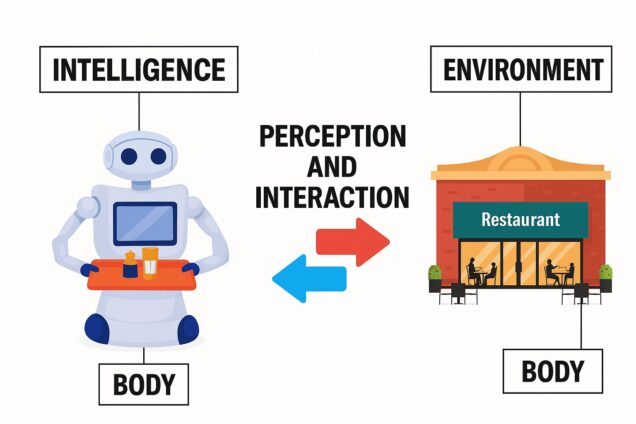
One can think of embodied intelligence as AI with a physical body and the ability to learn by interacting with the real world. Here, a three-way interaction occurs among the body (sensors, actuators and physical form), the brain (AI and decision-making systems) and the environment (the real world with which it interacts). For example, traditional AI can learn what a pen is by reading millions of descriptions during model training. An embodied intelligent robot, on the other hand, learns by actually seeing a pen, reaching for it, grasping it and using that sensory feedback to improve its ability to write.
At its core, embodied intelligence is a physical agent integrated into its environment, gathering information, making sense of the world and taking action in ways that reflect genuine intelligence and adaptability.
Disembodied intelligence refers to situations in which AI agents, such as those used on phones or computers, have limited perception and almost no ability to function in the physical world. In other words, intelligence and the physical body are decoupled.
It is important to note that a physical robot with an AI "brain" but without the ability to perceive through cameras or sensors, or without any means of movement or interaction, does not constitute embodied intelligence. True embodied intelligence requires an AI brain plus a body with both perception and actuation capabilities that enable it to interact with and adapt to the external environment in real time.
Embodied intelligence can be classified into several categories, with two principal classifications standing out: functionality (industrial robots, service robots or special-purpose robots) and morphology (humanoid robots, wheeled robots, legged robots and others).
In terms of functionality, embodied intelligence encompasses four main robot categories: humanoid robots (versatile, human-like systems for domestic, medical, industrial and retail tasks); wheeled robots (fast and efficient systems for warehousing, logistics and security); legged robots (terrain-adaptable systems for exploration, rescue operations and assistance); and autonomous vehicles, drones and unmanned vessels (sensor-equipped platforms capable of autonomous navigation and obstacle avoidance).
These categories of embodied AI generate considerable excitement and are especially popular at AI conferences and exhibitions. Despite this growing interest, embodied intelligence faces significant technical challenges, including high implementation complexity in perception (reliably understanding dynamic and cluttered environments) and motion control (integrating mechanics, dynamics and control theory for stable movement). Other challenges include the high cost and limited availability of real-world data, necessitating simulated environments; safety and security concerns relating to misuse and privacy; capital-intensive development requiring sustained funding and talent; and unresolved issues surrounding toolchains, standardisation, ethics and energy efficiency that demand long-term research.
Collaborative efforts among academia, industry and government are helping to address some of these challenges. Consequently, the outlook for embodied intelligence remains highly promising and paves the way for a more effective physical manifestation of AI to solve real-world problems.
In conclusion, although it faces several challenges, embodied intelligence has the potential to help address critical issues in developing countries. These include autonomous agricultural robots for precision farming, AI-powered healthcare assistants for underserved communities, intelligent waste collection and recycling systems, low-cost disaster-response and search-and-rescue robots, and adaptive educational robots that support learning in resource-constrained schools, among many others.
Dr Kwami Ahiabenu is an AI and technology consultant. He can be reached at Kwami@mangokope.com.
Latest Stories
-
NPLs declined to 15.7% in August 2026
1 minute -
Existing Cedi notes to remain legal tender alongside Heritage Series – BoG
7 minutes -
Consumer, business sentiments positive – BoG
17 minutes -
There’ll be no GHS500 Cedi note as part of Heritage Series issuance – BoG
34 minutes -
Heritage Series Cedi notes to modernise cedi while preserving national identity – BoG
48 minutes -
Ghana’s business environment at ‘Inflection Point’ as private Sector takes greater lead — Vish Ashiagbor
55 minutes -
At least 2 new airlines could join domestic aviation market by 2027 – GCAA Director General
1 hour -
What if Ghana’s next tourism boom begins with Ghanaians?
1 hour -
Energy Commission to monitor EV charging stations
1 hour -
Invest with confidence, Ghana’s golden era is beginning – Finance Minister
2 hours -
Do Ghana to launch The Great Ghana Day Out on World Tourism Day
2 hours -
Clean up our politics before politics cleans us up
2 hours -
2025 was a turning point, says Abradu-Otoo as NAFCO posts record GH¢91.7m profit
3 hours -
Today’s front pages: Friday, September 25, 2026
3 hours -
‘FA President has four clubs; what do you think he would do?’ – Nana Baffour Awuah fires back
3 hours