

Audio By Carbonatix
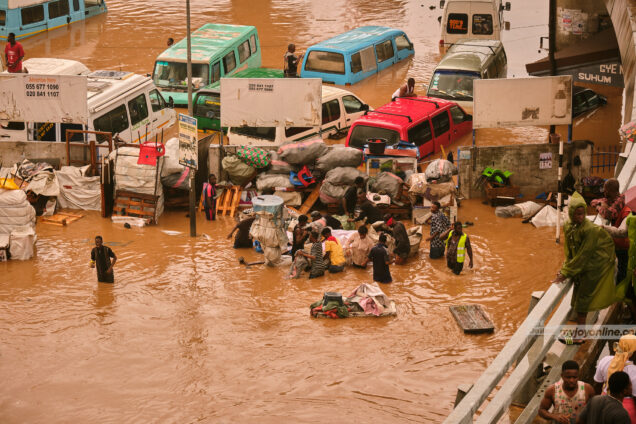
The Global Media Foundation (GloMeF), a human rights and anti-corruption media advocacy non-governmental organisation, has attributed the recurring flooding in Accra and parts of the country to governance failures.
A statement issued and signed by the Chief Executive Officer of the GloMeF, Mr Raphael Godlove Ahenu, noted that “Ghana can no longer afford to normalise annual flooding and the avoidable and needless loss of lives, livelihoods, properties and public resources.”
The GloMeF is therefore unhappy about the recurring flooding incidents that continue to affect communities in Accra and parts of the country, disrupting economic activities and threatening human lives.
“They aren’t merely acts of nature but a reflection of years of poor urban planning, weak enforcement of environmental regulations, inadequate drainage infrastructure, and a collective failure to prioritize disaster prevention over disaster response,” the foundation stated.
A copy of the statement made available to the Ghana News Agency (GNA) in Sunyani expressed concern about climate change impacts evidenced in rainfall intensity, saying that, “Many of the causes of the recurring disasters are human-induced and therefore preventable.”
It said reports showed that the nation loses approximately $200 million annually due to flooding and droughts, highlighting the enormous economic burden that climate-related disasters continue to place on the nation.
The statement added that the persistent flooding problem reflected long-standing failures in urban planning, environmental management, and enforcement of existing laws.
It bemoaned the bad practice of continued construction of buildings and structures on waterways and wetlands, weak enforcement of planning regulations and building codes, and poor waste management practices.
The statement said the nation ought to invest in stormwater drainage infrastructure and address the destruction of natural wetlands and water retention areas that traditionally absorb excess rainfall.
It also called on the government to invest more in climate adaptation and flood-resilient infrastructure.
The Foundation observed that despite repeated flood disasters over the years, responses had largely remained reactive rather than preventive.
It urged the government and the various Metropolitan, Municipal, and District Assemblies to improve drainage systems, enforce environmental laws, and protect wetlands and green spaces.
There is also the need to strengthen collaboration between local authorities and relevant state institutions like the Ghana Meteorological Agency, the Hydrological Authority, the National Disaster Management Organisation, and security agencies.
The statement indicated that expanding early warning and community preparedness systems to reduce disaster risks remained critical, too.
It also called on the citizenry to take responsibility by avoiding indiscriminate disposal of waste, complying with building regulations, and environmental laws.
Latest Stories
-
GNFS dismisses reports of unpaid 2025 rent allowance
22 minutes -
Gordon Asare-Bediako steps down from NPP Communications Director race, backs Dennis Aboagye
27 minutes -
GES dismisses requirement for newly promoted teachers to submit documents for salary adjustments
34 minutes -
Meko Bono 2026: Vice President pledges agricultural revival as Atebubu hosts grand homecoming
2 hours -
Russian skydiver Sergey Boytcov sets world record with 11,551-metre stratosphere jump
2 hours -
Ablakwa-led committee submits five reports to Mahama ahead of 2027 AU chairmanship
2 hours -
Africa not seeking Western cash in reparations campaign – Ablakwa
2 hours -
Production decline, reserve depletion threaten Ghana’s upstream sector – Jinapor
2 hours -
Surveyors caution against treating compensation disputes as professional misconduct
2 hours -
Mahama calls for AU dialogue on migration after South Africa xenophobic tensions
2 hours -
I haven’t experienced any envy in the gospel music industry — Ohemaa Mercy
4 hours -
Prayer does not solve everything — Ohemaa Mercy
4 hours -
New PURC office symbolises stronger consumer protection – Dr Jinapor
4 hours -
Rev. Wengam re-elected Assemblies of God, Ghana General Superintendent
4 hours -
Less than 20km of clearing left to connect Accra-Kumasi Expressway to Kumasi – Agbodza
5 hours