

Audio By Carbonatix
Ghana’s food security is under serious threat as acidic soils have become widespread across the country, coupled with low organic matter and low carbon content, hampering agricultural productivity.
The Director of the Council for Scientific and Industrial Research, Soil Research Institute (CSIR-SRI), Dr. Collins Tay, who raised the concern, says the situation poses a major challenge to sustainable agricultural development.
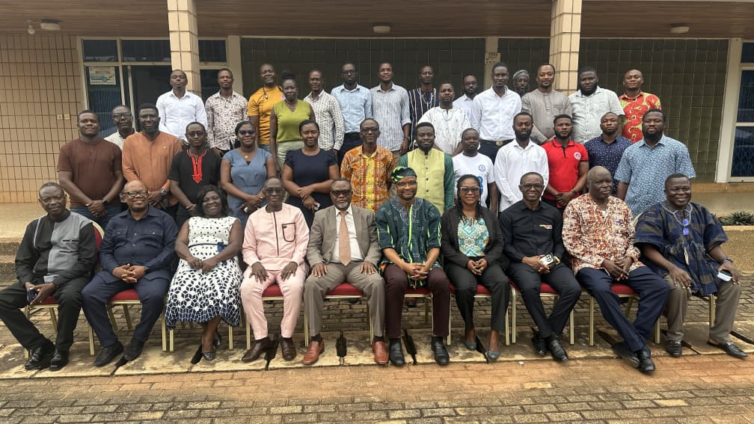
Speaking at the 2026 In-House Review and Research Planning Session (IRREP) of the CSIR-SRI at Kwadaso, Dr Tay said the institute is struggling to manage soil resources amid these challenges sustainably.
“Acidic soils are widespread across the country, hampering agricultural activities. There is also low organic matter and low carbon content, among other challenges, so it has been a very difficult situation for us as a research institute to ensure the sustainable management of our soil resources for improved agricultural productivity,” he said.
Speaking to JoyNews on the sidelines of the event, Dr. Tay revealed that some fertilizers imported into the country may not be well-suited to the country’s diverse soil conditions.
According to him, the indiscriminate application of such fertilizers, often imported without sufficient consultation with soil scientists, is contributing to soil degradation rather than improving fertility.
“Applying fertilizers without proper soil testing and nutrient assessment can lead to imbalances, where soils already rich in certain nutrients receive additional unnecessary inputs,” he stated.
Dr. Tay is therefore advocating stronger collaboration between government, policymakers and agricultural stakeholders to ensure fertilizer importation and application are guided by scientific evidence and local soil data.
“As an Institute, what we can do is advise government on the implications of continually depending on external sources for our fertilizer needs when discussing agricultural productivity in Ghana. We must make a conscious effort to develop fertilizer formulations specifically tailored to our soils,” he said.
Beyond fertilizer policy, Dr. Tay highlighted limited funding for agricultural research.
He revealed that while the government pays the salaries of researchers, it does not provide direct funding for research activities, leaving donor agencies as the primary financiers of scientific work at the institute.
He explained that the CSIR-SRI plays a key role in providing soil fertility information, land suitability assessments, and agricultural mapping services that support food production and environmental management, but inadequate domestic investment limits its ability to fully deliver on its mandate.
“The Council for Scientific and Industrial Research – Soil Research Institute (CSIR-SRI) is tasked with ensuring agricultural productivity, and all we need is government support or partnership to enable us to go to the field to conduct trials on the fertilizers,” he said.
Dr. Tay cautioned that continued underinvestment in agricultural research, combined with weak integration of scientific expertise into fertilizer policy, could undermine innovation, reduce productivity and threaten long-term food security.
He therefore called for a coordinated, science-driven approach to fertilizer management, alongside increased and sustained government support for agricultural research institutions to safeguard Ghana’s soils.
The two-day IRREP, chaired by a distinguished soil scientist at the Kwame Nkrumah University of Science and Technology (KNUST), Prof. Vincent Logah, serves as an annual platform for evaluating research achievements, sharing knowledge and setting priorities. Prof. Logah called on scientists to prioritize mentorship and collaboration to foster innovation.
The Vice Dean of the Department of Crop and Soil Sciences at KNUST also urged government to provide students, researchers and other stakeholders with the necessary equipment and financial resources to ensure soils remain healthy and productive.
Latest Stories
-
24-hour market: Who is actually in charge?
9 minutes -
OSP’s swift response to extortion allegation doesn’t mean selective investigations – Senanu
10 minutes -
Maradona’s ‘Hand of God’ ball sells for £2.5m
15 minutes -
WAFU B WCLQ: Ampem Darkoa Ladies beat ASEC Mimosas in Group B opener
22 minutes -
We will take action against Sammy Gyamfi over false allegations against Afenyo-Markin — Suame MP vows
27 minutes -
Bagbin refers Mahama’s 3 Supreme Court nominations to Appointments Committee
34 minutes -
Opong-Fosu engages NDC Western region caucus ahead of formal declaration
36 minutes -
Kakum National Park killing: Brother recounts how resource guard was shot during patrol
40 minutes -
Mahama officially nominates James Agalga as Acting Majority Leader
49 minutes -
NSMQ 2026: Sad day for Aggrey Memorial SHS as Osino Presby snatch the final one-eighth stage ticket
56 minutes -
€2m boost for Ghana pharmaceutical research and vaccine innovation
58 minutes -
Afenyo-Markin may struggle to wriggle out of GoldBod loss claims – Edem Senanu
59 minutes -
GES opens WAEC portal for 2026 school placement data submission
59 minutes -
Livestream: Parliament’s emergency sitting underway
1 hour -
Education Minister inducts KNUST Vice Chancellor as Chair of Technology and Consultancy Centre
1 hour