

Audio By Carbonatix
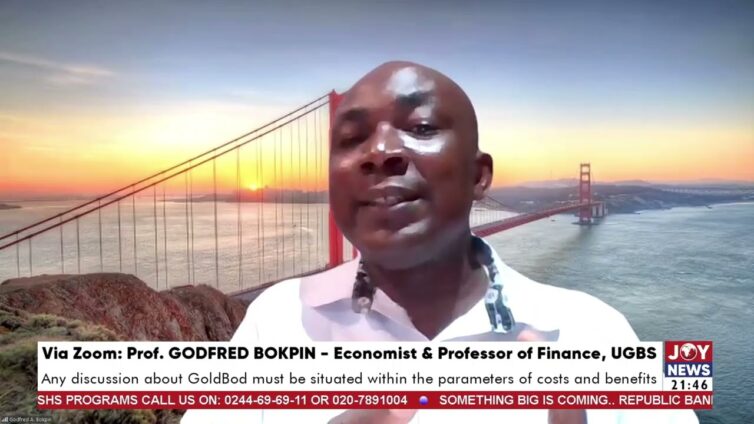
Professor of Finance and economist at the University of Ghana Business School (UGBS), Godfred Bokpin, has warned that Ghana’s recent gold-driven economic gains could be wiped out within months if global gold prices experience a sharp decline.
Prof Bokpin said the country’s improved macroeconomic indicators remained highly exposed to fluctuations in international gold prices and therefore could not be considered durable.
Speaking on Joy FM’s Super Morning Show on Monday, August 24, while discussing the reported losses under the Domestic Gold Purchase Programme (DGPP), he warned that a significant fall in gold prices could quickly reverse the gains being celebrated.
“If the gold price should dip by more than 40 per cent, this macroeconomic stability we talk about will only exist in the textbook,” he said.
According to Prof Bokpin, a price shock of that magnitude could wipe out the reported gains within six to eight months, leaving the economy significantly exposed.
He noted that commodity prices have historically undergone sharp corrections after periods of strong growth, cautioning policymakers against treating the current gold boom as evidence of lasting economic stability.
Prof Bokpin called for rigorous stress testing and sensitivity analysis to determine how Ghana’s economy, particularly its foreign exchange position and reserves, would withstand a significant decline in global gold prices.
Listen to him.
He also urged the government to adopt a broader value-chain approach to assessing the gold sector, taking into account not only foreign exchange earnings and reserve accumulation but also the environmental costs of gold production.
These costs, he said, include the destruction of forests, water bodies and wider ecological systems through irresponsible mining.
Prof Bokpin maintained that Ghana’s long-term development strategy must move beyond dependence on primary commodities and avoid economic growth that comes at the expense of environmental sustainability.
He warned that a growth model heavily reliant on primary commodities and environmental destruction would ultimately prove weak and unsustainable.
Latest Stories
-
Lawrence Kobena Nsarko Otoo, Esq
2 minutes -
Bel-Aqua intensifies mental well-being campaign ahead of 15th anniversary
5 minutes -
From banking to party finances: Alfred Kwadwo Thompson elected NPP Treasurer
10 minutes -
George Christian Papa Mends
15 minutes -
Ali Suraj elected NPP NASARA Coordinator
26 minutes -
Mustapha Hamid misses out on NPP Vice Chairmanship by 31 votes despite early poll lead
35 minutes -
Kojo Bamba, Henry Nana Boakye and Nana Akomea elected NPP Vice Chairmen
1 hour -
From Delta Force to NPP First Vice Chairman – Kojo Bamba’s political journey
1 hour -
Police restore calm at Larteh following Odwira festival disturbance
2 hours -
‘All the camps will dissolve’ – Bawumia demands one NPP for 2028
2 hours -
There is no time to waste – Bawumia orders NPP to begin 2028 work
2 hours -
Sarkodie visits MobileMoney Fintech LTD
3 hours -
John Boadu unveils new NPP strategy to win back youth and modernise party
3 hours -
Hawa Koomson elected NPP National Women’s Organiser
3 hours -
John Boadu begins NPP rebuild from grassroots ahead of 2028 election
3 hours