


Audio By Carbonatix
Zimbabwe's main opposition leader Morgan Tsvangirai is critically ill in a South African hospital, reports say.
Local media quoted family sources as saying the 65-year-old former prime minister - who is being treated for colon cancer - is suffering from weight loss, exhaustion and muscle thinning.
During his political struggle against ex-President Robert Mugabe, he has been beaten and imprisoned numerous times.
Mr Tsvangirai heads Zimbabwe's Movement for Democratic Change (MDC) party.
What is known about Tsvangirai's condition?
He has been in and out of hospital since June, receiving treatment in a Johannesburg hospital for cancer. He returned to the hospital early last month.
Mr Tsvangirai's health deteriorated rapidly on Monday, family sources told Zimbabwe's Bulawayo24 news website on Tuesday.
He had lost appetite and had difficulty eating or swallowing fluids, the sources said. Mr Tsvangirai also reportedly had breathing problems.
Meanwhile, an MDC party source was quoted by Reuters news agency as saying that Mr Tsvangirai "is critically ill and we should brace for the worst".
Mr Tsvangirai's spokesman, Luke Tamborinyoka, said the MDC leader was "stable but the nation should keep on praying".
The hospital where Mr Tsvangirai is being treated has so far made no public comments on the issue.
How could this affect future elections?
Last November, Mr Tsvangirai hailed the resignation of Robert Mugabe, expressing hopes that Zimbabwe was on a "new trajectory" that would include free and fair elections.
He said that Mr Mugabe - who was forced to quit after ruling the country for 37 years - should be allowed to "go and rest for his last days".
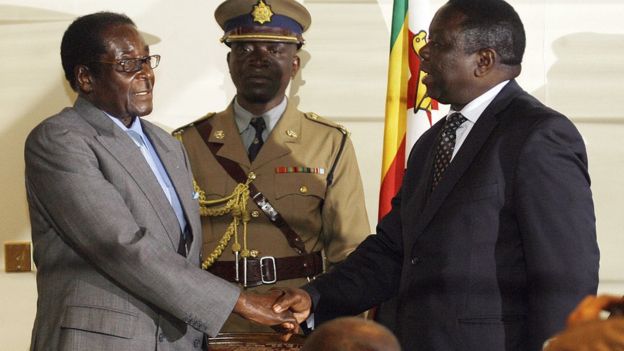
Mr Mugabe shakes hands with Mr Tsvangirai after a power-sharing agreement in 2008
Mr Tsvangirai's illness has divided the MDC, with a number of party officials reportedly jockeying to succeed the former trade union activist.
This has raised concerns about the party's political future, and its chances of taking on the ruling Zanu-PF party in presidential elections expected within six months.
In November, Mr Mugabe was succeeded by the former vice president, Emmerson Mnangagwa.
Latest Stories
-
PPF urges African youth to demand debt cancellation and reparations
20 seconds -
Kwesi Pratt says reparations must deliver equal rights, African self-reliance
32 seconds -
Isaac Dogboe opens reveals mental health battles, calls for support for athletes
12 minutes -
MTN Ghana webinar urges SMEs to get financial discipline right
44 minutes -
Duvor Klu, Hua crowned champions as J30 Accra Week 1 concludes
57 minutes -
Gov’t to make rural telephony services cheaper by first quarter of 2027 – Sam George
1 hour -
National Chief Imam remains Ghana’s strongest symbol of interfaith harmony – Mahama Ayariga
2 hours -
Gov’t to upgrade all rural telephony networks to 4G capability – Sam George
2 hours -
‘We’ve never seen a CJ in our judiciary system who is everywhere like MTN’ – Janet Nabla
2 hours -
Lawyers, prosecutors fume over abandoned 26-year-old Upper West High court project
2 hours -
At least two dead in blast at Bolivia military barracks
3 hours -
Tate brothers officially indicted with trafficking and sex crimes in Romania
3 hours -
US envoys arrive in Moscow ahead of Ukraine talks
3 hours -
Health Minister to brief media on Free Primary Healthcare programme on Monday
3 hours -
‘It was inappropriate to make that comparison’ – Dr Pumpuni Asante on CJ’s SOE comment
3 hours