

Audio By Carbonatix
The Ashanti Regional Director of the National Service Scheme (NSS), Emmanuel Reagan Fynn, has called on the government to take a keen interest in programmes that expand opportunities for national service personnel, describing such interventions as critical to reducing Ghana’s growing youth unemployment challenge.
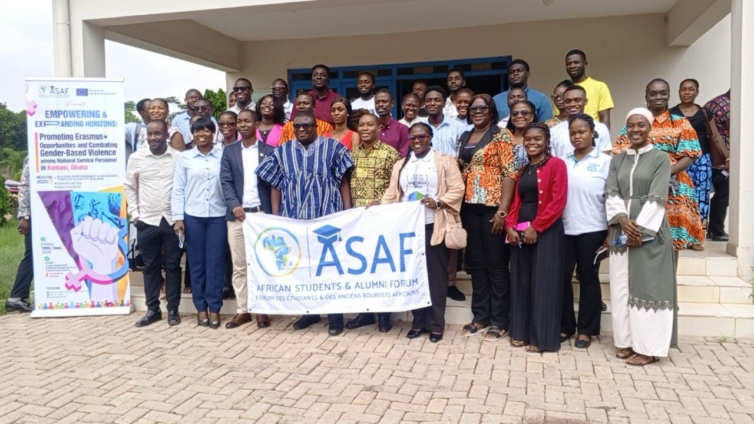
Speaking at a workshop on Promoting Erasmus+ Opportunities and Combating Gender-Based Violence among National Service Personnel in Kumasi, Mr Reagan Fynn stressed that initiatives of this nature must move beyond awareness creation and deliver practical outcomes for young graduates struggling to find jobs after national service.
“So it’s a good initiative, and I urge the government to also take it up and take an interest in such access so that it will also help.
Aside from getting employment, it also broadens the young people and builds their capacity going forward,” he said. He added that stronger government involvement would help turn such programmes into sustainable solutions rather than one-off interventions.
Mr Reagan Fynn noted that many graduates complete tertiary education and national service only to face limited employment opportunities, a situation that continues to fuel frustration among the youth.
He said structured access to international exposure, skills development and career pathways could make a significant difference, adding that the NSS in the Ashanti Region is exploring ways to scale up the workshop to open more job opportunities for service personnel.
According to him, exposure to international programmes such as Erasmus+ can better prepare young people for the job market while supporting national development. He argued that equipping service personnel with global skills and experience positions them to contribute meaningfully to Ghana’s economic growth and efforts to reduce unemployment.
Also speaking at the event, a Senior Research Scientist at the CSIR Crops Research Institute and Project Coordinator of the African Students and Alumni Forum (ASAF), Dr. Hillary Mireku Botey, said the workshop was designed to bridge the information gap that prevents many service personnel from accessing international scholarships and career development opportunities.
Dr Botey explained that the programme focuses on two key areas: access to European scholarship and career opportunities under Erasmus+, and education on gender-based violence and sexual harassment in the workplace. He said the initiative aims to empower young people to protect themselves while improving their career prospects.
“I know the government wants to build quality education, and it is important that this quality is not only in-country,” Dr. Botey said. “There is a lot of unemployment in the country. These forums can be another stepping stone. You get sa cholarship, you get to know other cultures and diversity, and also bring a lot of inclusivity.”
The workshop, which is fully funded by the European Union, aligns with Ghana’s broader policies on education, youth development and skills training. Dr Botey encouraged the government to deepen bilateral engagements with European programmes and channel such opportunities through universities and the National Service Scheme.
Participants welcomed the initiative, saying it offered practical guidance on accessing scholarships and international exposure. One participant, Eunice Eshun, said the workshop helped her understand how skills acquired abroad could be brought back to support national development.
“The employment in this country is limited, so going outside gives us a broader view,” she said. “If I learn how systems work elsewhere and come back to implement what I’ve learnt, it will help others as well.”
Other participants agreed that with stronger government backing for programmes like Erasmus+, Ghana could reduce youth unemployment while building a skilled and globally exposed workforce.
Latest Stories
-
Don’t let speed of information become your judgement – CJ tells new lawyers
35 minutes -
World Cup visa scandal: People have leveraged public office to facilitate fraud – Senyo Hosi
40 minutes -
Glut! Farmers count losses as prices crash, customers happy
1 hour -
GSA postpones auction of unserviceable vehicles
1 hour -
Man charged with attempted murder after stabbing
1 hour -
World Cup visa scandal: Senyo Hosi says issue goes beyond calls for Sports Minister’s resignation
1 hour -
Yaw Ampofo Ankrah hasn’t taken or received any money to facilitate visas – Lawyer insists
2 hours -
World Cup visa scandal: Senyo Hosi urges focus on constitutional accountability
2 hours -
La Beach demolition: Senyo Hosi condemns lack of consultation
2 hours -
Russian glide bomb attack on Zaporizhzhia kills at least 15 people
2 hours -
Jinapor warns underperforming energy sector CEOs of consequences, says no protection for failure
2 hours -
Fire destroys head of tipper truck on Lower Volta Bridge
2 hours -
Palmer signs new Chelsea contract until 2034
2 hours -
World Cup visa scandal: Mahama will act on corruption allegations – Abass Nurudeen
2 hours -
Abass Nurudeen accuses Minority of ‘scandal scavenging’ over World Cup visa controversy
2 hours