

Audio By Carbonatix
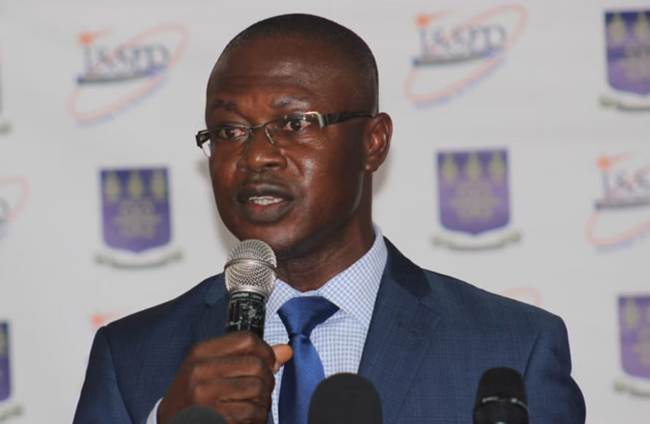
A Senior Research Fellow at the Institute of Statistical, Social and Economic Research (ISSER), Professor Charles Ackah, has stated that Ghana’s recent shift to heavy private market borrowing is a dangerous debt strategy.
In JoyNews’ hotline documentary titled "A Nation That Begs," produced by Isaac Kofi Agyei, the dire debt situation of Ghana was brought to light. The film shed light on Ghana's repeated reliance on the International Monetary Fund (IMF) for debt relief, totaling 17 times.
Discussing the documentary on JoyNews' AM Show, Prof Ackah highlighted the concerning state of Ghana's macroeconomic and debt management practices.
According to him, the country is heavily reliant on foreign aid due to its inability to generate sufficient domestic revenue. He emphasised, “When a country refuses to raise adequate domestic revenue, especially through taxation, the only way to break the resource constraint is to depend on external capital."
While Ghana previously borrowed from multilateral and bilateral sources, such as the Paris Club, recent years have witnessed a shift towards the private capital market.
Professor Ackah expressed deep concern about this shift, stating "That is, for me, the most dangerous part of our borrowing or debt management strategy.
“And we are borrowing at high-interest rates even though they are lower than the domestic rates. But because of the exchange rate problem, when you borrow dollars at a rate of about 10%, then you need to make sure that your return on investment, or all that you use the funds for, the return should exceed 10%,” he added.
"Most of the time, when we borrow foreign currency, we use it to support the budget or refinance existing debt. We are not really investing it in a way that yields returns of even 2%," Prof Ackah cautioned.
He further highlighted that since the 1980s, most of Ghana's borrowings have resulted in returns ranging between 0.8% and 1.4%, while interest rates remain around 9-10%. This mismatch between returns and interest payments has led to a growing debt problem for the nation.
According to Prof Ackah, the returns from foreign loans are not invested sustainably and productively, which would generate greater profits to service the interest. This inefficient and non-prudent approach to debt management exacerbates Ghana's debt crisis.
One way, he suggests, to achieve a sustainable debt profile is by growing the economy, as debt sustainability is determined by dividing the total debt stock by GDP.
"If the country can sustainably grow at 8%, 9%, or 7% for a decade, you will see that the debt-to-GDP ratios will fall,"
Ghana’s revenue sources
The Professor further highlighted that the primary external capital source for Ghana has been export revenue, which has been hindered by the country's heavy reliance on a limited number of commodities, resulting in inadequate foreign exchange earnings.
Foreign Direct Investment (FDI), another source of external capital, has seen a significant slump as Ghana has struggled to attract sustainable foreign investments. Prof Ackah described the inflow of capital as primarily "greedy", referring to foreign investment, and "hot money," mainly concentrated in the resource sector, such as oil and gold mining.
Insufficient capital control measures have failed to ensure sustainable development, as investors often repatriate their capital or profits during times of crises, leading to capital flight and limited benefits for the country.
“Investors come in and we don’t get maximum benefit from it and when there are crises there is capital flight. They repatriate most of their capital or their profit,” Prof Ackah explained.
Prof Ackah indicated that remittances, another source of external capital, are insufficient to meet the country's needs. He pointed out that remittances are typically procyclical, increasing during times of crisis when families send money to their relatives and so are not reliable and sustainable.
Additionally, Ghana's tourism sector has not been fully developed to attract significant sums of remittances. Consequently, borrowing has become the default channel for financing the economy, both externally and domestically, especially as aid has reduced with Ghana's transition to a middle-income country.
Latest Stories
-
I assure Otumfuo, Mahama will join him to commission KNUST Teaching Hospital by end of this year – Haruna Iddrisu
21 minutes -
Gov’t to roll out free special education for persons with disabilities from July 1 – Education Minister
42 minutes -
“We used it to test our officiating officials’ readiness” – Bawah Fuseini after CAA Athletics event
1 hour -
Volleyball emerges as Ghana’s fastest rising sport
1 hour -
National Sports Fund needs strong leadership from the top – Administrator David Wuaku
2 hours -
JoySports Exclusive: Steve McLaren in talks with GFA after expressing interest in Black Stars job
2 hours -
Fire guts auto parts warehouse at Bubuashie, one fire officer injured
2 hours -
I owe my victory to coach Ofori Asare – Allotey after winning WBA Africa Gold Super Flyweight belt
2 hours -
Church of Pentecost supports over 2,000 BECE candidates in Obuasi with career guidance seminar
3 hours -
Brandon Asante and Coventry all but promoted to Premier League despite Sheffield Wednesday draw
4 hours -
GPL 2025/26: Late Kwartemaa strike downs Hearts in Tema
4 hours -
Ghana Faces Sierra Leone Moment as Prosecutorial Powers come under strain
4 hours -
Don’t consume fish or seafood from Tema Shipyard until further notice – FDA warns
4 hours -
Why volunteering might be Africa’s most underrated career accelerator
4 hours -
ActionAid Ghana raises concern over gender gaps in Feed Ghana Programme
4 hours