

Audio By Carbonatix
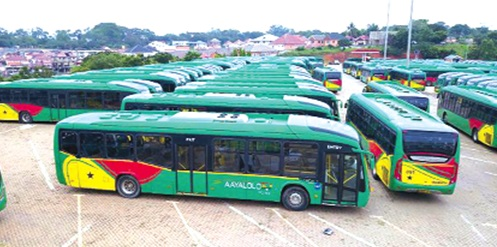
Accra’s flagship Bus Rapid Transit (BRT) system, Aayalolo, has reached its operational peak, and any further expansion will be ineffective without dedicated bus lanes, strong enforcement, and better inter-agency coordination.
The Monitoring and Enforcement Manager of the Aayalolo Bus Service, Theodore Ocansey, said while Aayalolo had expanded significantly in terms of fleet size, routes, and staff strength, congestion on Accra’s roads had neutralised the gains the system was designed to achieve.
“Operationally, the service is more efficient than when we started. We have expanded from one corridor to at least six corridors and increased both buses and staff, but in terms of intention, we are not running what we set out to run,” Mr Ocansey said during an interview with the Daily Graphic.
He explained that the original BRT model was designed around scheduled services with time intervals, supported by dedicated lanes that allowed buses to move faster than general traffic.
That model, he said, had largely collapsed.
He said the system had reached a point where adding more buses would no longer make any economic or operational sense.
“We are buying fuel at full cost. There is no subsidy. So the more buses you add and keep them stuck in traffic, the more losses you incur,” he said.
Mr Ocansey disclosed that about 150 buses were currently in operation, with fewer than 10 grounded, while others were deployed for special assignments, such as private hires.
Each Ayalolo bus, he said, was 13 metres long and could carry up to 89 passengers, making it unsuitable for inner roads and best suited to main arterial routes.
“The buses are meant to move people along the main roads. Trotros should feed passengers from inner communities to the main corridors,” he explained.
Traffic congestion
Mr Ocansey identified slow speeds due to traffic congestion as Aayalolo’s biggest challenge, linking the problem to poor road-space management and the dominance of single-occupant private vehicles.
He cited a 2007 transport study, which predicted that Accra would grind to a halt by 2035 without a proper public transport system.
“We are beginning to see it now.
Everybody is driving alone in their cars. No matter how much you expand the road, congestion will always come if the road space is not properly managed,” he said.
He argued that dedicating lanes exclusively for buses would significantly improve mobility.
“If the government decides that one lane is dedicated as a bus lane and it is enforced, you will see people park their vehicles and ride the bus,” he stated.
He recalled that when dedicated lanes existed from Circle to Tesano, Aayalolo buses saved commuters up to 30 minutes compared to trotros, but that advantage had since been lost.
“Now we are stuck in traffic. We are not moving,” he said.
He said Aayalolo extended its operating hours from 5 p.m. to 7 p.m. and added more buses during the Christmas period, but operational realities, including driver welfare and costs, limited further expansion.
“We are not supported by any subsidy. We buy fuel at full cost like everybody else.
The more buses you add and spend time in traffic, the more losses you make,” he stressed.
Comfort, safety
Mr Ocansey said the Aayalolo buses were deliberately designed to encourage people to abandon private vehicles, citing onboard cameras, phone charging ports, and Wi-Fi, all of which were successfully tested during the early days of the service.
“The buses ticked all the boxes. They were safe, comfortable, and moved a lot of people.
Even development partners who supported the projects were envious when the bus arrived, especially those from France.
They said the buses in Paris were not as nice as the ones we have,” he said.
Coordinated transport planning
Mr Ocansey indicated that Ayalolo had reached a point where further growth depended on dedicated lanes and a national conversation on public transport involving all stakeholders.
He called for the Greater Accra Passenger Transport Executive (GAPTE) to be strengthened and elevated to coordinate effectively with the Department of Urban Roads (DUR), metropolitan and municipal assemblies, the regional coordinating council, the police, and other agencies.
“Everyone has to be on the coordinating board so that when roads are being designed, transport considerations are factored in before contracts are awarded,” he said.
Dedicated lanes
The Public Relations Officer of the Aayalolo Bus Service, Justice K. Safo, also emphasised that Aayalolo was established strictly as an intra-city transport system mandated to operate within Accra to help decongest the city and improve travel times.
He said the effectiveness of the system hinged mainly on the enforcement of dedicated bus lanes, without which the very purpose of the Bus Rapid Transit (BRT) concept would be defeated.
“Aayalolo is basically a bus rapid transit. The buses are not meant to be caught up in general traffic like they are doing now, so the very purpose for which the system was set up is being hindered,” Mr Safo stated.
He questioned the relevance of describing the service as rapid when buses were forced to move at the same pace as other vehicles.
Mr Safo, therefore, appealed to the authorities to enforce existing dedicated lanes and to explore alternative traffic management solutions in areas where such lanes were not in place, noting that the buses were designed to have priority on the traffic infrastructure.
Latest Stories
-
Church of Pentecost supports over 2,000 BECE candidates in Obuasi with career guidance seminar
4 minutes -
Brandon Asante and Coventry all but promoted to Premier League despite Sheffield Wednesday draw
26 minutes -
GPL 2025/26: Late Kwartemaa strike downs Hearts in Tema
32 minutes -
Ghana Faces Sierra Leone Moment as Prosecutorial Powers come under strain
42 minutes -
Don’t consume fish or seafood from Tema Shipyard until further notice – FDA warns
47 minutes -
Why volunteering might be Africa’s most underrated career accelerator
53 minutes -
ActionAid Ghana raises concern over gender gaps in Feed Ghana Programme
55 minutes -
Windstorm wreaks havoc in Gushegu, displacing nearly 2,000 residents and damaging schools
58 minutes -
Friends of Bridget Bonnie Marks her 35th birthday with donation to Kasseh Model Health Centre
2 hours -
From Ekumfi Kokodo to the Pulpit Stage: Essi Donkor’s gospel journey takes shape
2 hours -
Landfilling waste management creates no value, it’s an economic waste
2 hours -
Photos: Speaker Bagbin Commissions MPs constituency office under parliamentary decentralisation programme
2 hours -
Black Stars technical advisor Winfried Schäfer sacked as GFA shakes up backroom staff
3 hours -
Wenchi water project almost complete, critical to gov’t agenda – GWL MD
3 hours -
Anti-LGBTQ+ bill not part of government’s legislative agenda – Inusah Fuseini
3 hours