

Audio By Carbonatix
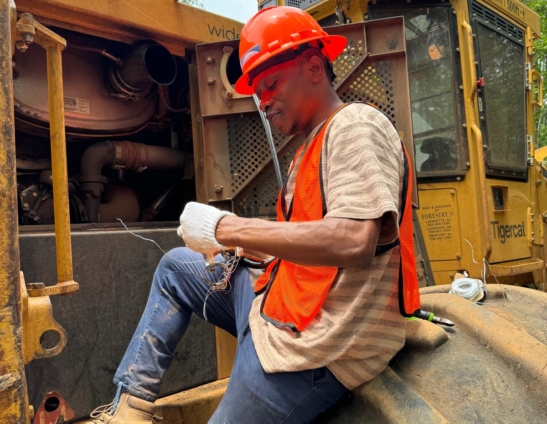
Forestry researcher Abubakar Tahiru is making waves in the United States and beyond with pioneering research that is transforming how the timber industry measures fuel consumption and carbon emissions. His innovative approach, capturing real-time data from logging machines in active forests, is giving companies and policymakers tools they never had before to cut costs while reducing environmental impacts.
The scholar in sustainable forestry has also gained global recognition through his Guinness World Record, a symbolic act that brought unprecedented public attention to his long-standing commitment to forestry and environmental sustainability.
In this exclusive interview with Myjoyonline, Abubakar Tahiru speaks about the motivation behind his research, the global impact of his work, and how science and public engagement can come together to shape the future of forestry.
Myjoyonline: Forestry is often seen as essential, but also one of the most resource-intensive industries. You have been credited with changing how the field approaches its biggest challenges. What sparked this direction in your research?
Abubakar Tahiru: For years, the industry relied mostly on estimates and laboratory simulations to measure fuel use and emissions from heavy logging machinery. But forests are unpredictable; terrain, soil, and operator techniques all matter. Without real-world data, managers couldn’t fully understand the true costs or environmental footprint. I wanted to change that by measuring things directly in the field.
Myjoyonline: And you developed an innovative approach that had never been applied this way before.
Abubakar Tahiru: Exactly. I equipped active logging machines with advanced gas analysers to track fuel consumption and carbon emissions in real time. Then I connected the data with conditions on the ground, terrain, operator choices, and machine type. This created the first clear, decision-ready picture of how forestry operations affect both costs and the environment.
Myjoyonline: What does this mean for the industry?
Abubakar Tahiru: It’s a game-changer. Fuel can account for nearly one-third of logging costs. That’s the single biggest expense. Even small improvements in efficiency can save companies millions every year. At the same time, those improvements reduce greenhouse gases. So managers no longer have to choose between profitability and sustainability; they can achieve both.
Myjoyonline: Your work is already gaining traction in the United States. How is it being applied?
Abubakar Tahiru: Timber companies and researchers are using the findings to guide equipment selection, operator training, and harvesting strategies. The results are both financial savings and measurable environmental benefits. It also fits perfectly into the U.S. climate goals by showing how forestry can contribute to reducing emissions while staying competitive.
Myjoyonline: And globally?
Abubakar Tahiru: The challenges are the same everywhere, balancing productivity with sustainability. My framework can be adapted to forestry systems in any part of the world. Industry leaders see its potential to strengthen forestry practices globally, making operations more climate-smart and cost-effective.
Myjoyonline: Many people globally have appreciated your research work through your Guinness World Record. How did that moment tie back to your research?
Abubakar Tahiru: Hugging 1,123 trees in an hour was symbolic, but it was also deliberate. It drew global attention to forestry and sustainability, making people curious about the science behind it. It helped me bring my research to a wider audience, which is important because solving environmental challenges requires both scientific innovation and public engagement.
Myjoyonline: So, what has actually been achieved through your Guinness World Record?
Abubakar Tahiru: The record did more than set a number; it created a global platform for my research. Hugging trees caught international attention, and through that attention, people started asking why forestry matters. It gave me the opportunity to showcase the core of my scientific work, how fuel efficiency and carbon emissions in logging can be measured and reduced. In many ways, the record became a bridge: it translated complex research into something people everywhere could connect with emotionally. That visibility has since supported the recognition of my academic contributions, strengthened collaborations, and amplified the impact of my work both in the U.S. and globally.
Myjoyonline: Finally, what do you see as the future direction of your work?
Abubakar Tahiru: My goal is to keep showing that forestry can be both economically strong and environmentally responsible. With the right data and smarter practices, we can protect forests while supporting the livelihoods that depend on them. That balance is the future of forestry, and my research is helping to prove it.

Latest Stories
-
US, Iran fail to reach peace agreement after marathon talks in Pakistan
58 minutes -
Port crises loom as 11,000 drivers threaten four-day strike
2 hours -
A source of excellence across generations – Vice President Opoku-Agyemang lauds Mfantsipim
2 hours -
(Photos) Mfantsipim School launches historic 150th anniversary
3 hours -
Knights and Ladies of Marshall group backs Catholic Bishops’ stance on anti-LGBTQ+
4 hours -
Bright Simons writes: All the Filla in the Ibrahim Mahama/E&P – Gold Fields Saga
4 hours -
Monetise Idiocy In Ghana
4 hours -
ECG kicks off Phase Two of transformer upgrades at Lashibi; brief outages expected
5 hours -
The Ghanaian prophet and the mysterious death of his scottish wife Charmain Speirs
5 hours -
Nearly 400 sentenced in Nigeria for links to militant Islamists
5 hours -
Ghana’s recovery supported by gold strength despite global oil price pressures – Standard Bank Research
5 hours -
Methodist Church hails Mfantsipim@150; calls for “fresh consecration” to excellence
6 hours -
‘Excellence is our inheritance’ – Nana Sam Brew-Butler hails Mfantsipim’s 150-year reign in leadership
6 hours -
Kwaku Azar writes: A-G vs OSP
6 hours -
Mfantsipim–Adisadel rivalry built excellence, not division – Sam Jonah
6 hours