

Audio By Carbonatix
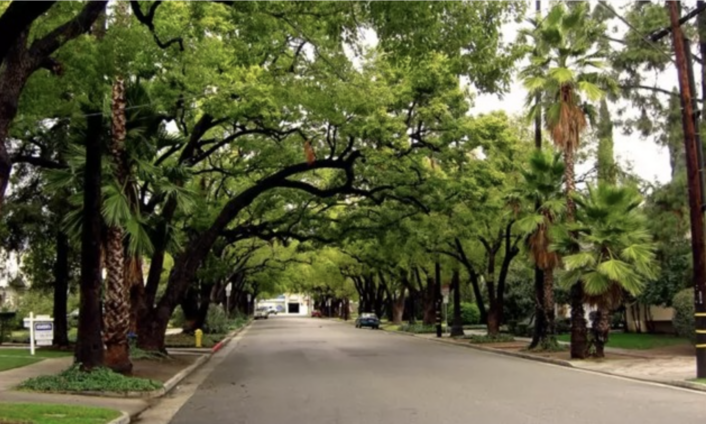
Dr. Prosper Mensah, an engineer with the Wood Industry and Utilisation Division, has made a case with empirical evidence that planting the right trees at the right place in cities and urban areas has an enormous economic benefit.
He said it also had social, environmental, and aesthetic benefits directly linked to sustainable development.
He said the haphazard management of urban forestry, especially lack of maintenance of trees and other forest resources in urban areas poses serious risks to humans?
Planting the wrong trees species at the wrong side of the road, according to a Research Scientist at the Forestry Research Institute of the Council for Scientific and Industrial Research (CSIR-FORIG), exposes humans to the dangers of vehicular interactions he said.
A presentation he has put together dubbed “Engineering Urban Forestry: Right Tree at the Right Place,” Dr Mensah highlighted the urgent need to plant the right trees at the right places with acceptable standards complemented by monitoring, evaluation, and stewardship.
The environmental benefits, according to the presentation, include storm water management, beautification, and provision of shade and wildlife habitat and refuge for urban courses and carbon storage.
He noted that urban green spaces also contributed to the local economy by enhancing real estate prices, attracting economic activities, improving local tax base as people tend to shop in cities with more trees.
Properly engineered urban forestry reduces attention deficit hyperactivity disorder symptoms, eliminates nature deficit disorder, build stronger communities, according to the presentation.
Touching on the properties of suitable tree for urban forestry, Engr. Dr. Mensah mentioned drought tolerance, aesthetic qualities, low maintenance requirements, pest and disease resistance, resistance to girdling, and compact growth habit as some of the characteristics to look out for.
Among some of the tree species he recommends are West Africa Cedar, West African Mahogany, African Mahogany, Neem Tree, Silk Cotton Tree, West African Ebony, and Golden Shower Tree.
He also identified biotic and abiotic conditions, anthropogenic pressures, and social developments such as changing politics, economics, conflicts, wars, and other crises as some of the challenging environment inimical to a thriving urban forestry.
According to him, Ghana has demonstrated great ambition to plant trees over the years but what is lacking is adequate planning, consultation, assessment, stewardship and monitoring and evaluation after planting.
He therefore called on the government and relevant stakeholders to prioritise well-engineered urban forestry not only for the economic and social benefits but the safety of the people as well.
Latest Stories
-
UN housing expert urges Ghana to strengthen Rent Control Department amid housing affordability concerns
6 minutes -
Delta-BCI partnership reaches 166,000 people with breast cancer education
15 minutes -
Power restoration fault suspected in Kumasi Central Market fire
5 hours -
The 7-foot giant of Ngleshie Amanfro: Seven-foot Ghanaian Ephraim Saawa dreams of joining the national basketball team
6 hours -
Government promises support for Kumasi Central Market fire victims
6 hours -
Vibes The Movie: Big Ghun’s Ghanaian film earns five nominations at 2026 REFFA
7 hours -
‘I’m a fulfilled man’—Justice Korbieh on missing out on Supreme Court despite two nominations
7 hours -
MamaCare CEO warns unresolved conflicts among health workers could undermine maternal and neonatal care
7 hours -
Health professionals urged to translate medical knowledge into practice to save mothers
7 hours -
Retired judge Justice Francis Korbieh charges 1,568 new lawyers to uphold integrity
9 hours -
Conflicts among care providers linked to maternal, neonatal deaths – Expert
9 hours -
GIS marks 10th TIME conference, champions improved teaching practices
9 hours -
BRICS Or Balance? What Ghana’s bid really means
9 hours -
Adamus Resources launches breast cancer awareness campaign in Nzema
9 hours -
GPRTU wants full TRAFFITECH-GH implementation to start in 2027
10 hours