

Audio By Carbonatix
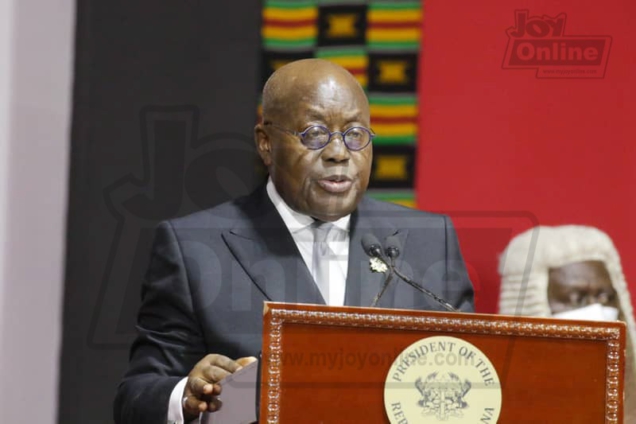
President Akufo-Addo has underscored the nexus between climate change, peace, security and development and called for global action.
He said socio-economic difficulties, political and economic exclusion, mismanagement, drought, corruption, nepotism, unemployment, religious extremism, transnational crime, drug trafficking and external political interference in the affairs of African countries were some of the factors identified by the African Union as the main causes of instability on the continent.
The President said this in speech read on his behalf by Madam Shirley Ayorkor Botchwey, the Minister of Foreign Affairs and Regional Integration, at the 984th Virtual Meeting of the Peace and Security Council at Heads of State and Government Level to Discuss Sustainable Peace in Africa: Focusing on Climate Change and its Effects on Peace and Security on the Continent.
He recalled that Mr Miroslav Jenča, the UN Assistant Secretary-General for Europe, Central Asia and the Americas, in calling on peace and security actors to play their role and help speed up implementation of the landmark Paris Agreement on Climate Change, described the climate emergency as a danger to peace.
"And that failure to consider the growing impacts of climate change could undermine global efforts at peace as well as risk trapping vulnerable countries into a vicious cycle of climate disaster and conflict."
The President said scholars and practitioners engaged in conflict resolution and management agree that the effects of climate change extended beyond the environmental impacts in a complex intersection with economics, social development and security.
“It, therefore, comes as no surprise that climate change today is defined as a threat multiplier and equally as no coincidence that seven out of the 10 countries most vulnerable and least prepared to deal with climate change, host a peacekeeping operation or special political mission,” he said.
The President. informed that across sub-Saharan Africa, South Asia and Latin America, climate-driven population displacement, migration, water and food insecurity had and could continue to undermine regional stability.
He called for stronger partnerships that would align ongoing efforts by the UN, Member States, regional organizations, to identify best practices to strengthen resilience and bolster regional cooperation.
He said at the sub regional level, the Economic Community of West African States (ECOWAS) in line with the Decision of the ECOWAS Authority of Heads of State and Government, in 2015, enhanced the capacity of Member States to better address the major risks ranging from security and terrorism, environment, crime and criminality, governance and health by setting up of National Early Warning and Response Mechanisms in each Member State.
“As of today, five centres in Burkina Faso, Cote D’Ivoire, Guinea Bissau, Mali and Liberia have been fully operationalized, whilst the remaining are at various levels of completion.”
He said Ghana in 2013 developed a National Climate Change Policy to serve as a springboard for initiating a climate-resilient economy that would accelerate her development efforts and enhance the well-being of our people without sacrificing the quality of the environment and its resources.
He said the National Climate Change Policy affirmed Ghana’s resolve to lessen the potential hardships that climate change impacts may pose to the sustainable development of the country.
President Akufo-Addo said "the policy seeks to provide strategic directions and coordinate issues of climate change in Ghana, bearing in mind its linkages with our development, adding that what was relevant for Ghana was to ensure the mainstreaming of the climate-proofing agenda into national development."
He said long lasting and enduring peace must of necessity become more climate-sensitive by assessing climate-related security risks, increase cross-agency knowledge exchange and learning, maximize synergies, engage with communities, strengthening the state’s ability to provide services and enabling climate-sensitive development.
He said such an approach, if properly implemented could aid conflict prevention by mitigating local grievances and reduce marginalization, which were becoming increasingly prevalent root causes of conflicts.
Latest Stories
-
Mobile Money Fintech LTD, UMB train hairdressers and beauticians
1 hour -
Asylum votes show people want help, says Kemi Badenoch
2 hours -
Badenoch welcomes expanded grooming gangs inquiry
2 hours -
GACL MD sues Samuel Buabeng over alleged Facebook defamation
2 hours -
Christa Pike in critical condition after surviving two lethal injections, lawyer says
2 hours -
Kemi Badenoch backs face covering ban at protest
3 hours -
Man City not ‘above the rules’, says No 10 after backlash to Burnham remarks
3 hours -
Real Madrid submit ‘substantial’ dossier in Barca payments case
3 hours -
Messi completes purchase of second Spanish club
3 hours -
Government must engage horticulturists on tomato crisis – GhIH
3 hours -
King Promise’s ‘Can’t Tame Us’ becomes official Chelsea anthem
3 hours -
Afenyo-Markin demands Baffour Awuah’s release from EOCO’s custody, end to alleged political intimidation
3 hours -
Rapper Rick Ross arrested on domestic violence charges
3 hours -
Minority demands security review of Ghana-Colombia visa waiver and port deals
4 hours -
Pursue drug kingpins, not persecute political opponents – Afenyo-Markin tells EOCO
4 hours