

Audio By Carbonatix
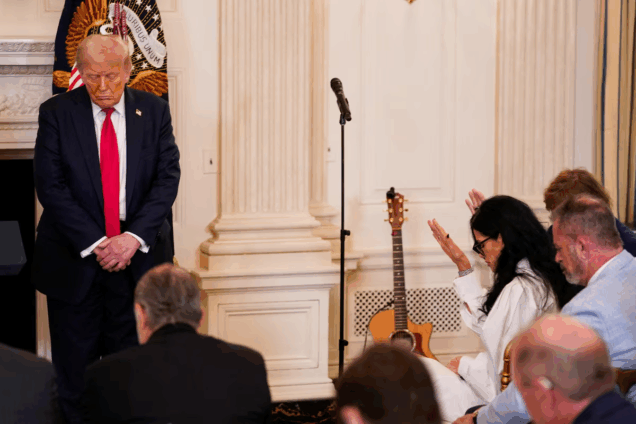
Federal employees may discuss and promote their religious beliefs in the workplace, the Trump administration said on Monday, citing religious freedoms protected by the U.S. Constitution.
Agency employees may seek to "persuade others of the correctness of their own religious views" in the office, wrote Scott Kupor, director of the Office of Personnel Management, the U.S. government's human resources agency.
Supervisors can attempt to recruit their employees to their religion, so long as the efforts aren’t “harassing in nature,” according to Kupor's statement. Agencies can't discipline their employees for declining to talk to their coworkers about their religious views.
The statement represents the latest effort of the six-month-old Republican Trump administration to expand the role of religion in the federal workplace.
Courts have long held that employers cannot suppress all religious expression in the workplace, but can lawfully curb conduct that is disruptive or imposes an undue hardship as long as it applies equally to members of any religion.
The U.S. Constitution's First Amendment protects individuals' rights to practice their religion while preventing the government from favoring one religion or another or religion in general.
OPM in mid-July said agency workers can get permission to work from home or adjust their hours to accommodate religious prayers, after previously demanding that workers report to offices fulltime.
The new statement cites President Donald Trump's February executive order calling on agencies to eliminate the "anti-Christian weaponization of government."
That order directs cabinet secretaries to identify federal actions hostile to Christians. Trump has embraced the conservative Christian world view and promoted policies that speak to concerns that their religious liberty is under attack.
Federal employees can also set up prayer groups in the workplace, so long as they don't meet during work hours, Kupor's statement said.
The memo references Title VII of the Civil Rights Act of 1964, a law that prohibits workplace discrimination based on a person's religion or religious practices.
Kupor in the memo said that means the law requires employers to allow workers to proselytize, organize prayer groups on non-working time, and display religious icons.
The U.S. Equal Employment Opportunity Commission, which enforces Title VII, has said that proselytizing in the workplace can amount to unlawful religious harassment if it is unwelcome and is so severe or pervasive that it creates a hostile or abusive work environment.
"A consensual conversation about religious views, even if quite spirited, does not constitute harassment if it is not unwelcome," the agency said in a 2008 guidance document.
Kupor's memo is not legally binding, and any court that reviews it could disagree about the scope of Title VII's protections. But the memo could be difficult to challenge directly in court, as judges in many past cases have said they lack the power to review internal agency documents.
Latest Stories
-
ECG announces power outage in parts of Tema, Central Region due to network fault, maintenance
26 minutes -
When the Gospel Becomes a Weapon: The church, blackmail and the abuse of faith
51 minutes -
JoyNews’ Jacqueline Ansomah Yeboah selected for UK Media Excellence for Emerging Technology Fellowship
1 hour -
Mental Health Alliance urges government to operationalise Mental Health Fund
1 hour -
Ghana–Holy See agreement heads to Parliament after Cabinet approval
1 hour -
Luv FM Corporate Games 2026: Kumasi Central Prisons, Amanfiman Bank win big amid fun
2 hours -
WAFU B U17: Ghana top Group A after win over Togo
2 hours -
Ho Central Mosque reopens amid unresolved leadership dispute that led to closure
3 hours -
Minority caucus questions GH¢16.4m in Ablakwa’s SA evacuation spending, demands independent audit
4 hours -
Gender Ministry meets Nana Akua Addo’s husband over domestic violence after hospital discharge
4 hours -
UG Vice-Chancellor urges swift operationalisation of National Research Fund
5 hours -
Pope Leo to have surgery after lump found in lung
5 hours -
Joseph Cudjoe writes: Ghana must break free from the dangerous mindset that natural resources are the foundation for wealth
5 hours -
Children among 109 dead after boat capsizes off Djibouti, UN says
5 hours -
OmniBSIC Bank’s 11th health walk promotes fitness and business growth
5 hours