

Audio By Carbonatix
The sanitation situation in Ghana is set to improve as a waste-to-energy project is being piloted at Gyankobaa in the Atwima-Nwiabiagya South district of the Ashanti Region.
The project, which will take 48 months to complete is expected to generate 400 KW of electricity from municipal waste. This will be scaled up to other parts of the country.
The German Government, through its Federal Ministry of Education and Research, signed a 5.8 million euro contract involving 4 institutions in Germany and 1 from Ghana.
These comprise 3 academic institutions, one research and development institution and a medium-scale industry.
The project’s overall aim is to develop concepts for waste segregation and the conversion of various fractions into energy by using biogas, pyrolysis and solar PV plants.
The project will also create business models to successfully replicate and propagate the models in 10 different regions in Ghana.
It will also build local experts to design, construct and maintain hybrid waste to energy facilities.
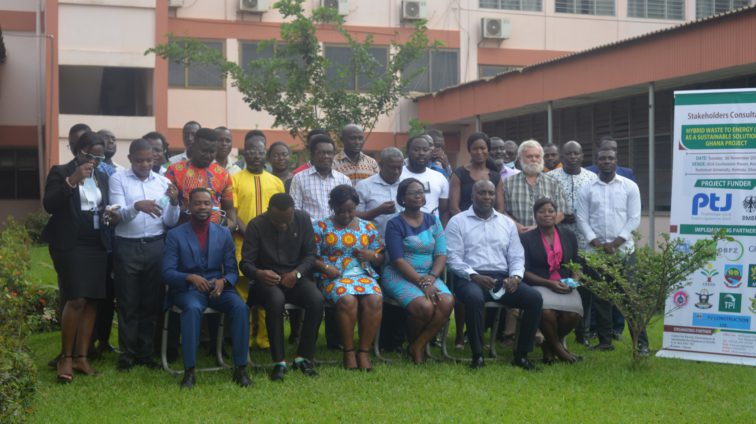
At a stakeholder consultation meeting at the Kumasi Technical University, the Project Coordinator and Head of the Renewable Energy Centre at the KsTU, Dr. Julius Ahiekpor said the project will begin full operation by the middle of 2022.
“We want to produce energy and train people to manage such projects in the future. It’s a pilot that has a research component,” he summarized.
How the project started
Germany's Federal Ministry of Education and Research (BMBF) of Germany in collaboration with Ghana’s Ministry of Environment, Science, Technology and Innovation, through the West African Science Service Centre in Climate Change and Adapted Land Use in Accra conducted feasibility studies on renewable energy resources in Ghana.
This was under the supervision of the Council for Scientific and Industrial Research.
Two scoping studies were commissioned around the same time by BMBF to examine the Bioenergy production and utilization in Ghana (BioGRAG) project and the possibility of producing bioenergy from cocoa husk through the Energize Ghana by Cocoa Husk (ENGHACOH) project coordinated by the University of Rostock and SRH-Berlin respectively.
The three individual studies and scoping reports crystallized into one project with the common objective of finding an appropriate treatment pathway for municipal solid waste generated in Ghana.
Latest Stories
-
Ghana must value skilled trades, build resilient learners — Ibn Chambas
8 minutes -
Ghana must rethink education around relevance, resilience and responsibility — Ibn Chambas
11 minutes -
Prince Harry faces defamation lawsuit from charity he co-founded
13 minutes -
South Korea deploys thermal cameras to track escaped zoo wolf
14 minutes -
Calls for royal meeting with Epstein survivors grow ahead of US visit
18 minutes -
Ibn Chambas advocates blend of technology and human values in education
19 minutes -
UMA improves healthcare access in Asutifi North with GH₵700k ‘Kim Taylor Legacy’ Walkway
24 minutes -
Scholarships Authority and Fanaka University offer sponsorship for procurement and supply chain studies
27 minutes -
Bisa Kdei drops new single ‘Go N Look’ featuring Medikal
33 minutes -
Benin facing rising terrorism in north as French military presence faces growing criticism
35 minutes -
UEW Public Lecture Series 2026: Education debate ‘about the soul of Ghana’s future’ — Dr Ibn Chambas
36 minutes -
EU fingerprint and photo travel rules come into force from today
1 hour -
Anti-LGBTQ+ Bill: Ghanaians demand expedited passage, not dialogue – Ntim Fordjour to Mahama
1 hour -
EU airline industry warns of fuel shortages if Strait of Hormuz stays closed
1 hour -
White House staff told not to place bets on prediction markets
1 hour