

Audio By Carbonatix
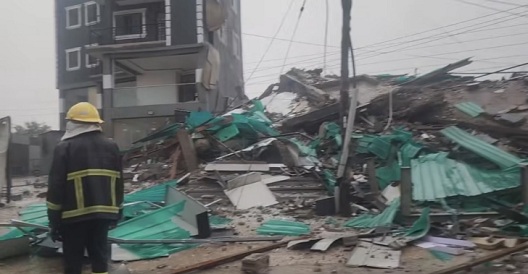
A structural engineer who inspected the site of Sunday's Avenor building collapse has raised serious concerns about the quality of concrete used in the four-storey structure, saying it visibly falls short of basic engineering standards.
Emmanuel Aidoo, a Professional Engineer with the Ghana Institution of Engineering specialising in Structural Engineering, told journalists that even from a visual assessment, the concrete in the collapsed building showed clear signs of weakness.
"Visually, from the concrete, what I'm seeing is that you can clearly see that that concrete is not in the best condition," he said.
Speaking on Joy FM's Super Morning Show, Aidoo explained that standard structural engineering requires concrete to achieve a compressive strength of at least 25 Newtons per square millimetre — a benchmark he does not believe this structure would meet.
"I don't think it will get to that particular value," he said.
He described the collapsed structure as a four-storey building — ground floor plus three additional floors — with a hidden roof, located along a road he said he travels frequently.
"This is not a single-storey building — your house or something. This is a four-storey building, so the concrete, the steel, everything has to be designed. These structures have to be engineered. You can't just use your mind to construct such buildings. It'll come back and hunt you," Aidoo said.
He added that construction on the building is believed to have begun around 2020 or 2021, making it barely six years old at the time of its collapse.
"For it to just come down, it's an issue," he said.
Aidoo noted that his observations are based on an initial visual assessment, and that formal tests — including concrete sampling and structural modelling — are yet to be conducted before definitive conclusions can be drawn.
His remarks follow a separate disclosure by fellow engineer Prince Kas-Avotri, also of the Ghana Institute of Engineers, who said the building appears to have been constructed without a permit from the Accra Metropolitan Assembly — meaning no approved architectural or engineering plans were in place to guide the construction.
The collapse, which occurred in the early hours of Sunday, June 7, killed two people and left two others hospitalised.
It is the second building collapse in Accra within a week, coming days after a similar incident at Adenta New Site on June 3rd, which claimed one life.
Latest Stories
-
Immigration officer transferred from Accra International Airport after asking passenger for ‘breakfast’
1 minute -
Proceed cautiously with further policy rate cuts – IMF to BoG
17 minutes -
Duncan-Williams calls for prayers to heal Ghana’s land and water, raises food security alarm over galamsey
18 minutes -
2022/2023 AUCC students ‘shall be eligible’ for certificates under University of Ghana seal – UG clarifies
45 minutes -
New physical and electronic devices for VAT implementation will be a game changer – GRA boss
56 minutes -
An Evening for Cure: Otumfuo leads global appeal to support Ghana’s new $100m cancer centre
1 hour -
Lands Minister honours former Environment, Science and Technology Minister
1 hour -
Ayariga’s stance on anti-LGBTQ+ Bill may have influenced his removal as Majority Leader – Kpebu
1 hour -
‘Your leadership will strengthen Ghana’s defence architecture’ – Brogya Genfi to Gilbert Adjei
2 hours -
Return home and serve taxpayers who funded your education – Lawyer tells scholarship beneficiaries
2 hours -
Galamsey becoming a ‘pandemic’; Ghana needs united front to fight it – Eric Adjei
2 hours -
‘Arresting people over insults hurts the government’ – Dafeamekpor
2 hours -
Mahama gov’t has arrested more people over free speech in 18 months than Akufo-Addo did in 8 years – Kpebu
2 hours -
Apam SHS to be upgraded from Category B to A school – Education Minister
3 hours -
NPP Mion Constituency Chairman resigns
4 hours