

Audio By Carbonatix
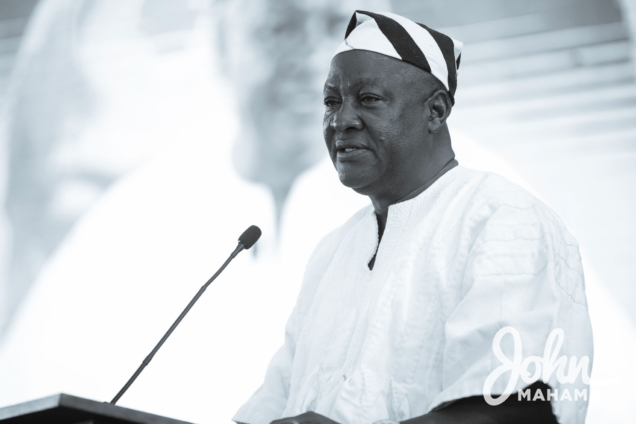
Former President John Mahama has reiterated his promise to restore the licences of some financial institutions that collapsed as part of a banking sector clean-up by the New Patriotic Party (NPP) administration.
According to Mr Mahama, this move will revive the banking industry and boost financial confidence.
Speaking at the 7th Ghana CEOs Summit and Expo held at the Kempinski Hotel in Accra, the newly elected flagbearer of the opposition NDC said, the gesture will also offer opportunities for experienced banking professionals who were laid off during the reforms to “move from the menial jobs that they were forced into with the closure of the indigenous banks.”
He argued that the Akufo-Addo-Bawumia government spent more money after closing down financial institutions that could have been allowed to operate with less financial support.
“I cannot to this day understand why a GH¢4 billion problem was made to cost the taxpayers GHS25 billion. These banks were asked to capitalize to GHS400 million, and if there were even 10 of them, that would be GHS4 billion and yet with the closure of banks, we incurred a public debt of GHS25 billion guaranteeing depositors' accounts.”
In view of this, the former President said he was convinced that the decision by the NPP government to shut down these financial institutions was mainly political.
“Indeed, for some of these banks, there was no problem. It was purely politics or personal vendetta. One bank was shutdown solely because its principal shareholder was being investigated for corruption in a case involving a state enterprise.”
Mr. Mahama further added that for businesses in the country to thrive, government must be apolitical in how it deals with the private sector.
“We must create an environment where businesses are allowed to grow no matter their political, ethnic or other colorization," he said
About the banking sector cleanup
The government in 2017 undertook the banking sector clean-up under the supervision of the Finance Minister, Ken Ofori-Atta.
The exercise saw a reduction in the number of banks from 34 to 23, whilst 347 microfinance institutions, 15 savings and loans and eight finance houses had their licences revoked.
A number of the institutions that had the licences revoked were found to have varying degrees of corporate governance lapses.
The total estimated cost of the state’s fiscal intervention, excluding interest payments, from 2017 to 2019 was pegged at GH¢16.4 billion.
The government in 2020 claimed that it spent about GH¢21 billion on the banking sector clean-up exercise.
Some of the financial institutions that disagreed with the revocation sued the government and the cases are still pending in court.
Latest Stories
-
Let’s give OSP time to mature, not to scrap it – Hassan Tampuli
3 minutes -
Nigeria convicts 386 Islamist militants in mass trials
8 minutes -
Djibouti president wins election with 97.8% of vote, state media says
12 minutes -
We don’t have mandate to deduct tax from rent allowance of security services personnel – Interior Ministry clarifies
26 minutes -
Ablakwa receives Presidential Special Envoy on Reparations to advance global agenda
44 minutes -
Christina Koch becomes first woman to travel around the moon on Artemis II
55 minutes -
Epstein survivors’ calls to meet King Charles and Queen harder to ignore as US visit approaches
1 hour -
UN Secretary-General names Ghana’s Anita Kiki Gbeho as South Sudan envoy
1 hour -
Mali withdraws recognition of Sahrawi Republic, backs Morocco’s autonomy plan
1 hour -
Gov’t distributes over 8,500 laptops to One Million Coders project
1 hour -
Julius Debrah, ‘man to beat’ as NDC’s James Agbey dismisses Musah Dankwah’s polls
1 hour -
GPRTU in Savannah Region to protest alleged eviction in Damongo
2 hours -
Re: Reinsurance does not replace process — A response to the SIGA–SIC defence
2 hours -
Gender Ministry supports Harriet Amuzu in ongoing abuse case
2 hours -
AG joins plaintiff to scrap OSP ?: We should be mindful of the mischief in this – Bobby Banson
2 hours