

Audio By Carbonatix
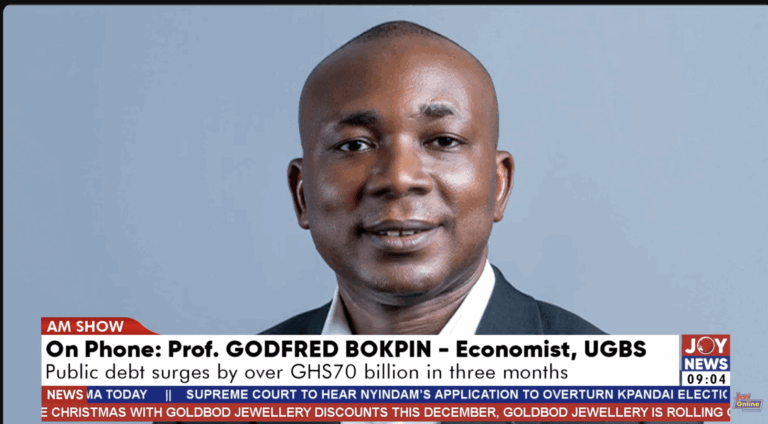
Professor Godfred Bokpin,an Economist and University of Ghana Business School (UGBS) lecturer, has played down concerns over Ghana’s recent rise in public debt, insisting the country is no longer classified as being at high risk of debt distress.
Speaking on Joy FM’s AM Show, Prof Bokpin urged Ghanaians to focus on the broader debt sustainability outlook rather than short-term fluctuations driven largely by currency movements. “I don’t think it presents a bigger concern here. Let’s not major on the minor,” he said, citing the International Monetary Fund’s (IMF) latest debt sustainability analysis.
According to him, the IMF’s October 2025 assessment shows Ghana has exited the high-risk debt distress category and is now considered a moderate debt risk country.
“If you look at the October debt sustainability analysis that the IMF released, Ghana has exited the high-risk of debt distress category. We are now considered a moderate debt risk country, given our economic fundamentals,” Prof Bokpin explained.
His comments come against the backdrop of fresh data from the Bank of Ghana, tracked by JoyNews Research, showing that Ghana’s public debt stock rose by GH¢71.6 billion in the third quarter of 2025. The increase has been largely attributed to the sharp depreciation of the cedi against the US dollar during the period. Total public debt has now climbed to GH¢684.6 billion, with projections suggesting it could exceed GH¢700 billion by the end of the year if exchange rate pressures persist.
Prof Bokpin acknowledged the rise in debt but argued that the increase should be properly contextualised. He noted that Ghana officially entered the high-risk debt distress category in 2014, prompting the government at the time to seek IMF support. “That was the reason President Mahama, on August 6, 2014, went to the IMF for the 16th IMF-supported programme,” he recalled.
He added that although Ghana exited that IMF programme in April 2019, debt sustainability was not fully restored, describing it as one of the key shortcomings of the programme. “We exited that programme without being able to restore debt sustainability. That was a major drawback,” he said.
The economist stressed that while some level of borrowing remains necessary to meet refinancing obligations and support economic recovery, the focus should be on sustainability rather than headline debt figures. He argued that recent debt increases, driven mainly by exchange rate effects, do not necessarily signal a return to crisis conditions.
Ghana is currently implementing IMF-backed reforms aimed at stabilising the economy, restoring confidence, and placing public debt on a sustainable path, amid ongoing challenges from currency volatility and global economic pressures.
Latest Stories
-
EBID strengthens regional integration role amid global economic uncertainty
17 minutes -
Two assault rifles, ammunition retrieved in Police probe of Tamale gang attack
23 minutes -
EBID records strong financial growth with $722m disbursements in 2025 – President, Dr George Donkor
26 minutes -
EBID to mobilise $2.69bn under new 2026–2030 growth strategy – Dr George Donkor
30 minutes -
An open letter to telcos, regulators and security agencies on mobile money fraud in Ghana
30 minutes -
Mobile Money Merchants are driving fraud
45 minutes -
Alban Bagbin declines minority’s motion to investigate sale of gold reserves at BoG
45 minutes -
NACOC leadership tours drug testing centres in Accra
47 minutes -
OSP’s power to prosecute without AG’s authorisation unconstitutional – AG files at Supreme Court
49 minutes -
Seven African referees selected for World Cup 2026 as Ndala, Issa Sy miss out
1 hour -
Why diaspora investors are using Accra real estate to hedge against global uncertainty in 2026
2 hours -
GWL urges public support to stem water thefts
2 hours -
Fire guts 2-storey apartment at Ashaley Botwe
2 hours -
Come down and account, it’s a constitutional requirement – Martin Kpebu to Ofori-Atta
2 hours -
The power of the private courtyard: How regalia is redefining resort-style living in Accra
2 hours