

Audio By Carbonatix
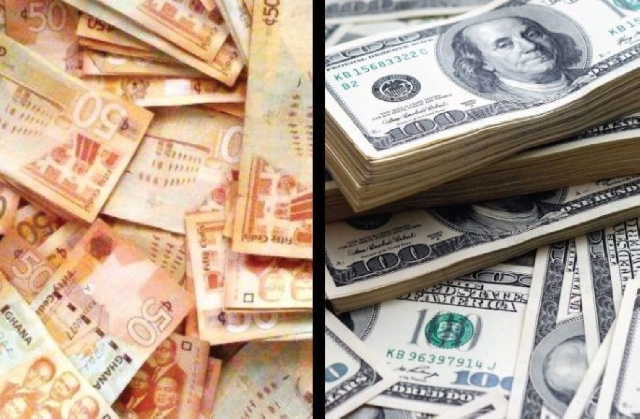
Based on the current trend, the cedi is expected to end 2020 with a year-to-date depreciation of less than 5.0%.
This would be better than the 8.33% loss over the same period last year.
The local currency has since January 1, 2020 lost 24 pesewas to the American ‘green back’, approximately 2.60% in value to the US dollar.
Many analysts have attributed the strong performance of the cedi to the Bank of Ghana’s bi-weekly Foreign Forward Auctions and Spot Market interventions, which is supported by healthy secondary reserves, equivalent to about 4.3 months of imports.
Also, the loss in the value of the dollar to some global currencies on the external front, amid rise in covid-19 pandemic and political uncertainty in the US has benefited the cedi.
Economic and currency analyst with Databank Research, Courage Mantey told Joy Business, “Overall we see foreign portfolio outflows from Ghana’s domestic market as the key risks to the cedi stability which could become pronounced as the elections approach in December 2020.
"But generally, the cedi remains firmly on course to not exceed 5% depreciation in 2020”.
He pointed out that the cedi has done fairly well so far this year, based on historical trend.
“I think the cedi has done creditably well this year, especially when view within the context of historical standards [past cedi performances] and when view within the context of global pandemic and what the market had accepted of currencies such as ours.
“Year-to-date, the cedi has lost just about 2.60% against the US dollar on the interbank market. On the retail market, the losses are less than 1.0%, and so based on current trend, and holding election trend constant, the cedi is in for a better end to 2020 and the outturn based on the trend we are seeing will likely lead us to an annual depreciation of less than 5%
In quarter one 2020, the cedi appreciated by 1.68% to the US dollar, but lost 3.5% in value to the world’s most important currency in the second quarter.
Drop in imports
Some analysts and market watchers have argued that the decline in imports in 2020, largely because of covid-19 could be playing a role in the relative strength of the local currency. Others also believed that the cedi’s relative stability is due to the Central Bank’s monetary policy.
Exports have declined, but according to data from the Bank of Ghana, the nation’s trade balance remains positive. The country registered a trade balance of US$51.9 million, compared with USS135.93 million and US$57.41 million in March and April 2020 respectively.
Historical performance of the cedi to dollar
2019 12.9% depreciation
2018 8.4% depreciation
2017 4.9% depreciation
2016 9.6% depreciation
2015 18.75% depreciation
Latest Stories
-
The attack on Ghanaian traders in Burkina Faso and the blame game: Why Hybrid Security Governance holds the key (I)
2 minutes -
TaxForGalamey: Stop taxing galamsey immediately or face sanctions – Gov’t cautions MMDCEs
5 minutes -
FNB Ghana strengthens balance sheet with higher earnings and improved asset quality
17 minutes -
Stakeholders call for stronger action to advance women’s economic empowerment at UKGCC–British High Commission IWD Event
24 minutes -
Global Network of Export-Import Banks holds 6th exchange programme in Accra
29 minutes -
Prudential Bank Ladies celebrate IWD with candid talk on Love, Life, and Livelihood
30 minutes -
Kejetia Market now a ‘death trap’ – Federation of Kumasi Traders warns
32 minutes -
NDPC DG urges shift to resilient, shock-responsive social protection systems
33 minutes -
New Town building collapse: Enforce existing laws — Architecture Alliance
36 minutes -
Kudus to play under new coach as Tottenham appoint De Zerbi
37 minutes -
Gov’t may review fuel taxes amid rising oil prices – Kwakye Ofosu
46 minutes -
Iran–US conflict pushes fertilizer prices higher, raising food security risks in 2026
52 minutes -
Iran using children in security roles in war, reports and witnesses say
55 minutes -
Evalue-Ajomoro-Gwira MP pledges to safeguard peace in Lower Axim and Nsein
58 minutes -
Global collaboration in focus as Malaysia courts Ghanaian top business executives
1 hour