


Audio By Carbonatix
The Federation of Associations of Ghanaian Exporters (FAGE), has debunked claims made in a viral social media video that mangoes are being chemically injected to hasten the ripening process.
According to FAGE, mangoes in Ghana adhere strictly to Good Agricultural Practices (GAP) per international standards, and are thus safe for human consumption as they ripen through a natural process influenced by factors such as temperature, humidity, and exposure to ethylene gas.
In a press statement signed by its president, Davies Korboe, the federation described the said video as deceptive, and called on its creators to retract and apologize for the harm caused.
For information regarding the quality of food, FAGE urged the public to rely on organisations such as the Ghana Standards Authority (GSA), the Ministry of Food and Agriculture (MoFA), the Food and Drugs Authority (FDA), and Plant Protection & Regulatory Services (PPRSD).
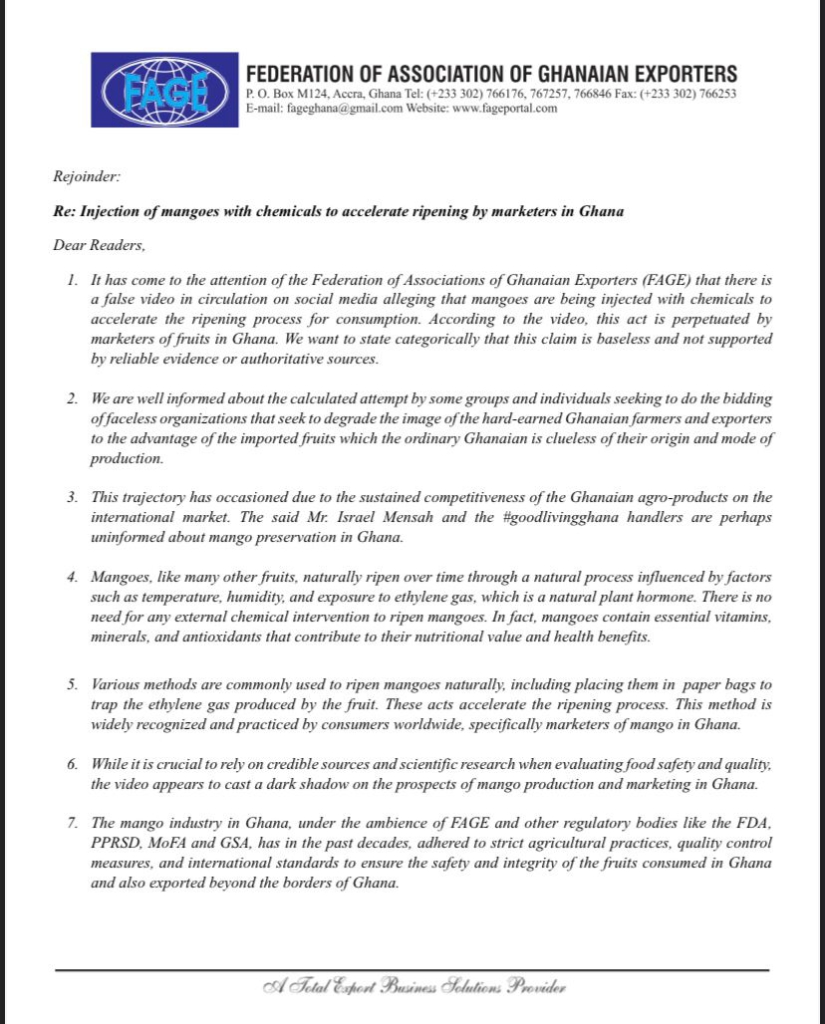
The Federation in a statement said, "We are well informed about the calculated attempt by some groups and individuals seeking to do the bidding of faceless organizations seeking to taint the image of the hard-earned Ghanaian farmers, marketers and exporters to the advantage of the imported fruits which the ordinary Ghanaian is clueless of their origin and mode of production."
"This trajectory has occasioned due to the sustained competitiveness of the Ghanaian agro-products on the international market. The said Mr. Israel Mensah and the #goodlivingghana handlers are perhaps uninformed about mango preservation in Ghana.
Mangoes, like many other fruits, naturally ripen over time through a natural process influenced by factors such as temperature, humidity, and exposure to ethylene gas, which is a natural plant hormone. There is no need for any external chemical intervention to ripen mangoes. In fact, mangoes contain essential vitamins, minerals, and antioxidants that contribute to their nutritional value and health benefits.
It said the mango industry in Ghana, "under the ambience of FAGE and other regulatory bodies like the FDA, PPRSD, MoFA and GSA, has in the past decades, adhered to strict agricultural practices, quality control measures, and international standards to ensure the safety and integrity of the fruits consumed in Ghana and also exported beyond the borders of Ghana.
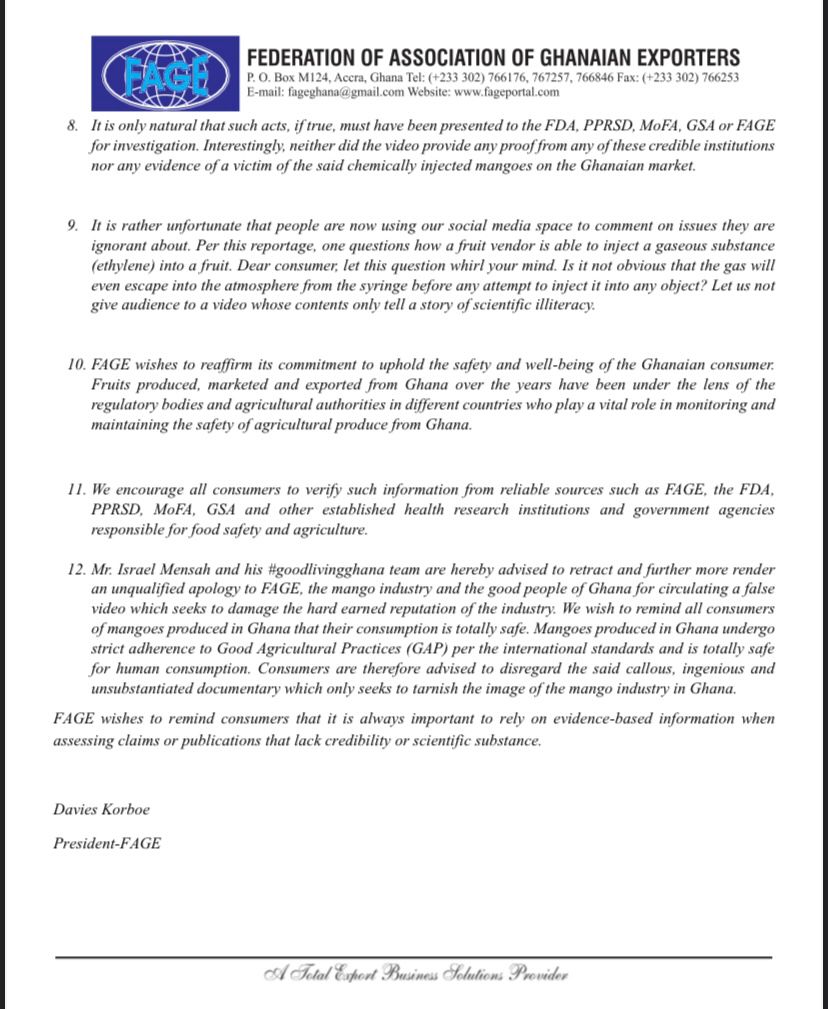
Read the full statement below:
Latest Stories
-
SSNIT says La Beach clearance was to protect hotel investments, beaches to remain public
9 minutes -
APSU congratulates St Augustine’s College after back-to-back National Investment Quiz wins
13 minutes -
Renewed flood intervention at Mallam Junction raises hopes among residents, businesses
53 minutes -
St Augustine’s College retain National Investment Quiz title after nail biting grand finale
1 hour -
Education infrastructure investment will drive Banda’s development – Ahmed Ibrahim
1 hour -
Teacher unions strike: Gov’t presents fresh proposals as talks end inconclusively
2 hours -
51,000 teachers’ promotion arrears to be validated for October payment – Education Minister
2 hours -
Kwabena Boamah appointed Board Chair for Impact Investing Ghana
2 hours -
Striking teacher unions to meet Fair Wages and Salaries Commission on October 6
3 hours -
EOCO working with AG to arraign Nana Baffour Awuah before weekend court
3 hours -
Duraplast reassures customers after fire, announces October 5 reopening
3 hours -
Call off strike, gov’t will not renege on promotion arrears pledge – Haruna Iddrisu to teacher unions
3 hours -
Committee set up to validate teachers eligible for 20% deprived-area allowance – Education Minister
3 hours -
Five-member committee to search for new Black Stars coach after Sports Ministry-GFA meeting
4 hours -
Pinktober: Breast cancer survival exceeds 90% when detected early – Breast Society of Ghana
4 hours