

Audio By Carbonatix
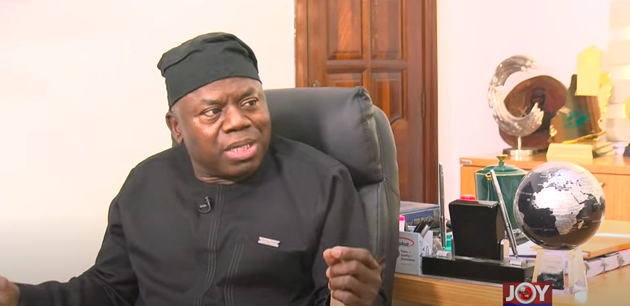
Former President of the Ghana Association of Banks, Alhassan Andani, says commercial banks should not be faulted for selling cocoa bills to customers.
According to him, the cocoa bills were one of the safest bond instruments on the market and thus a preferred choice for customers who wanted very low risk bonds to buy.
He explained that what made the cocoa bills particularly enticing was the fact that COCOBOD, the issuer, has a better credit risk than the government of Ghana, making it a very credible institution.
“First of all, let’s not miss it. What is the credit rating of cocoa bill? I have been in 14 COCOBOD syndications, 14 international syndications as a lead player. And I always said how come that COCOBOD has a better credit risk than the government of Ghana which owns it a 100%.
“And it was simple, because of course they sold cocoa in US dollars which was externalized and the borrowers sat around the money before it comes into Ghana. So COCOBOD borrowed sometimes at best rates, I mean, 67 basis points was the highest I saw in a very long run.
“Otherwise they were borrowing at 15, 25, 30 basis points above LIBOR ( London Interbank Offered Rate) when Ghana government itself was borrowing at 8 above LIBOR or 7 above LIBOR. Think about it,” he said on JoyNews’ PM Express Business Edition on Thursday.
He noted that allowing debt on the cocoa bills was what led to the current situation.
His comments follow the Bank of Ghana directing banks not to pay customers their maturing cocoa bills investments following cash flow challenges facing COCOBOD.
In a statement, the Central Bank said it expects that this short-term cash flow challenges facing COCOBOD will be resolved soon to enable the cocoa regulator meet its obligations to investors.
In a recent statement, the Bank of Ghana, Ghana Cocoa Board (COCOBOD) and the commercial banks have agreed to allow banks to use COCOBOD’s deposits/placements at the banks to cater for retail customers who may not want a rollover of their cocoa bills.
According to Alhassan Andani, “So COCOBOD and cocoa bills that’s a kind of risk instrument you don’t want any debt on, and we should have done everything possible to prevent that. Not who bought it and who didn’t buy it. It wasn’t a weekly packaged deal, the subprime you’re talking about was a lot of rotten debt hidden into a credit package when you start to unpack.
“This is a very credible institution that as I said in the international market was rated better than the Ghana government. So if they have a bond and the bank bought it and even had clients who had wanted very safe bonds and you recommend it to them to buy, really did you do anything wrong?
“So let’s not divert the issue. What has happened to hurt the credibility of COCOBOD or the COCOBOD bills which were really really highly rated? That’s what we should be looking at,” he said.
Latest Stories
-
Mahama commissions Christian Tetteh Yohuno Ward Complex at Police Hospital
13 minutes -
Vice President calls for wider access to Ghana’s political party histories
13 minutes -
Republic Bank JoyNews Habitat Fair to connect prospective homeowners with exhibitors in Ho from October 16 to 18
23 minutes -
Obaasima Summit: ‘AI is not a spiritual attack’ — Rev. Dr. Ofori-Boateng urges young women to embrace technology
33 minutes -
GHS to distribute 80,000 pairs of locally-made protective footwear to health workers
40 minutes -
GoldBod boosts local jobs as 90% of gold undergoes refining in Ghana – Sammy Gyamfi
42 minutes -
The search for the politically unblemished: Are we asking the impossible of public appointees?
43 minutes -
Ghana seeks climate finance access for debt-restructuring countries
53 minutes -
Afenyo-Markin urges stronger media scrutiny of public institutions
54 minutes -
GoldBod recovers GH¢38.7m in legacy PMMC debts, targets remaining arrears
56 minutes -
62 out of every 100 commercial meters inspected missing from Ghana Water database – MD
56 minutes -
GoldBod gets BoG authorisation to sell forex, Sammy Gyamfi tells PAC
59 minutes -
Ghana Water revenue mobilisation below 50% of potential – MD
1 hour -
Ghana’s democracy must accommodate dissent and constructive criticism – Haruna Iddrisu
1 hour -
Fact check: Trump posts fake quote of Denzel Washington supposedly praising him
1 hour