

Audio By Carbonatix
If you have ever passed through Lapaz, you know it doesn’t introduce itself quietly.
At first, it feels like the city is pressing in on all your senses.
The honking is constant, trotro mates shout destinations like auctioneers, and traders compete for your attention.
The air carries a cocktail of smoke, sweat and food — roasted plantain, mingling with the acrid sting of burning waste.
It is overwhelming, yet unmistakably alive.
Lapaz is not just another neighbourhood.
It is Accra’s beating, choking heart — a place where convenience and inconvenience have become inseparable.
What should be Ghana’s most connected transport hub has instead become a byword for traffic, trash and tension.
On paper, Lapaz is perfectly placed.
The N1 Highway — the most important road in the country — runs right through it, linking Tema Port to Kasoa, Cape Coast and beyond.
By geography alone, Lapaz ought to be a powerhouse of logistics and trade.
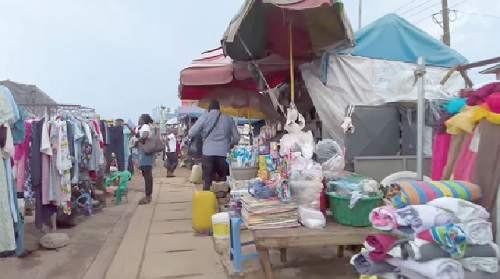
Instead, the highway has been consumed. Lanes meant for cars now double as markets.
Pavements meant for pedestrians are buried under goods. A journey through Lapaz is less a drive and more a negotiation with chaos.
At the centre of this storm stand the drivers — especially the GPRTU buses.
With no proper terminals, they turn the road itself into their office.
Buses stop where they please, block lanes to load passengers and lurch back into traffic without warning.
The GPRTU has mastered this disorder: setting up unofficial terminals, barricading roads to collect their tolls.
We have allowed them to trade safety for convenience, and the price is paid by everyone else.
Food vendors move through the snarl of traffic with trays balanced effortlessly on their heads, selling roasted doughnuts, eggs and water.
Their businesses are agile, their prices unbeatable.
For the hungry commuter, they are a lifeline. But here too, convenience comes with hidden costs.
Where was that food prepared? Was the water safe?
The Ghana Food and Drugs Authority repeatedly warns about the risks of foodborne illnesses from unhygienic street food, yet we buy, we eat and we shrug.
We have normalised the risk, turned sickness into just another part of daily life.
The waste is impossible to ignore. Gutters choke with plastic, heaps of rubbish line the streets and clouds of smoke from burning piles hang over the horizon.
Old washing machines, broken TVs and old model fridges — remnants of the digital age — are stacked in toxic heaps, slowly poisoning the ground beneath.
Lapaz has earned its reputation as Accra’s “borla” capital not by accident, but by years of unchecked neglect.
And the Assemblies? Their own red paint tells the story. Kiosks and containers marked “Remove by 2/11/20” still stand boldly in 2025. A timeline not of enforcement, but of inaction.
There are sparks of civic pride among the smog. Groups like the Buz Stop Boys and City Boys have stepped forward, clearing gutters and sweeping streets with their bare hands.
They prove that Ghanaians are not indifferent; people want change, and some are willing to lead it. But let’s be honest: volunteers cannot fix a systemic failure.
They can inspire, but without national action — real urban planning, law enforcement and infrastructure — their work is a drop in the ocean of dysfunction.
And the dysfunction is deadly. In Asamankese, a truck recently lost control, ploughing into pedestrians and vehicles, with devastating results.
It was a vivid reminder that when roads double as markets and enforcement is lax, disaster is never far away.
In Lapaz, where hawkers, buses and trucks squeeze into the same narrow stretch, such a tragedy feels less like an accident and more like an inevitability waiting its turn.
Lapaz is tragic because it is also a wasted opportunity. With its raw connectivity, it could be a model of organised trade: proper transport terminals, structured markets, safe pavements and a clean environment that attracts business instead of driving it away.
Instead, we have settled for a culture of compromise. Small acts of convenience — dropping waste, parking anywhere, buying the cheapest meal — have hardened into a permanent dysfunction.
Lapaz is a mirror. It reflects both our brilliance and our blindness: the ingenuity of our hustle, the strength of our survival, but also our tolerance for disorder and our willingness to trade tomorrow’s safety for today’s ease.
But Lapaz is also more than traffic, trash and trade. It is a reminder that the environment and its people shape one another in an endless loop.
The streets teach aggression, ruthlessness and compromise, and the people, in turn, etch those behaviours deeper into the streets.
Over time, what began as neglect hardens into culture, until chaos itself feels normal — even natural.
This is how survivalist instincts replace collective vision, and how place and people mirror each other’s decline.
And then there are the child beggars.
Their presence at car windows tugs at something deeply human.
You see small hands, tired eyes, and the instinct is to give. But here lies a cruel dilemma: that act of compassion may ease your guilt, but it often feeds a darker system.
Many of these children are placed there, part of an organised economy of begging where every coin encourages their continued exploitation.
And here’s the part most people don’t even know: under Ghana’s Beggars and Destitute Act of 1969, begging is technically illegal — and so is giving to beggars.
Yes, by stretching your hand out the car window with a coin, you may be committing an offence.
Of course, nobody thinks about that in the moment; most are oblivious to it.
But it adds another layer of irony to the cycle: the very act meant to show kindness is not only fueling exploitation, it’s also, on paper at least, against the law.
Lapaz is not a lost cause, but it is a warning.
It shows us who we are today — and who we risk becoming tomorrow.
The road to something greater — cleaner, safer, more prosperous — already runs through its heart.
The question is whether we are bold enough to walk it.
-
By Malcolm Osei Tutu
E-mail: malcolm1x@hotmail.com
Latest Stories
-
GCB Bank rewards first 10 winners in ‘Pa To Pa Promo’
2 minutes -
GIPC hosts business forum with 54-member Japanese delegation following presidential state visit to Japan
9 minutes -
FosCel announces National Sickle Cell Fun Fair on Valentine’s Day
9 minutes -
Passengers tell of terror, screams and darkness after Spain train crash
28 minutes -
Transport unions form joint task force to curb indiscipline, ease Accra commuter woes
32 minutes -
At least 39 dead in Spain after two high-speed trains collide
36 minutes -
Hindsight: Will Ghana win the AFCON again?
40 minutes -
Power supply has been stable since June 2025 – Ashanti Regional Minister commends ECG
41 minutes -
No school will be under trees at Akatsi North by end of year – Nortsu-Kotoe
44 minutes -
Student arraigned over alleged GH¢24,849 ATM card fraud in Accra
55 minutes -
“Gold in the ground is not dead wealth”, Ghana’s proven gold reserves estimated at US$146bn – CPS
55 minutes -
Accra doesn’t have a transport problem, it has a reliability problem
57 minutes -
Accra commuters endure long queues despite transport reforms
1 hour -
“In the midst of abundant gold, we are a liquidity trap” — Prof. Alagidede
1 hour -
Kennedy Agyapong emerges frontrunner in NPP flagbearer race in new study
1 hour