

Audio By Carbonatix
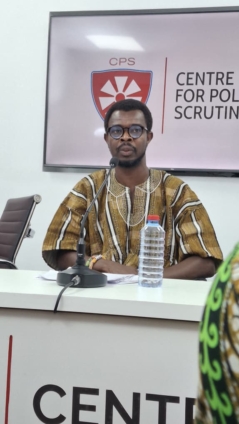
The Centre for Policy Scrutiny (CPS) has expressed worry that despite gold sitting at the center of Ghana’s economic history, yet its role in shaping monetary policy has been underutilized.
Professor Paul Alagidede, who is a fellow of the Center, therefore wants this to change if the country is to escape chronic liquidity constraints.
“Gold plays a very significant role as a store of value and an inflation hedge,” he said.
“It can also serve as a strategic reserve asset for emerging market economies like Ghana”, he added.
Ghana is the sixth-largest gold producer globally, producing about 440 tonnes annually. Yet only a small fraction of this wealth appears on the country’s balance sheet.
Speaking at a public lecture organised by the Centre for Policy Scrutiny (CPS) in partnership with Joy Business, the professor noted that while Ghana holds about 38 tonnes of gold in official reserves, proven in-situ reserves are estimated at around 1,000 metric tonnes.
“From an economic point of view, we can do much better by keeping the gold here rather than selling it for dollars,” he argued.
At current prices, the value of Ghana’s proven gold reserves alone is estimated at about US$146 billion, forming part of a broader natural asset base valued at roughly US$1.5 trillion.
Yet orthodox economics treats this wealth as dormant until it is extracted and sold.
“In the age of reductionism, gold in the ground is seen as dead,” he explained. “But in the age of regeneration, it is an opportunity for balance-sheet renewal", he added.
By activating just 40 to 60% of its in-situ gold equity, Professor Alagidede argued, Ghana could unlock between US$634 billion and US$952 billion in fiscal space.
“The illusion of poverty is very powerful,” he said.
“Orthodox thinking sees Ghana as a poor country that must always look outside for liquidity”, he added.
He acknowledged recent policy shifts, including the establishment of the GoldBod which has mobilized about US$10.8 billion from small-scale and artisanal mining within a year. But he described these as preliminary steps.
“These are baby steps unless they are supported by a deeper shift in monetary philosophy,” he cautioned.
Ultimately, he called for a transition from managing economic flows to managing the national balance sheet, anchored on sovereign assets.
“Ghana is not a poor nation,” he concluded. “It is a wealthy nation in a temporary state of amnesia. It is time to wake up.”
Latest Stories
-
Hohoe floodwaters recede, leaving over 5,000 homeless
6 minutes -
Three arrested after drones allegedly flown over EOCO headquarters during Baffour Awuah probe
6 minutes -
Gender Ministry urges Ghanaians to see older persons as contributors, not beneficiaries
10 minutes -
Flydubai passenger describes hugging his children as plane nosedived during attack
10 minutes -
Africa’s richest man launches Kenya oil refinery despite land protests
10 minutes -
CSOs urge government to review 10,000 sq km offshore gold licences over fisheries concerns
11 minutes -
National Ambulance Service treats 8 casualties after Avenor fire in Accra
12 minutes -
Former Duffuor spokesperson, Antonio Asinyo enters NDC Youth Organizer race
14 minutes -
Zimbabwe tycoon Wicknell Chivayo and wife killed in helicopter crash
15 minutes -
Russia targets busy bridge in central Kyiv in broad daylight
15 minutes -
Putin shows no sign of stopping the war as Russia doubles down on Ukraine
17 minutes -
Gov’t outlines measures to support Ghana’s growing population of older persons
18 minutes -
Star Oil rejoins COMAC, calls for reforms to governance structure
24 minutes -
Norwegian government strengthens soybean value chain to expand market access for farmers
25 minutes -
NPP diaspora executives back proposal to allow dual citizens to contest parliamentary elections
27 minutes