

Audio By Carbonatix
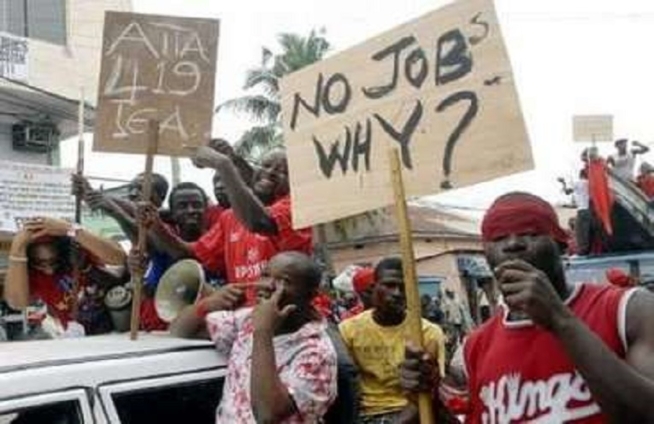
Rising unemployment and limited economic opportunities could pose the greatest threat to Ghana’s stability in 2026, despite signs that inflationary pressures are beginning to ease, according to the World Economic Forum’s Global Risks Report 2026.
The report, based on insights from the Executive Opinion Survey 2025 involving business leaders, indicates growing anxiety that Ghana’s economic recovery has not yet produced sufficient employment, particularly for the country’s expanding youthful population.
This gap between macroeconomic improvement and job creation is viewed as a major vulnerability.
Economists warn that persistent joblessness could weaken household incomes, suppress consumer spending and undermine long-term productivity, increasing the risk of economic and social instability if left unaddressed.
The report identifies technological disruption, especially the unintended consequences of artificial intelligence, as the second most significant risk facing Ghana.
While digital technologies offer efficiency and growth potential, the Forum cautions that rapid adoption without adequate skills development, labour market flexibility and regulatory preparedness could lead to job displacement and deepen inequality.
Inadequate public services and social protection systems also feature prominently among Ghana’s key risks. The assessment highlights mounting strain on healthcare, education, transport infrastructure and pension schemes, at a time when fiscal tightening constrains government spending amid rising population growth and urbanisation.
Concerns about declining health and well-being further emphasise the connection between social outcomes and economic performance, as weak health systems can erode labour productivity and raise household expenses.
Although inflation has slowed from recent highs, the report notes that cost-of-living pressures remain a sensitive issue for households and businesses.
The World Economic Forum concludes that mitigating these risks will require Ghana to move beyond short-term economic stabilisation towards a strategy anchored in job creation, human capital investment and resilient public service delivery.
Latest Stories
-
The job interview question you don’t have to answer
1 hour -
Trump unveils ‘Super Intelligence Force’ to oversee AI policy
1 hour -
Actress Chioma Chukwuka announces death of father in emotion-laden post
4 hours -
[Video]‘I have asked God to take me when it is time’ – Pete Edochie on health struggles
4 hours -
Manager remanded over $1m auto fraud
4 hours -
Mr President, Ghana was mentioned at the UN; why aren’t we talking about it?
4 hours -
US Marine arrested over murder of woman in Okinawa, Japan
4 hours -
Accra to convene Africa’s regulators and markets on tokenisation at AVAS 2026
4 hours -
Indian police accused of sexually harassing journalists at protest
5 hours -
Jeffrey Archer returns to his former school library
5 hours -
France to close up to 500 schools on Monday over student protests
5 hours -
The Paradox of Plenty — When every smartphone becomes a newsroom
5 hours -
Australia investigating Flydubai co-pilot’s links to country
5 hours -
GTA sensitises taxi drivers in ‘Know Ghana’ tourism campaign
6 hours -
Archbishop Agyinasare calls for responsible speech amid growing social media abuse
6 hours