

Audio By Carbonatix
As African leaders are demanding that former colonisers compensate for the wealth and power built through slavery, the French President Emmanuel Macron is continuing his Africa charm offensive despite refusing to take responsibility.
But across the continent, African unity is rapidly becoming the primary force enabling African nations to break free from Paris’ postcolonial shadow. With countries in North and West Africa turning to China for financial alternatives in development funding, such as infrastructure investment, and political alignment.
The changes are steadily helping dismantle the pillars that once propped up French influence in West Africa.
Only last week, France moved to repeal outdated legislation that defines people enslaved in its colonies as "moveable goods", in a symbolic move as the country grapples with its colonial legacy while trying hard to maintain influence in Africa. The question is, why only now?
The French were the third largest slave traders in Europe, after the British and the Portuguese
In 2001 the country recognised slavery and the slave trade as "crimes against humanity" yet failed to apologise for its role in slavery trade despite growing demands in Africa for reparations. Further than that, France failed to support the recent UN resolution sponsored by Ghana declaring Transatlantic slavery as the greatest crime against humanity.
By its own admission, ships departed from French ports between the 17th and 19th centuries forcibly transported more than one million men, women and children from Africa into slavery, many to plantations in its overseas colonies in the Caribbean.
France ended slavery in 1794 under the French Revolution, but Napoleon Bonaparte ordered troops to be sent to Guadeloupe in 1802 to restore the practice. France then abolished it again in 1848; to the surprise of many, it was slave owners who received financial compensation rather than formerly enslaved people.
Historically, France exerted influence across Africa through political networks, military and defence partnerships, and currency control through the CFA franc.
France formerly dominated about 21 countries across the continent, organised into the federations of French West Africa and French Equatorial Africa.
Today, it has lost every influence as France's military withdrawal has revealed the most significant weakness in the Françafrique system.
After years of conducting security operations under Operation Barkhane, France was expelled from Mali (2022), Burkina Faso (2023), and Niger (2023).
The increasing levels of anti-French sentiment in its former African colonies have forced the former slave trader to prioritise building new political and commercial ties with anglophone African nations such as Kenya.
Paris-based professor of political science at the American Graduate School, Douglas Yates, said: "Through its predatory neocolonial relationships, France underdeveloped its francophone African states."
The Ivory Coast, Chad, and Senegal have since ordered the exit of French troops.
France handed over control of its last major military facility in Senegal after Senegalese President Bassirou Diomaye Faye, who attended the Kenya summit, said French bases were incompatible with the country’s sovereignty.
France as a source of instability
Since 1990, 78% of the 27 coups in sub-Saharan Africa have occurred in Francophone states, leading commentators to ask whether France - or the legacy of French colonialism - is to blame.
France’s Africa strategy of the 1950s, which was built upon cultural diplomacy – an exchange of ideas, values, traditions and other aspects of culture – is being revived through the Nairobi Summit.
The Africa Forward Summit held in Kenya was met with chaos in Nairobi and widespread protests against Macron.
Such protests are similar to those of the post-1945 period, when African trade unionists and members of civil society began making political claims and calling for a new relationship with Paris.
At the time, Madagascar was gripped by a violent nationalist revolt against France between 1947 and 1948. Senegal became the epicentre of anti-colonial activism as trade unions grew more political, as shown by the 1946 general strike.
What is distinctive about France's role in Africa is the extent to which it continued to meddle in the politics and economics of its former territories after independence.
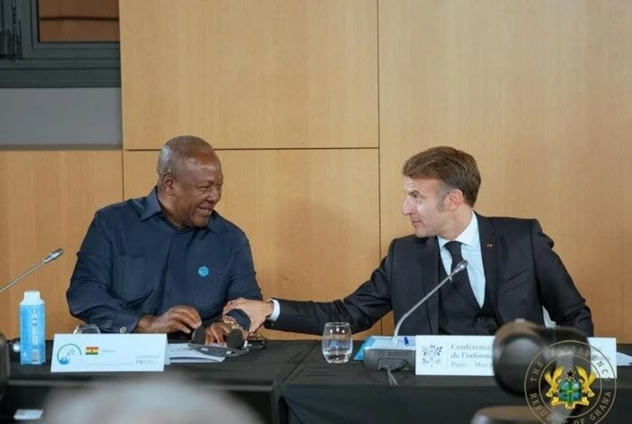
The question we must ask ourselves is why French President Emmanuel Macron is suddenly heading to Ghana to discuss reparations?
This is just weeks after France abstained from the historical United Nations vote declaring the transatlantic slave trade the gravest crime against humanity, Macron is now embracing conversations about reparatory justice and preparing to engage with African leaders in Accra.
Analysts believe this is a calculated diplomatic strategy aimed at rebuilding French influence on a continent that has been rejected in West and Central Africa.
The noticeable shift in France's position, Ghana's growing role in the global reparations movement, the collapse of traditional French influence across Africa, the future of the CFA Franc, and the fact that Africa's rising leverage, including the emergence of BRICS, are all forcing Europe to rethink its entire approach to the continent.
Many Ghanaians are asking why Macron is being invited to Ghana and how that sends a highly contradictory signal, especially when the continent is actively pushing for sovereignty and moving away from French neocolonial interference.
"We cannot talk about historical justice, reparations, or protecting our own family values from foreign ideologies on one hand, and then turn around to sign security deals with the very architect of Françafrique on the other. The Alliance of Sahel States (AES) showed that true advancement comes from self-reliance and regional solidarity, not from back-door deals with Paris. Ghana needs to stand firm, not compromise its stance for Western photo-ops," answered one popular commentator.
********
The writer, Tintswalo Baloyi, is a senior political journalist for CAJ News Africa
Latest Stories
-
‘I don’t hire coaches, and I don’t fire coaches’ – Kofi Adams
59 minutes -
NPP sets up 31 voting centres to speed up national executive elections
1 hour -
Demolition begins at La Pleasure Beach amid heavy security presence
2 hours -
Senyocue: Highlife will dominate global music in the next 20 years
2 hours -
Innovare Limited congratulates Ahantaman Community Bank PLC on ISO/IEC 27001:2022 certification urges others to follow suit
2 hours -
Today’s front pages: Friday, October 2, 2026
2 hours -
GPL 2026/27: Opoku Agyemang strike sends Kotoko third after Karela win
3 hours -
Government ‘cannot dissolve’ GFA – Sports Minister Kofi Adams
3 hours -
“Every genre we create doesn’t have to be ‘Afro’ something” – M.anifest
4 hours -
GMTF marks first anniversary with lifesaving equipment for 9 more hospitals
4 hours -
NAIMOS seizes 10 excavators in raid on illegal mining sites blocking River Pra’s flow
4 hours -
Pump prices may stay unchanged as government holds TOR, Sentuo prices
4 hours -
Akra Reads! 2026: Ladé Wosornu poetry contest expands to JHS
4 hours -
K9 dog sniffs out 72lbs of prohibited Ghanaian food items at JFK
4 hours -
If family planning is our choice, why isn’t it in our budget?
4 hours