

Audio By Carbonatix
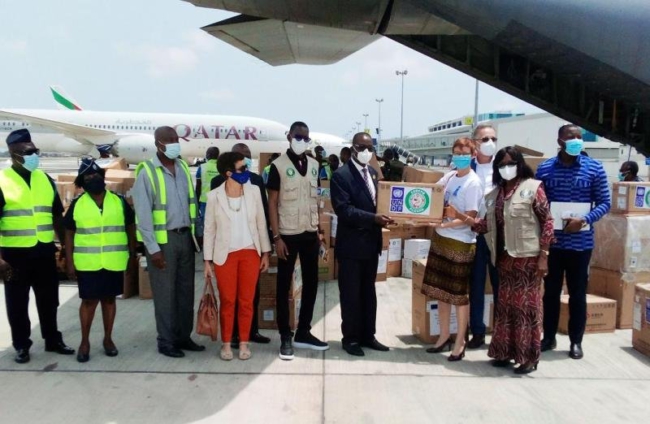
Ghana has received the second batch of Personal Protective Equipment (PPEs) from the West African Health Organisation (WAHO) to protect front-line workers and equip Covid-19 testing laboratories across the country.
The items arrived at the Kotoka International Airport, Accra, on Wednesday, from Abuja, Nigeria, and received by Mr Kwabena Boadu Oku-Afari, the Chief Director of the Ministry of Health, on behalf of government.
Mr Sampson Ayeni, the Logistics Specialist, WAHO, said the items, which included test kits, medical equipment, oxygen concentrator, and surgical masks, weighed 10 tons by 43 cubic meters, making it the largest to be dispatched to the Economic Community of West African States (ECOWAS) member countries so far.
He said the distribution was facilitated by President Muhammadu Buhari, the COVID-19 Response Coordinator, ECOWAS, with support from Germany, the European Union (EU), and procured by the United Nations Development Programme (UNDP).

Madam Silke Hollander, the Deputy Resident Representative, UNDP, said the items formed part of the bigger batch procurement made for ECOWAS, estimated at $15 million.
Madam Diana Acconcia, the Ambassador, Head of EU Delegation to Ghana, said she was happy to be part of the team to receive the items.
That was because a year ago, the European Commission launched its global response to the COVID-19 pandemic and had raised about 40 billion Euros from EU banks and member states to support the fight, of which 26 billion had already been spent, she said.
Madam Acconcia said ECOWAS had a project to prepare itself for pandemics during the outbreak of Ebola and that the EU had supported that initiative with nine billion Euros.
She said the EU also supported Ghana with 87 million Euros in 2020 and invested 2.2 billion Euros in the COVID-19 COVAX vaccine with the hope to supplying more vaccines to the country.

She commended Ghana for the fight against the pandemic and said: “EU is by Ghana’s side in the fight against COVID-19.”
Mr Christoph Retziaff, the German Ambassador to Ghana, said the items were to show the special commitment of EU and Germany towards Ghana’s fight against the pandemic.
“Germany has supported the COVID-19 COVAX vaccine initiative with 2.3 billion Euros and in Ghana, through our bilateral relations with 25 million Euros to set up a COVID-19 intensive care unit in Takoradi in the fight against COVID-19,” he said.
Mr Oku-Afari, on his part, said the items would help provide protection for frontline workers in their line of duty and add to supplies in COVID-19 testing laboratories in the country.
He expressed appreciation on behalf of government to WAHO and partners for the support.
Latest Stories
-
GUTA calls for suspension of Publican AI system over trade disruptions, demands temporary halt in import activities
2 minutes -
TTAG raises alarm over proposed recruitment of 7,000 teachers, demands national posting roadmap
35 minutes -
Civilians feared killed after reports of air strike on Nigerian market
45 minutes -
Bishop Simon Kofi Appiah installed as new Jasikan Diocese Bishop
46 minutes -
Trump’s Strait of Hormuz blockade threat raises risks and leaves predicaments unchanged
48 minutes -
US Court backs extradiction of former MASLOC CEO Sedina Tamakloe-Attionu’s to Ghana
1 hour -
Seven arrested as NAIMOS dismantles illegal mining camp, seizes firearms at Boin River
1 hour -
Fire erupts at Madina Ritz Junction, destroys multiple wooden structures and containers
1 hour -
Daniel-Kofi Kyereh returns from long-term injury, registers assist for Freiburg U23
2 hours -
Knifeman calling himself ‘Lucifer’ slashes three at NYC’s Grand Central
2 hours -
Brands are built from within to without
2 hours -
Matriculants urged to pursue excellence as gov’t reaffirms support for Maritime education
2 hours -
See the areas that will be affected by ECG’s planned maintenance on Monday, April 13, 2026
2 hours -
GPL 2025/26: Salim Adams double fires Medeama back to summit after Kotoko rout
2 hours -
Two robbery suspects convicted following violent gold dealer attack in Obuasi
2 hours