

Audio By Carbonatix
German leaders have postponed a summit on extending the vaccine rollout as they await confirmation from the EU's medicines regulator that the Oxford-AstraZeneca drug is safe to use.
Germany is among a number of European countries that have suspended its use but Vice-Chancellor Olaf Scholz said he was hopeful it could be used again.
The EU regulator has again insisted the drug's benefits outweigh any risks.
The German decision has been criticised by some politicians and doctors.
Emer Cooke, executive director of the European Medicines Agency, said the EMA was still "firmly convinced" of the benefits of the AstraZeneca drug, and she pointed out that blood clots highlighted by some countries were relatively common in the general population. The main question was whether it was a real side-effect of the vaccine or a coincidence, she said.
The agency's safety committee will further review the latest evidence and report back on Thursday. Experts from the World Health Organization (WHO) were also meeting on Tuesday but spokesman Christian Lindmeier stressed there was "no evidence" that the incidents were linked to the vaccine.
The WHO has urged countries not to pause their vaccinations.
In the UK, more than 11 million people have already received at least one dose of the AstraZeneca vaccine and there has been no sign of excess deaths or blood clots occurring.
What reaction has there been in Germany?
Germany has so far used 1.6 million doses of the AstraZeneca vaccine, considered second only to the Pfizer-BioNTech drug in importance to the national rollout.
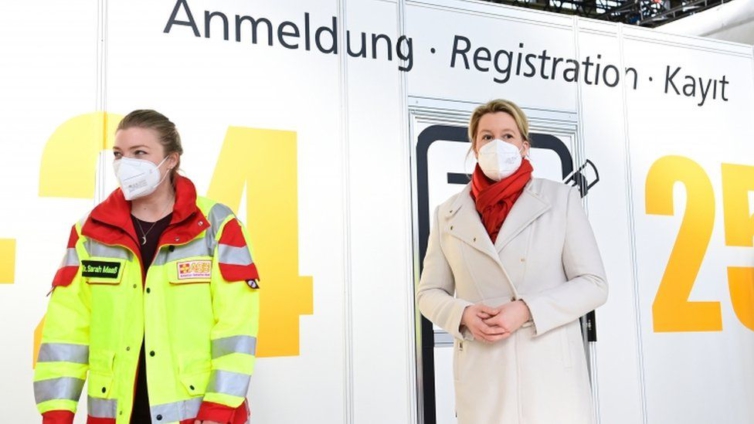
The planned meeting of federal and state leaders will now take place after the EMA decision, and they are expected to back the involvement of a national network of family doctors' surgeries from April, which officials hope will then enable 20 million vaccinations per month.
German infections are growing "exponentially", with cases up by 20% in the past week, an expert from the RKI public health agency warned on Tuesday.
There have been seven cases of cerebral blood clots (cerebral sinus venous thrombosis, which is very rare) in recently vaccinated people in Germany, three of them fatal.
The government's decision to suspend the vaccine on Monday was criticised by Karl Lauterbach, an epidemiologist and health spokesman for the centre-left Social Democrats, who said while it was justifiable, it was also political.
"I would even now get vaccinated with the AstraZeneca. Based on the incidents we now know, the benefits of vaccination significantly outweigh the risks, particularly for the elderly," he told Deutschlandfunk radio.
A Free Democrat spokeswoman said the decision had set back the entire vaccination rollout. Greens health expert Janosch Dahmen argued that authorities could have provided detailed information about "manageable risk" and continued using the drug.
Latest Stories
-
Tiptoe Lane’s tech takeover: The story behind Ghana’s booming informal phone market
16 minutes -
Abanga vows to use social media to counter NDC messaging ahead of 2028 elections
18 minutes -
Okai Mintah seeks Sabah Zita Benson’s support for NDC National Youth Organiser bid
32 minutes -
Okai Mintah vows to strengthen NDC campaign machinery ahead of 2028
38 minutes -
Mother of four and Jasikan teacher among new Telecel M’ahitti Promo winners
39 minutes -
International Youth Shakers Conclave 2026 set to bring global young leaders to London
40 minutes -
Gov’t is committed to addressing teachers’ conditions of service, deprived-area allowance – Education Minister
44 minutes -
GoldBod’s structure encouraging galamsey – Afenyo-Markin
46 minutes -
Tullow starts selling Jubilee, TEN crude to Ghanaian refineries
48 minutes -
Local Government Service authorises rationalisation, redistribution of staff
51 minutes -
PURC assures consumers of working to ensure quality services in Northern Region
57 minutes -
Ghana develops US$4.28bn water financing framework
1 hour -
Christian Council calls for protection of mission schools’ religious identity
1 hour -
Mahama holds discussions with India’s External Affairs Minister
1 hour -
Even when you cough, they come after you — Abanga accuses Mahama govt of criminalising free speech
1 hour