

Audio By Carbonatix
The Board Chairman of ARP Apex Bank, Dr Toni Aubynn has said that the Domestic Debt Exchange Programme (DDEP) has had a negative impact on the growth plans of Rural and Community Banks (RCBs).
According to him, the sector has incurred a loss of GH₵1.10 billion as a result of the recently concluded DDEP.
Dr. Aubynn noted that this decision has disrupted the growth trajectory of Rural and Community Banks.
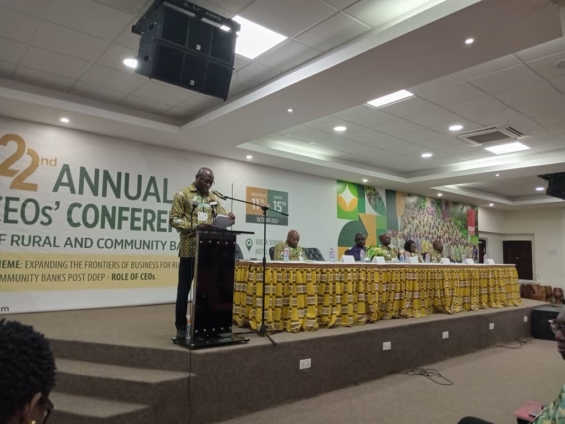
He made these remarks during the opening of the five-day 22nd Annual Conference of Chief Executive Officers (CEOs) of RCBs in Ho. The conference is being held under the theme, "Expanding the Frontiers of Business for Rural and Community Banks Post DDEP – Role of CEOs."
The Conference is being attended by more than 200 delegates.
He challenged CEOs of RCBs to change their mindsets and make positives of the current DDEP initiatives and transform it into a Domestic Deposit Expansion Programme as these RCBs hold the largest number of customers in the banking sector.
He recognised the unique role that RCBs play in fostering economic development and financial inclusion.
He noted that expanding the frontiers of business for RCB would require a multifaceted approach including embracing innovation and technology to enhance the efficiency and effectiveness of Digital banking solutions, mobile payment platforms, and online lending services to help bridge the gap as well as foster strategic partnerships and collaborations.

He again called for investment in the development of human capital by nurturing a culture of continuous learning and professional growth to meet the evolving needs of numerous customers.
“Expanding the frontiers of business for rural and community banks post Domestic Debt Exchange Programme is a collective endeavour that requires visionary leadership, innovation, collaboration, and a strong sense of social responsibility. As CEOs, we have the power to shape the future of our banks and make a lasting impact on the communities we serve.”
“Let us seize this opportunity to drive positive change, empower individuals and businesses, and create a more inclusive and sustainable financial sector. Together, we can build a brighter future for rural communities and ensure that no one is left behind,” Dr Aubynn added.
The Managing Director of ARB Apex Bank, Mr Alex Kwasi Awuah indicated that RCBs have risen to 147 and spread across 800 plus locations across all 16 regions, since the first set up at Agona Nyakrom in the Central Region in 1976, it has become leaders in micro, small, and medium financial delivery to entrepreneurs and businesses in the rural areas of the country.
He expected the government to offer concessions during the introduction of major austerity programmes such as tax hikes and the recently concluded DDEP.
He lamented the many presentations to the government for a reduction in the applicable corporate income tax rate for the RCBs, which has now increased to 25 per cent from eight per cent, remained unheeded.
Mr Awuah called for the reduction of the corporate income tax rate from the current 25 per cent to 10 per cent, to facilitate speeding up of capital accumulation that would quickly restore the strong solvency position of the affected banks.
He said ARB Apex Bank and the RCBs, which held GH₵1.10 billion in government bonds under the DDEP after the restructuring, wiped up projected incomes, leading to significant losses due to impairment charges.
He said it is critical for RCBs to engraft Environmental, Social and Governance (ESG) risk principles into its operations and financial reporting and has engaged a team of consultants from Deloitte and Touche Ghana Country office to begin the processes of guiding them to integrate ESGs.
Professor Richard Bani, Volta/Oti Chapter, Association of Rural Banks in a welcome address announced that RCBs need to shore up their operating capital base, adding that up to some GH₵400 million belonging to the banks including Volta and Oti regions remained locked up with Security and Exchange Commission and other regulated financial institutions.
He said though there are two cases in court concerning the matter, discussions have taken a dip and prayed that the issue be brought to the front burner to enable locked-up funds released to them to regenerate the economy of the rural people.
He said since the emergence of the DDEP the Bank of Ghana had placed a moratorium on RCBs to raise additional equity to meet their CSR.
He said more credit means readiness to grant more funds to their customers and called for drastic measures towards releasing their locked-up funds to facilitate strategising to create better value for the banks and shareholders.
Latest Stories
-
KGL U17 Colts 2026: Western beat Prempeh Elite Academy to set up final final with Greater Accra Region
2 minutes -
Late Solanke strike salvages 10-man Spurs draw at Man United
12 minutes -
Gender Ministry to monitor welfare of Nana Akua Addo’s children amid domestic violence case
18 minutes -
Benedict Okyere Yeboah: Ghana’s football problem goes beyond sacking a coach
28 minutes -
GPL 2026/27: Darkwah Wiafe’s winner sees All Blacks beat Kotoko
34 minutes -
ITF World Tour : Patel Wins Boys’ Singles Final at J100 Accra
46 minutes -
Ghana must pursue BRICS partnership if it brings economic benefits – Kpebu
49 minutes -
Success and Wright Claims J100 Accra Girls’ Doubles Championship
50 minutes -
ITF J100: America’s Wright wins J100 Accra Girls’ Singles Title
56 minutes -
Expedition hopes to find aviator Amelia Earhart’s plane on remote island
57 minutes -
US seeks changes to rejected $109m health compact with Ghana – Mahama
1 hour -
Nine dead in mass shooting at Pennsylvania home
2 hours -
‘Time for Ukraine to get new president,’ says Trump after Zelensky condemns diesel deal
2 hours -
Hincapie injury adds to Arsenal issues after Guimaraes rescue act
2 hours -
Henderson scores twice as Chelsea thumb Bournemouth
2 hours