

Audio By Carbonatix
The Dean of the University of Ghana Business School (UGBS), Prof. Justice Bawole, has called for an independent monitoring framework to track the implementation of government’s youth-focused policies.
His call comes amid concerns about the effectiveness of past initiatives and doubts about the current administration’s ability to deliver on job creation promises for young people.
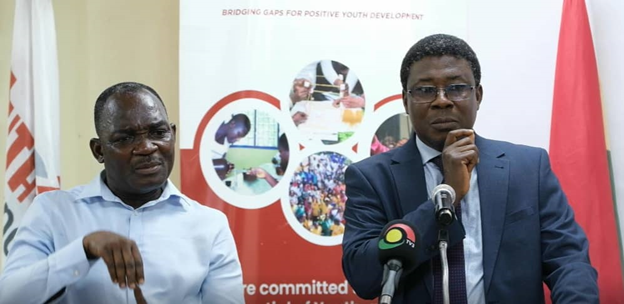
Speaking at a youth empowerment policy briefing organised by the Youth Bridge Foundation, Prof. Bawole emphasized the need for a systematic approach to ensure effective execution of youth policies, moving away from past inefficiencies.
The event, held under the theme “Empowering Youth to Elevate Accountability”, was supported by STAR-Ghana Foundation with funding from the Foreign, Commonwealth, and Development Office. It brought together over 250 participants, including students from four universities, development partners, youth representatives from the Ghana Disability Association, and members of the media.
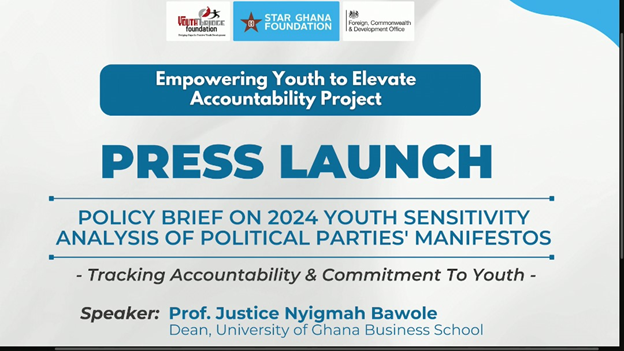
Prof. Bawole’s remarks align with the Youth Bridge Foundation’s ongoing advocacy for the government to transition from policy promises to concrete, measurable actions in the 2025 national budget. A recent Youth Sensitivity Analysis of Selected Political Party Manifestos conducted by the foundation revealed significant gaps in youth-focused initiatives, raising concerns about the government’s ability to translate commitments into action.
Findings indicate that while the manifestoes of the current administration address youth-centric issues, they fall short in critical areas such as funding adequacy, measurable outcomes, and mechanisms for active youth engagement in policy implementation.
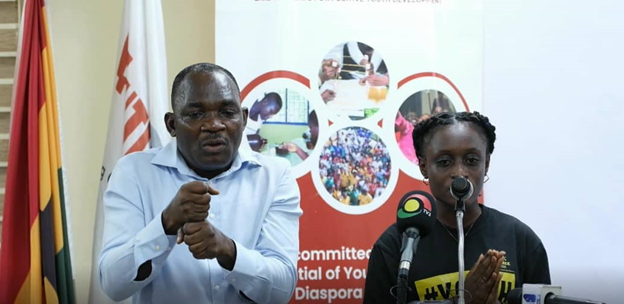
To ensure youth policies are not reduced to mere political rhetoric, the foundation and its partners are demanding greater transparency and accountability. Prof. Bawole stressed that youth policies should be embedded within established state institutions rather than being managed by politically structured agencies.
With Ghana’s youth becoming increasingly vocal about their expectations, the upcoming National Budget will serve as a critical test of the government’s commitment to implementing meaningful, youth-centered policies.
Latest Stories
-
British national arrested in connection with RAF Fairford incident
2 minutes -
‘Strike is the only language government understands’ –IFEST backs teachers
3 minutes -
Teachers must not be blamed for maintaining strike; the gov’t failed to act earlier – IFEST
12 minutes -
Attijariwafa’s acquisition of Societe Generale likely to be ratings neutral; Ghana’s banking environment healthy – Fitch
20 minutes -
Mahama’s Reset Agenda will make resource wealth benefit citizens – Dr Djokoto
25 minutes -
La Pleasure Beach to reopen after demolition exercise
29 minutes -
La Pleasure Beach demolition victims to receive compensation
42 minutes -
NPP Germany congratulates new national executives, calls for unity ahead of 2028 elections
45 minutes -
Avaricious elitism and intellectualism
47 minutes -
Speeding tipper truck kills 2 basic school students at Ekumfi
49 minutes -
‘I’m 16, passed my BECE and want to become a lawyer’ – Adanwomase ‘smallish’ SHS boy
1 hour -
Ghanaians in their 30s and 50s dying from heart disease without knowing – Cardiothoracic Centre
1 hour -
Emeritus Professor Kwame Akon Ninsin: The man who mentored a department
1 hour -
BoG orders banks to give fraud units direct access to CEOs
1 hour -
Government must clarify fate of 29,000 teachers awaiting promotion – NAGRAT
2 hours