

Audio By Carbonatix
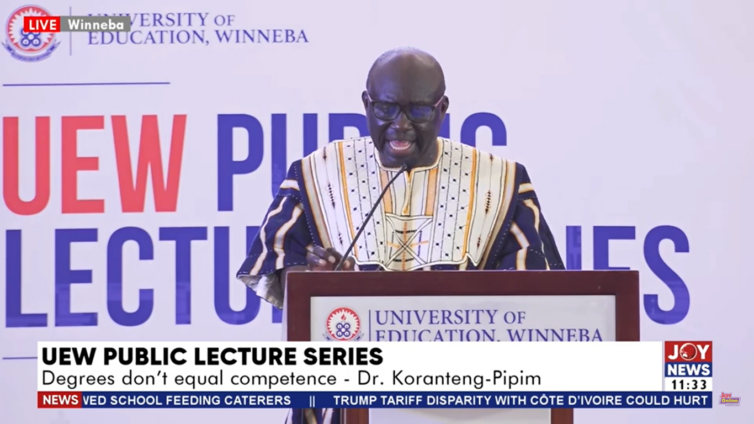
The Executive Director of EAGLESonline, Samuel Koranteng Pipim, has called attention to a critical flaw in Ghana’s education system, arguing that degrees do not necessarily translate into competence.
Speaking at the University of Education, Winneba (UEW) Public Lecture Series on Friday, April 11, Mr Pipim stressed that the education system is failing to adequately prepare graduates for the demands of the modern workforce, with a significant disconnect between what is taught in academia and the skills required by industries.
"Degrees don’t equal competence," Pipim asserted during his address. "There is a gaping disconnect between academia and industry needs, and the data supports it." According to the International Data Science Association (IDSA), a study on the Ghanaian economy in 2022 revealed that 40% of employers reported that graduates lacked critical problem-solving skills," Mr Pipim stated.
He further questioned the value of academic accolades that do not prepare individuals for real-world challenges, stating, “What good is a first-class degree if it leads to a third-class life?”.
In his view, the system is training people for poverty rather than prosperity, as it does not foster the entrepreneurial spirit necessary for economic growth.
Mr Pipim criticised the focus on academic qualifications rather than practical skills, lamenting that the education system rewards "paper over productivity."
He explained that this narrow focus on degrees and academic credentials has contributed to the country’s growing problem of job seekers rather than job creators.
"We produce job seekers, not job creators," he said.
He also pointed out the detrimental impact of the obsession with white-collar jobs, which has led to a stifling of creativity and enterprise among young people.
"The system rewards conformity to the ‘white-collar job’ ideal, which has stifled innovation and entrepreneurial spirit," Mr Pipim said.
According to him, this mentality has led many young people to view entrepreneurship as a last resort, rather than a viable career option, and has ultimately undermined the country’s ability to generate its own wealth.
Latest Stories
-
The journey of hope
13 minutes -
5G launch in Ghana will be a national rollout for all networks – Sam George
16 minutes -
Independence Day should mark shift from stability to transformation – United Party
28 minutes -
How schools in Old Tafo, Kumasi showcased vibrant traditional regalia to preserve cultural heritage
30 minutes -
69 Years on, Ghana has a long way to go — Asamoah Boateng
43 minutes -
President Mahama commissions Olam Agri pasta facility, driving local production and job creation
1 hour -
Ghana to push UN motion declaring slavery a grave crime – Mahama
2 hours -
Minority calls for stronger maritime security, protection for Ghanaians abroad
2 hours -
Minority raises alarm over farmers’ crisis, galamsey in Independence Day statement
2 hours -
Government pledges to make housing affordable for all Ghanaians
2 hours -
Minority demands reinstatement of over 1,500 public workers dismissed after 2025 change of government
2 hours -
Ghana @ 69: Africa Prosperity Network hosts high-level webinar on continent’s integration ahead of 2028 deadline
2 hours -
Mahama urges youth to harness technology for national development
2 hours -
Mahama pledges to serve with integrity as Ghana marks 69 years of independence
2 hours -
Two shot dead, one in critical condition at Sawla hospital
2 hours