

Audio By Carbonatix
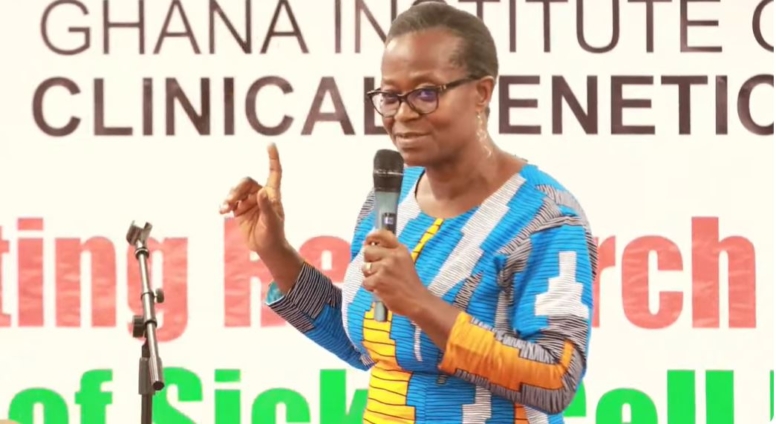
A professor of Haematology at the University of Cape Coast, Professor Ivy Ekem, has urged Ghanaians to stop blaming mothers for giving birth to children with sickle cell disease.
The past Vice President of the West African College of Physicians & Head of Department of Haematology at the University of Cape Coast emphasised that the condition is inherited from both parents, making it a shared genetic responsibility.
Delivering a public lecture on Friday, August 29, to commemorate the 50th anniversary of the Ghana Institute of Clinical Genetics, Prof. Ekem said, "If you have a mother or a father who is blaming the wife for a child who has been born with sickle cell disease, it's not right, because both parents contribute to the condition."
She clarified that a child can only be born with sickle cell disease if they inherit the gene from both their father and their mother.
She further noted that there are different types of the condition, with some individuals being SS while others are ST.
Prof. Ekem also sought to correct the common misconception that all people with sickle cell disease are constantly ill.
She explained that while the condition can be associated with illness, there are many individuals who live full and healthy lives with proper care and management.
She stressed the importance of moving away from the term "disease" to a more accurate understanding of the condition.
Professor Ekem's address comes at a crucial time for Ghana, which has one of the highest burdens of sickle cell disease in the world.
Approximately 2% of newborns in the country are born with the condition, which translates to about 15,000 babies each year.
The Sickle Cell Foundation of Ghana estimates that about 10,000 children born with the disease die before their fifth birthday.
The high number of carriers, which is around 20% of the population, further highlights the scale of the challenge.
The Ghana Institute of Clinical Genetics has been at the forefront of tackling this issue for the past 50 years, providing essential care, conducting research, and advocating for increased public awareness.
Prof. Ikem's message reinforces the need for a collaborative approach to sickle cell management, one that involves not only medical professionals but also community education and support to fight the stigma associated with the condition.
Latest Stories
-
We can tackle multiple priorities – Sam George defends Anti-LGBTQ Bill push
18 minutes -
Statement: Ghana Chamber of Mines’ Response to Claims in Joe Jackson’s “Ananse Stories about the Economy of Ghana”
19 minutes -
GES opens 2026 teacher recruitment for licensed B.Ed graduates
22 minutes -
Ghana must value skilled trades, build resilient learners — Ibn Chambas
30 minutes -
Ghana must rethink education around relevance, resilience and responsibility — Ibn Chambas
33 minutes -
Prince Harry faces defamation lawsuit from charity he co-founded
35 minutes -
South Korea deploys thermal cameras to track escaped zoo wolf
36 minutes -
Calls for royal meeting with Epstein survivors grow ahead of US visit
39 minutes -
Ibn Chambas advocates blend of technology and human values in education
41 minutes -
UMA improves healthcare access in Asutifi North with GH₵700k ‘Kim Taylor Legacy’ Walkway
46 minutes -
Scholarships Authority and Fanaka University offer sponsorship for procurement and supply chain studies
49 minutes -
Bisa Kdei drops new single ‘Go N Look’ featuring Medikal
55 minutes -
Benin facing rising terrorism in north as French military presence faces growing criticism
56 minutes -
UEW Public Lecture Series 2026: Education debate ‘about the soul of Ghana’s future’ — Dr Ibn Chambas
57 minutes -
EU fingerprint and photo travel rules come into force from today
1 hour