

Audio By Carbonatix
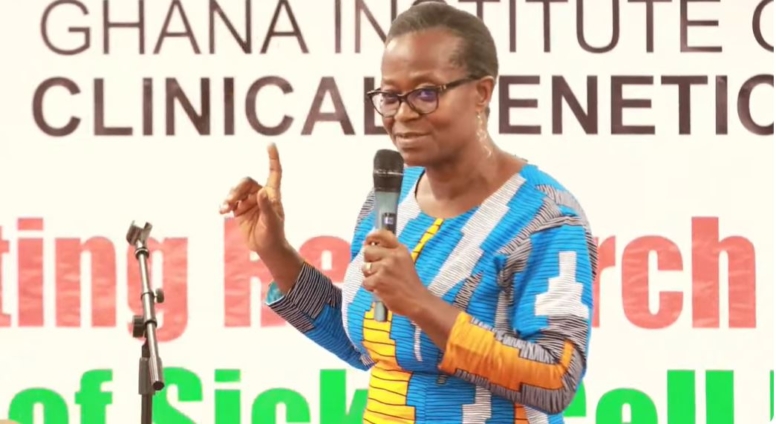
In an enlightening public lecture held on Friday, August 29, Professor Ivy Ekem, a distinguished medical professional and Head of the Department of Haematology at the University of Cape Coast, delivered a compelling presentation titled "Translating Research into Care: 50 Years of Sickle Cell Excellence."
This event marked the 50th anniversary of the Ghana Institute of Clinical Genetics, spotlighting significant advancements in sickle cell management and care in Ghana.
The auditorium was filled with healthcare professionals, students, and members of the community, all eager to hear Prof. Ekem's insights on sickle cell disease, a condition that affects approximately 2% of the Ghanaian population, with an estimated 10,000 new cases diagnosed each year.
Her lecture underscored the importance of shifting perceptions and language surrounding sickle cell, starting with the terminology used to describe those living with the condition.
"There is a term that we have been talking about that we should stop using: the term 'sickler,'" Prof. Ekem stated, urging the audience to reconsider how language shapes our understanding of individuals.
"Why it's called a sickle is that there is an implement used to weed, and that's the shape. If you look at it, it's about the same as this one. So that's why it's called the sickle cell. It's not referring to the whole individual. You might as well call it a C-cell, something like that. So please, from today, just note that sickle refers to the cell, not the patient."
Her remarks resonated deeply, as she emphasised that individuals with sickle cell disease are not defined by their condition; instead, they are vibrant members of society deserving of dignity and respect.
This call for a change in language reflects a broader movement towards enhancing the quality of care and life for those affected by sickle cell in Ghana.
Prof. Ekem also outlined the milestones achieved in sickle cell research and treatment over the past five decades in Ghana.
The Ghana Institute of Clinical Genetics has been at the forefront of these developments, advocating for better diagnosis, treatment, and education around sickle cell disease.
She highlighted that early diagnosis through newborn screening programs has drastically improved outcomes, enabling children with sickle cell to live healthier, fuller lives.
Statistics reveal that with appropriate medical care, including regular health check-ups and pain management, individuals with sickle cell can live beyond 50 years, a significant improvement compared to previous decades.
Prof. Ekem noted that community education initiatives play a crucial role in dispelling myths about sickle cell disease, which is often surrounded by stigma and misunderstanding.
In her lecture, she also introduced the audience to innovative treatments and ongoing research aimed at improving the lives of those with sickle cell. These include advancements in gene therapy and new drug therapies that have shown promise in preventing complications associated with the disease.
As the lecture concluded, Prof. Ekem called for continued collaboration between healthcare providers, researchers, and community organizations to ensure that the progress made over the past 50 years continues to flourish.
"Translating research into care is not just a slogan; it’s a commitment to the well-being of our people. Let us work together to ensure that every individual with sickle cell receives the care and respect they deserve," she urged.
The event was not only a celebration of past achievements but also a rallying call for the future, inspiring a new generation of healthcare professionals to champion the cause of sickle cell awareness and excellence in care.
With the support of the community and ongoing research, there is hope that those affected by sickle cell in Ghana will continue to thrive.
Latest Stories
-
GPL 2026/27: Darkwah Wiafe’s winner sees All Blacks beat Kotoko
5 minutes -
ITF World Tour : Patel Wins Boys’ Singles Final at J100 Accra
18 minutes -
Ghana must pursue BRICS partnership if it brings economic benefits – Kpebu
21 minutes -
Success and Wright Claims J100 Accra Girls’ Doubles Championship
22 minutes -
ITF J100: America’s Wright wins J100 Accra Girls’ Singles Title
28 minutes -
Expedition hopes to find aviator Amelia Earhart’s plane on remote island
29 minutes -
US seeks changes to rejected $109m health compact with Ghana – Mahama
59 minutes -
Nine dead in mass shooting at Pennsylvania home
1 hour -
‘Time for Ukraine to get new president,’ says Trump after Zelensky condemns diesel deal
1 hour -
Hincapie injury adds to Arsenal issues after Guimaraes rescue act
1 hour -
Henderson scores twice as Chelsea thumb Bournemouth
2 hours -
Photos: Mentapulse Africa convenes health and labour summit to address talent retention
2 hours -
Mahama inspects Nkokɔ Nketenkete plant, eyes Bechem as chicken capital
2 hours -
Ghana not seeking full BRICS membership, applying as Partner Country – Ablakwa
2 hours -
Woman injures three people in third Poland school knife attack in a week
2 hours