

Audio By Carbonatix
A major new study published in the journal Nature has found that climate change is redrawing the malaria map across Africa, making the disease worse in cooler regions like southern and East Africa, while pushing it toward elimination in some of today's hottest malaria hotspots, including much of West Africa and the Sahel.
The research was led by Colin J. Carlson (Yale University), Tamma Carleton, Romaric C. Odoulami, Cullen D. Molitor, and Christopher H. Trisos, with major involvement from the Climate Impact Lab at the University of Chicago and the African Climate and Development Initiative at the University of Cape Town. The team analysed more than 50,000 medical surveys spanning 116 years (1900–2016) to measure how much human-caused climate change has already changed malaria's spread, and where it's headed next.
Malaria remains one of the world's biggest killers. According to the World Health Organisation's most recent World Malaria Report, there were an estimated 282 million malaria cases globally in 2024, and about 610,000 deaths. Roughly 95% of those cases and deaths occurred in Africa, and children under five accounted for about 76% of malaria deaths on the continent.
Why Temperature Controls Malaria
Malaria is spread by mosquitoes, and both the mosquitoes and the parasite they carry are very sensitive to temperature. The study found the disease spreads best around 25°C (77°F) and becomes far less likely once temperatures drop below about 16°C (61°F) or rise above about 34°C (93°F). That means a warming climate doesn't just make malaria "worse everywhere", it pushes some places into the mosquito's ideal zone, and pushes other places out of it entirely.
What's Already Happened
Since 1901, climate change has caused a small overall increase in malaria across the continent, researchers estimate about 1 extra case for every 1,000 children aged 2 to 10. That tiny continent-wide number hides two very different stories happening side by side: rising heat has already started pushing conditions past the mosquito's comfort zone in hot West African and Sahelian countries, while warming has made previously cool, high-altitude places like the Ethiopian highlands and parts of southern Africa newly suitable for mosquitoes.
"Climate change isn't just making malaria worse or better, it's moving it. Whether a place sees elevated malaria risks or reduced burdens under climate change depends on how hot it is today. We see relief in the current hotspots and new risk nearly everywhere else." – Tamma Carleton, Faculty Head of Research, Climate Impact Lab, and Assistant Professor, University of California, Berkeley
The Data, Country by Country
The study includes detailed country-level projections of how malaria prevalence (cases per 1,000 children) has changed already, and how it's projected to change by 2050 and by 2100.
| Country | Historical impact | Projected by 2050 | Projected by 2100 |
| Ghana | -4.94 | -7.85 | -15.12 |
| Nigeria | -3.53 | -6.26 | -14.14 |
| Burkina Faso | -7.04 | -9.68 | -20.71 |
| Mali | -7.8 | -10.29 | -23.55 |
| Niger | -8.69 | -9.97 | -23.62 |
| Mauritania | -8.06 | -10.37 | -23.5 |
| Sudan | -5.62 | -8.21 | -17.41 |
| Benin | -4.96 | -7.94 | -15.77 |
| Senegal | -4.5 | -7.34 | -15 |
| Kenya | +6.64 | +3.99 | +6.88 |
| Ethiopia | +5.33 | +1.7 | +2.44 |
| Burundi | +9.87 | +6.2 | +10.56 |
| Swaziland | +8.14 | +7.19 | +12.72 |
| Rwanda | +13.52 | +8.81 | +16.11 |
| South Africa | +10.79 | +9.96 | +17.78 |
A negative number means fewer cases of malaria per 1,000 children (improvement); a positive number means more cases (worsening).
Countries Projected to Be Hit Hardest
South Africa faces the largest projected increase of any country in the study, at 17.78 additional cases per 1,000 children by 2100, followed by Rwanda (+16.11), Swaziland (+12.72), and Burundi (+10.56). These are largely cooler, higher-altitude, or more southerly countries where malaria has historically been less established, meaning health systems there may be less experienced at fighting it.
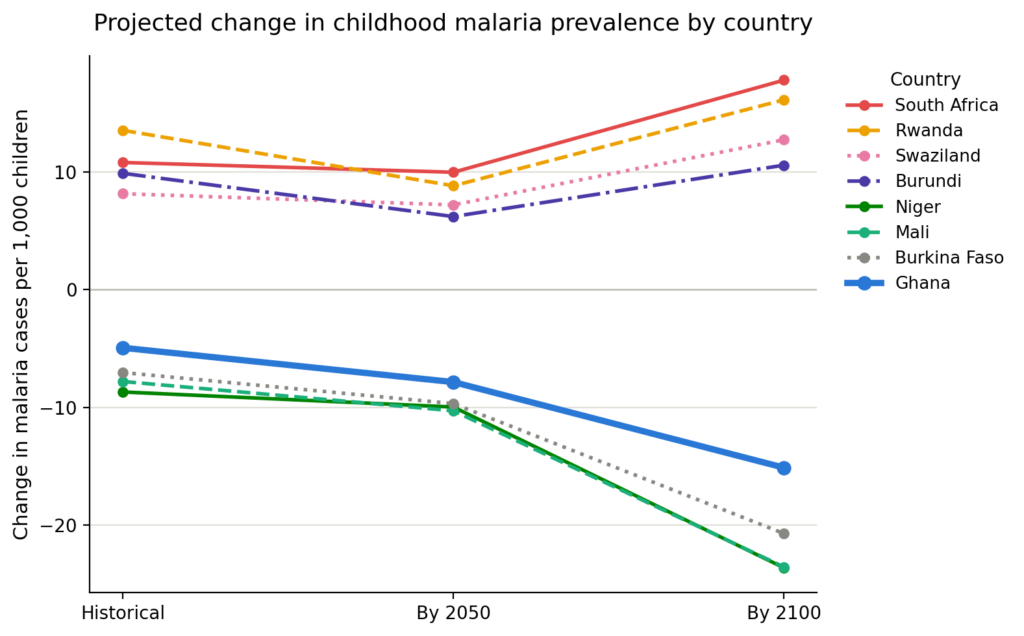
Chart: Projected change in childhood malaria prevalence (cases per 1,000 children), historical vs. 2050 vs. 2100, for the countries facing the sharpest rises and the sharpest falls. Ghana is highlighted in bold blue.
Countries Projected to See the Biggest Improvements
Niger is projected to see the largest drop of any country, with prevalence falling by 23.62 cases per 1,000 children by 2100, closely followed by Mali (−23.55) and Mauritania (−23.5), then Burkina Faso (−20.71). These are mostly hot West African and Sahelian nations where temperatures are already pushing past what mosquitoes can tolerate, consistent with the study's finding that malaria could be nearly eliminated in some of today's most extreme hotspots by the century's end.
What This Means for Ghana
Ghana's numbers put it firmly among the countries expected to benefit from rising heat. Climate change has already reduced malaria prevalence in Ghana by an estimated 4.94 cases per 1,000 children compared to a world without human-caused warming. That reduction is projected to grow to 7.85 cases per 1,000 by 2050, and to 15.12 cases per 1,000 by 2100, a bigger drop than Nigeria's projected decline (−14.14), though smaller than Burkina Faso's (−20.71), Mali's (−23.55), or Niger's (−23.62).
It's worth being clear about what this does and doesn't mean. This is a projection of climate's effect on malaria transmission specifically, not a prediction that malaria will disappear in Ghana on its own. The researchers are explicit that climate change is a modest factor next to the impact of malaria control efforts: bed nets, treatment access, vaccines, and vector control have historically reduced malaria far more than climate change has increased or decreased it.
A Second Report Adds a Warning: Heat Is Still Deadly, Even Where Malaria Falls
A separate Climate Impact Lab report from March 2026, Adaptation Roadmap: Human Health, authored by Emily Grover-Kopec, Tamma Carleton, and Michael Greenstone, adds an important caution to this story. That report found that climate-driven temperature changes could cause about 430,000 additional deaths globally each year by 2050, with heat-related deaths projected to be roughly 10 times higher in poor countries than in wealthy ones.
Ghana appears in that report too: it's projected to see about 19 additional heat-related deaths per 100,000 people by 2050. That means even as Ghana may see some relief from malaria as temperatures rise, the same heat is expected to bring other serious health risks. The Human Health report found some of the sharpest increases in heat deaths concentrated in Niger (+68 deaths per 100,000), Burkina Faso (+60), Djibouti (+55), Chad (+47), and Mauritania (+42), several of which also show up among the countries seeing the biggest malaria improvements in the new Nature study, including Niger and Mauritania.
Why This Matters for Communities Not Used to Malaria
According to the researchers, the places expected to see the biggest malaria increases, southern and East Africa, are not as used to dealing with the disease as West African countries are.
"Governments, health systems and communities must adapt to the evolving malaria threat. That means getting ready now to implement more aggressive anti-malaria programs in cooler regions of sub-Saharan Africa where malaria risk is growing, and which can be less experienced at tackling it." – Christopher Trisos, Director, Climate Risk Lab, and Principal Research Officer, African Climate and Development Initiative, University of Cape Town
Can This Still Be Changed?
Emissions choices matter, according to the study. If the world manages to keep warming below 2°C (the key target under the Paris Agreement), it could prevent about 5 excess cases of malaria per 1,000 children in southern Africa, and even more in the East African highlands, compared to a hotter future. But cutting emissions alone won't be enough; the study stresses that strong healthcare systems, disease surveillance, and continued economic development remain far more powerful tools than climate alone.
"Malaria was one of the first health outcomes linked to climate change, but it's taken a quarter century to be sure which direction things are headed. The big story here is the opportunity for action: so far, elimination efforts have counteracted climate change impacts by nearly 200-fold. Malaria elimination within a generation is not only possible, but one of the best ways to protect frontline populations from climate change impacts." – Colin Carlson, Assistant Professor of Epidemiology, Yale University
END.
Latest Stories
-
We won’t return to the classroom without concrete solutions – NAGRAT
5 minutes -
Mahama urges Africa to invest in local pharmaceutical manufacturing
11 minutes -
Akufo-Addo giving Bawumia space to assert himself as NPP leader – Gabby Otchere-Darko
17 minutes -
NPP delegates, not social media, will decide election winners – Miracles Aboagye
34 minutes -
I have no interest in this election; I believe Bawumia will win 2028 election – NAPO
37 minutes -
Livestream: NPP National Delegates Conference underway in Kumasi
1 hour -
‘We are waiting for the delegates’ – NPP explains delay in voting at Kumasi conference
1 hour -
Drug fight will yield results as Mahama steps up action – Dzimega
1 hour -
‘It’s bizarre’ – Freddie Blay questions EOCO’s handling of Baffour Awuah case
1 hour -
NPP conference to reinforce support for Bawumia ahead of 2028 – Evans Nimako
2 hours -
France and Ghana’s Gender Ministry explore cooperation on women’s economic empowerment
2 hours -
Ghana’s growing drug trafficking links are deeply troubling – Victoria Bright
2 hours -
‘The MP’s tears are crocodile tears’ – Kofi Bentil on La Pleasure Beach demolition
2 hours -
Freddie Blay alleges Mahama ordered demolition of son’s Polo Beach Club at La Beach
2 hours -
‘We’ve complied with all the rules’ – NPP assures transparency in national elections
2 hours