

Audio By Carbonatix
Ghana is facing a climate story with two very different sides, according to a set of studies from the Climate Impact Lab and a major new paper published in the journal Nature. As temperatures rise, Ghana is projected to see falling malaria rates, good news driven by the same heat that is making the country more dangerous in other ways. Heat-related deaths are expected to climb, and Ghana's electricity supply isn't growing fast enough to help people cool down and protect themselves.
Together, these findings paint a fuller picture of what a warmer Ghana will actually look like: safer from one of Africa's deadliest diseases, but exposed to new and serious risks that the country isn't yet equipped to handle.
Ghana's Silver Lining: Falling Malaria Risk
The Nature study, led by Colin J. Carlson (Yale University), Tamma Carleton, Romaric C. Odoulami, Cullen D. Molitor, and Christopher H. Trisos, with major involvement from the Climate Impact Lab at the University of Chicago, analyzed more than 50,000 medical surveys spanning 116 years (1900-2016) to measure how climate change is reshaping malaria across Africa.
Malaria thrives in a narrow temperature range, spreading best around 25°C (77°F) and struggling once temperatures pass roughly 34°C (93°F). As Ghana warms, parts of the country are expected to cross that threshold, making it harder for the mosquitoes that carry the disease to survive and spread it.
The study projects that climate change has already reduced malaria prevalence in Ghana by an estimated 4.94 cases per 1,000 children, compared to a world without human-caused warming. That reduction is projected to grow to 7.85 cases per 1,000 children by 2050, and to 15.12 cases per 1,000 children by 2100.
"Climate change isn't just making malaria worse or better, it's moving it. Whether a place sees elevated malaria risks or reduced burdens under climate change depends on how hot it is today. We see relief in the current hotspots and new risk nearly everywhere else." – Tamma Carleton, Faculty Head of Research, Climate Impact Lab, and Assistant Professor, University of California, Berkeley
Ghana's projected improvement sits in the middle of the pack regionally: bigger than Nigeria's projected decline (-14.14 cases per 1,000 by 2100), but smaller than Burkina Faso's (-20.71) or Mali's (-23.55), both hotter Sahelian countries where the disease is retreating even faster.
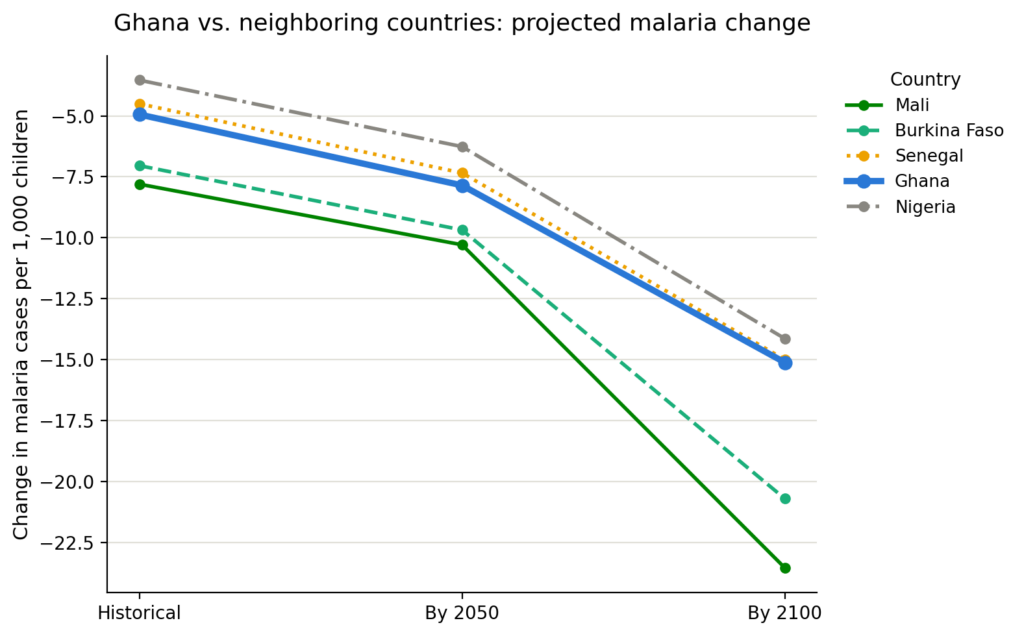
Chart: Projected change in malaria prevalence (cases per 1,000 children) for Ghana and four neighboring countries, historical vs. 2050 vs. 2100. All five countries are expected to see malaria decline as it becomes too hot for the disease to spread as easily. Ghana is highlighted in bold blue.
It's important to be clear about what this does and doesn't mean. This is a projection of climate's specific effect on malaria transmission, not a claim that malaria will disappear in Ghana on its own. Researchers are explicit that bed nets, treatment access, vaccines, and vector control programs have historically reduced malaria far more than climate change alone.
The Other Side of the Coin: Rising Heat Deaths
A separate Climate Impact Lab report from March 2026, Adaptation Roadmap: Human Health, authored by Emily Grover-Kopec, Tamma Carleton, and Michael Greenstone, offers a less encouraging outlook. It found that climate-driven temperature changes could cause about 430,000 additional deaths globally each year by 2050, with heat-related deaths projected to be roughly 10 times higher in poor countries than in wealthy ones.
Ghana is projected to see about 19 additional heat-related deaths for every 100,000 people nationally by 2050. That number climbs sharply in the country's most exposed regions: in the specific areas the Lab identifies as most at risk, heat deaths in Ghana are projected to rise by 30 per 100,000 people.
The same report found much sharper increases in some of Ghana's neighbors. Burkina Faso is projected to see 60 additional deaths per 100,000, Mali 37, Chad 47, and Niger a striking 68, among the highest in the world. By comparison, Nigeria's projected increase is a much smaller 8 deaths per 100,000, and Senegal's is 16.
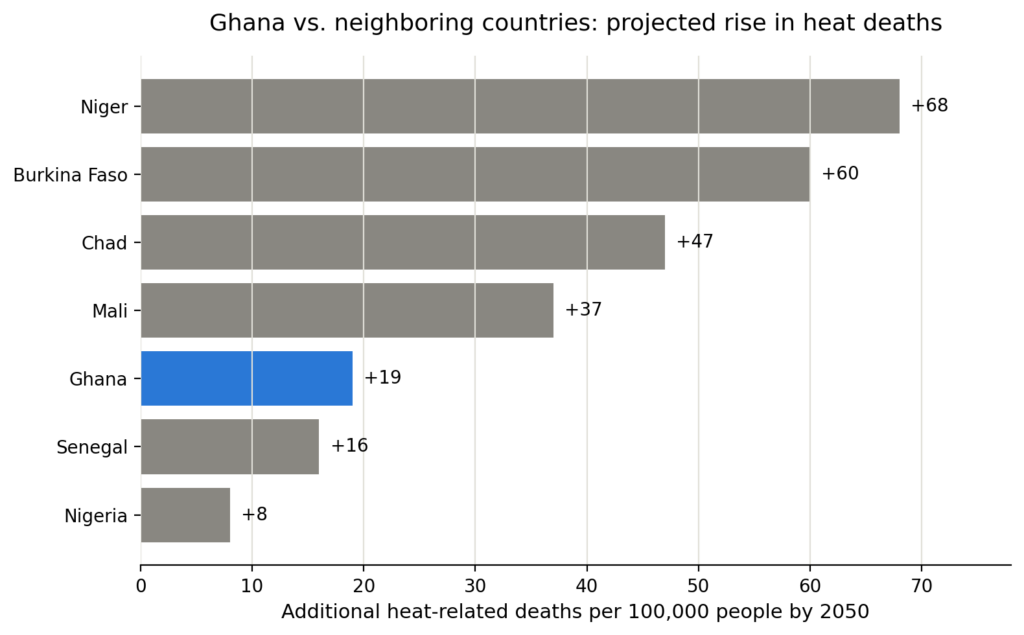
Chart: Projected increase in heat-related deaths (per 100,000 people) by 2050 for Ghana and six neighboring countries. Ghana is highlighted in bold blue.
This means the same rising heat that is projected to ease Ghana's malaria burden is also expected to bring a real and growing risk to human life through heat exposure itself, a reminder that a warming climate rarely brings only good news or only bad news to the same place.
Not Enough Power to Cool Down: Ghana's Energy Gap
A third Climate Impact Lab report, Adaptation Roadmap: Energy (July 2026), authored by Emily Grover-Kopec, Ashwin Rode, Genevieve Maricle, Michael Greenstone, and Tamma Carleton, explains why rising heat is so dangerous in places like Ghana: many communities don't have enough electricity growth to power the fans and air conditioners that could protect them.
The report identifies 18 countries caught in what it calls the Mortality-Cooling Trap, places where heat deaths are rising sharply, but electricity supply isn't growing fast enough to help. Ghana is one of them. About 31% of Ghana's population lives in these high-risk, low-electricity-growth areas, where mortality is projected to rise by 30 deaths per 100,000 people alongside only a modest 0.07 gigajoules per capita increase in electricity, nowhere near enough to meaningfully expand access to cooling technology.
Ghana's situation is serious, but not the most extreme in the region. Burkina Faso and Mali each have 99% of their populations living in Mortality-Cooling Trap conditions, compared to Ghana's 31%. Senegal sits in between, at 43%. Nigeria, notably, does not appear on the trapped-countries list at all, and is instead projected to see a healthier 23% increase in national electricity consumption, giving it a better chance of using cooling technology to protect its people.
"Air conditioning is a life saver, and climate change will no doubt lead to more AC adoption in today's wealthy countries. Our research finds, however, that in too many countries around the world people will not be able to respond in the same way. The result is one of climate's great cruelties, lots of death in the very countries that have contributed the least to climate change." – Michael Greenstone, Milton Friedman Distinguished Service Professor in Economics, University of Chicago
How Ghana Compares to Its Neighbors
Putting all three studies side by side shows how Ghana's risks and relative advantages stack up against nearby countries.
| Country | Malaria change by 2100 | Extra heat deaths /100k (2050) | Electricity growth in MCT regions |
| Ghana | -15.12 (fewer cases) | +19 (nationally); +30 in MCT regions | +0.07 GJ/capita; 31% of population in MCT regions |
| Nigeria | -14.14 | +8 | Not in MCT list; +23% national growth |
| Burkina Faso | -20.71 | +60 | +0.06 GJ/capita; 99% of population in MCT regions |
| Mali | -23.55 | +37 | +0.07 GJ/capita; 99% of population in MCT regions |
| Senegal | -15 | +16 | +0.06 GJ/capita; 43% of population in MCT regions |
MCT = Mortality-Cooling Trap, the Climate Impact Lab's term for regions facing large increases in heat deaths alongside very small increases in electricity supply. A negative malaria number means fewer cases per 1,000 children.
What Researchers Say Needs to Happen Next
Across all three reports, the message from researchers is consistent: mitigating climate change matters, but so does adapting to the heat that is already locked in.
"Governments, health systems and communities must adapt to the evolving malaria threat. That means getting ready now to implement more aggressive anti-malaria programs in cooler regions of sub-Saharan Africa where malaria risk is growing, and which can be less experienced at tackling it." – Christopher Trisos, Director, Climate Risk Lab, and Principal Research Officer, African Climate and Development Initiative, University of Cape Town
On the energy side, researchers point to a mix of solutions beyond simply hoping for more electricity: reforms to electricity markets that make power more affordable and reliable, plus interventions that don't depend on electricity at all, such as heat early-warning systems, heat action plans, and expanded healthcare access.
"We've identified the places most at risk of seeing more people die from the heat and least able to power up ACs to save them, so people and governments can zero in on saving the greatest number of lives. Communities will need to find ways to protect people from heat like improved energy access, employing heat early warning systems and action plans, expanded healthcare access, and targeted social programs. But as of now, many adaptation approaches remain untested. We're working to change that." – Ashwin Rode, Fellow, Climate Impact Lab, and Director of Scientific Research, Energy Policy Institute, University of Chicago
END.
Latest Stories
-
Drug fight will yield results as Mahama steps up action – Dzimega
22 seconds -
‘It’s bizarre’ – Freddie Blay questions EOCO’s handling of Baffour Awuah case
2 minutes -
NPP conference to reinforce support for Bawumia ahead of 2028 – Evans Nimako
11 minutes -
France and Ghana’s Gender Ministry explore cooperation on women’s economic empowerment
19 minutes -
Ghana’s growing drug trafficking links are deeply troubling – Victoria Bright
22 minutes -
‘The MP’s tears are crocodile tears’ – Kofi Bentil on La Pleasure Beach demolition
24 minutes -
Freddie Blay alleges Mahama ordered demolition of son’s Polo Beach Club at La Beach
35 minutes -
‘We’ve complied with all the rules’ – NPP assures transparency in national elections
46 minutes -
‘Who is financing all this?’ – Victoria Bright questions networks behind Ghana-linked drug trade
52 minutes -
If we don’t know Baffour Awuah’s charge, there’s a fishing expedition going on – Kofi Bentil
59 minutes -
Parliament questions continued detention of Baffour Awuah by EOCO, demands due process
2 hours -
Baffour Awuah did not report to EOCO voluntarily; an arrest warrant forced him – Theophilius Dzimega
2 hours -
Baffour Awuah case risks looking like a display of state power – Sulemana Braimah
2 hours -
Campaign posters, billboards take over Kumasi as NPP goes to polls
2 hours -
‘I’ve been told I’m also involved’ – John Darko says he’ll cooperate with EOCO if invited over Baffour Awuah case
2 hours