

Audio By Carbonatix
The World Health Organisation (WHO) has warned that Africa could lose decades of progress in tackling HIV, tuberculosis, malaria and other diseases unless governments increase domestic investment to make up for declining international funding.
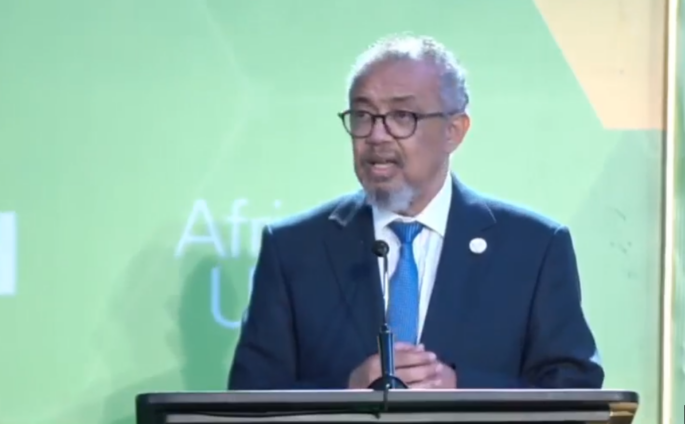
Speaking at the African Union's first Extraordinary Summit dedicated to health in Accra, WHO Director-General Dr Tedros Adhanom Ghebreyesus urged African leaders to make health sovereignty a political priority by strengthening health systems and investing more in healthcare.
Reflecting on Africa's progress, the WHO chief acknowledged the significant gains made in the fight against HIV but cautioned that those achievements remain under threat.
"Africa has made extraordinary progress against HIV, with new infections down 40% since 2010. But Africa still carries the heaviest burden, and as external funding declines, we risk losing ground," he said.
Dr Tedros noted that the challenge extends beyond HIV to include maternal health, tuberculosis, malaria, neglected tropical diseases and the growing burden of non-communicable diseases.
"These are not separate crises. They are one crisis, health systems not yet strong enough to protect every person on this continent, in our Africa," he stated.
He also drew attention to the impact of conflict on healthcare delivery, citing the ongoing Ebola outbreak in Bunia, in the Democratic Republic of Congo's Ituri Province.
"As you may know, in Bunia, Ituri Province, an Ebola outbreak is spreading amid active armed conflict, slowing contact tracing and keeping health workers from communities," he said.
According to Dr Tedros, responding to diseases alone will not be enough unless African countries also address the underlying factors that drive poor health outcomes.
"We must also tackle what drives it. Conflict, poverty, poor education, unsafe water, and gender inequality. That's why strengthening health systems must be at the centre of everything you decide in Accra."
He reaffirmed the WHO's commitment to supporting African countries with technical expertise but stressed that lasting progress depends on political leadership and increased domestic financing.
"WHO stands with you as a partner providing technical guidance and support, but only Africa's leaders can deliver the political will and domestic investment this moment requires."
As African leaders work towards a new health roadmap, Dr Tedros urged them to focus on key priorities.
"Let domestic resources lead, invest in primary healthcare and local manufacturing, use the science available today, protect the most vulnerable, and hold each other accountable, because the declaration is only as strong as the follow-through behind it."
President John Mahama also called on African leaders to accelerate efforts towards health independence, saying the continent must reduce its reliance on imported medicines and medical products.
"The sovereign health agenda that is guiding our steps as we march out of dependence will ring hollow if we cannot reach every corner of our continent," he said.
The President warned that conflict continues to undermine public health efforts across the continent.
"We cannot have the fog of war in the beautiful Congo Basin cloud the spread of Ebola on the delightful banks of the Nile."
He highlighted Africa's heavy dependence on imported health products, noting that the COVID-19 pandemic exposed the dangers of relying on external suppliers.
"By now we've all heard that Africa imports around 70% of its medicines, more than 90% of its medical devices and over 99% of its vaccines."
"We all remember standing in the queue in 2021, cash in hand, watching others served first as the panic of COVID-19 threatened to overwhelm the world. We learnt a bitter lesson, and thank God we have learnt from it."
He said Africa is beginning to reverse that trend through growing investments in local pharmaceutical and vaccine production.
"Today gives me great pride to see vaccines flowing from Dakar, to see messenger RNA science being advanced from Cape Town, to see the head of Ghana's brand new vaccine institute go toe-to-toe with biotech strategists around the world, and to hear the new facility for cutting-edge biologicals humming on the streets of Kigali."
President Mahama announced that plans to establish a pharmaceutical manufacturing industry for Africa are making significant progress.
"The pharmaceutical manufacturing plant for Africa is no longer a mere scribble on paper," he said, adding that the African Medicines Agency is moving "from treaty to working instrument."
He explained that continental initiatives, including joint procurement and a strategy for active pharmaceutical ingredients, would help strengthen Africa's pharmaceutical manufacturing industry while creating jobs for young people.
"Health value chains mean factories, laboratories, and dignified work for our young people," he said.
The President also reminded African leaders of the commitment made in Abuja 25 years ago to allocate 15 per cent of national budgets to health.
"That promise is now old enough to have children of its own. So the pledges we make this afternoon must be physical, not lyrical."
He urged governments to involve finance ministries in health planning and ensure that health spending remains protected regardless of changes in political leadership.
"Let each of us bring the Ministry of Finance to the health table and keep it seated right at that table."
"Prevention repays us ninefold. Show me a better bond in the economic market than prevention," he added.
Latest Stories
-
GAEC must retain nuclear scientists for Ghana’s nuclear ambitions – Minister
25 minutes -
Man reportedly mistaken for game and shot by hunter dead in forest
27 minutes -
19-year-old mason jailed 15 years for defiling seven-year-old pupil
32 minutes -
Ghana’s banking sector assets rise 20.47% to GH¢500.2bn – BoG Governor
36 minutes -
22 injured as Sprinter bus overturns at Sege after tyre burst
38 minutes -
UN housing expert urges Ghana to strengthen Rent Control Department amid housing affordability concerns
46 minutes -
Delta-BCI partnership reaches 166,000 people with breast cancer education
55 minutes -
Power restoration fault suspected in Kumasi Central Market fire
6 hours -
The 7-foot giant of Ngleshie Amanfro: Seven-foot Ghanaian Ephraim Saawa dreams of joining the national basketball team
7 hours -
Government promises support for Kumasi Central Market fire victims
7 hours -
Vibes The Movie: Big Ghun’s Ghanaian film earns five nominations at 2026 REFFA
7 hours -
‘I’m a fulfilled man’—Justice Korbieh on missing out on Supreme Court despite two nominations
8 hours -
MamaCare CEO warns unresolved conflicts among health workers could undermine maternal and neonatal care
8 hours -
Health professionals urged to translate medical knowledge into practice to save mothers
8 hours -
Retired judge Justice Francis Korbieh charges 1,568 new lawyers to uphold integrity
9 hours