


Audio By Carbonatix
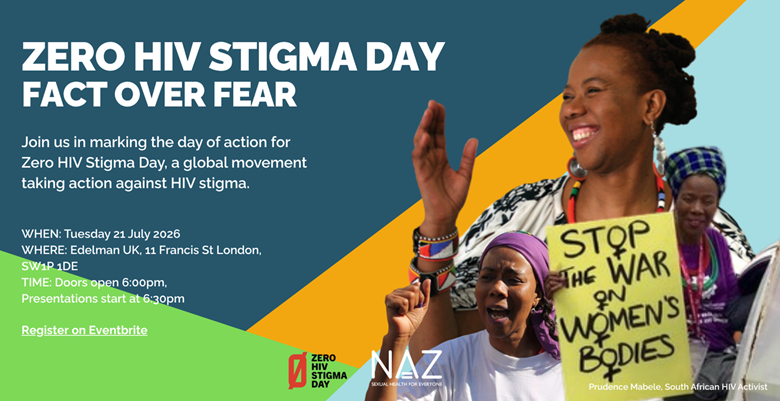
Today is Zero HIV Stigma Day.
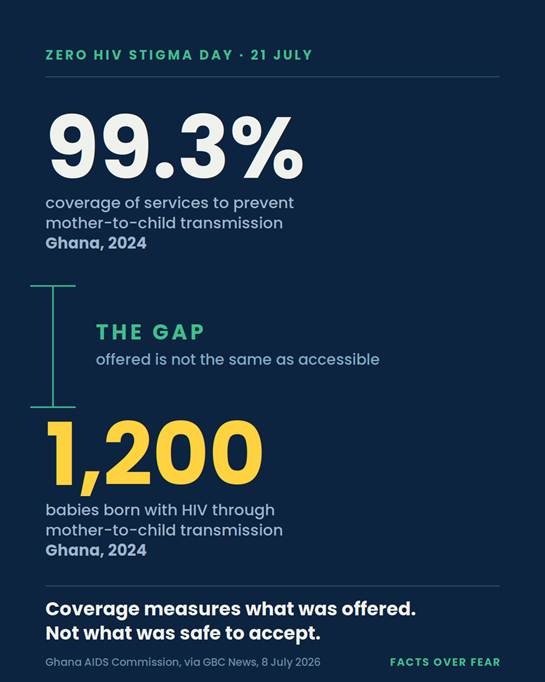
On 8 July, Dr Fred Nana Poku, Director of Technical Services at the Ghana AIDS Commission, told the country that 1,200 babies were born with HIV in 2024 through mother-to-child transmission.
Some have referred to the cause of this as ignorance of status.
I want to sit with that word. Ignorance.
It is the wrong word. Not just because it is unfair, though it is, but because it is inaccurate, and inaccuracy here costs lives.
A woman does not "ignore" her HIV status. She does not know it. And whether she comes to know it is not a matter of her curiosity or her character. It is a matter of whether a test was offered early enough, whether she could afford the transport to reach the clinic, whether she trusted that her result would stay private, whether she believed the person handing it to her would treat her with dignity, and whether she could face what her partner, her mother-in-law, or her church might do if they found out.
Not knowing is not a personal failing. It is the measurable output of a system that has not yet made knowing safe.
The number that does not fit
Here is what makes the 1,200 figure so important, and so uncomfortable.
Ghana's most recent national estimates report prevention of mother-to-child transmission (PMTCT) coverage at 99.3% in 2024, presented, reasonably, as a success story. In the same year, Ghana recorded 15,290 new HIV infections and 12,614 AIDS-related deaths, with 334,721 people living with HIV, of whom 68.5% were women.
So, near-universal coverage and 1,200 infants infected. Both figures come from the national response. Both are on the record for 2024.
That gap is not a contradiction to be explained away. It is the most useful piece of information Ghana has right now, because it tells us precisely where to look. Coverage measures whether a service was offered. It cannot measure whether a woman felt able to accept it, return for the result, disclose, start treatment, and stay in care through pregnancy and breastfeeding.
The 1,200 live in the space between those two things.
Where the pathway breaks
The drivers named alongside the figure are real: late or absent antenatal care attendance, lack of testing, and delayed or defaulted antiretroviral therapy. But each one is a symptom with a cause behind it.
Walk the continuum honestly:
- Was HIV testing offered early enough? Late ante-natal clinic booking is not indifference. It is transport costs, work that cannot be missed, distance, and the fear of what a clinic visit signals to a community.
- Did she receive her result? Collecting a result requires a second journey and the nerve to hear it. Both are made harder when confidentiality is not visibly protected.
- Was she linked to care? Linkage depends on a warm handover, not a referral slip.
- Did treatment begin promptly? Starting antiretroviral therapy (ART) can be a disclosure event in a household. Many women weigh that risk realistically.
- Was she retained through pregnancy and breastfeeding? Retention over eighteen months requires that every single visit be worth the cost of attending.
A gap at any one of these stages can produce an infant infection. Stigma is present at every one of them.
Stigma is structural, not sentimental
We tend to treat stigma as an attitude problem, something to be countered with a slogan and a red ribbon. It is not. It is built into how services are arranged and how people are treated: whether testing happens in a room with a door that closes, whether staff are trained in non-judgemental communication and held to it, whether a woman's file can be read by someone she knows, whether the clinic sign announces her diagnosis to everyone in the waiting area.
Alongside it sit the barriers we already know: transport costs, delayed antenatal attendance, health system constraints, service accessibility, and plain socioeconomic reality.
Interventions only work when people can actually access them, and access is not only physical. It is psychological and social.
What Zero HIV Stigma Day should mean this year
21 July should be the visible peak of a year-round effort, not the whole of it. Ghana has the data, the infrastructure, and, as the 99.3% figure shows, the delivery capability. What is needed now is a sustained commitment to the human conditions that let that capability translate into outcomes.
1. Change the language, publicly. Retire "ignorance" from how we collectively talk about HIV in Ghana: in media, in advocacy, in clinical settings. Replace it with the accurate framing: undiagnosed, not yet reached, not yet safe to test. Language sets the terms of the response. If the problem is described as women's failure, the solution will be designed as women's education. If it is described as a system gap, the solution will be designed as system change.
2. Run a Facts Over Fear narrative with reach. In the languages people actually speak. In schools, markets, workplaces, and faith communities. Centred on U=U, undetectable equals untransmittable, which remains one of the most powerful stigma-reduction facts we have and one of the least known.
3. Put lived experience and youth champions in front. Trust travels through people, not posters. Women living with HIV who have had HIV-negative babies are the single most persuasive voice available on this issue, and they are not being platformed enough.
4. Make stigma-free service design a measurable standard. Private testing spaces. Confidentiality that holds. Same-day results where possible. Staff trained and assessed on dignity as a clinical competency, not a courtesy.
5. Measure what matters. Alongside coverage, track linkage, retention through breastfeeding, and infant testing completion. Publish an annual audit of infant infections that asks, without blame, where each pathway broke.
6. Address the cost of attending. Transport support for antenatal and ART visits can be transformative.
The point
The 1,200 figure is more than a number. It is a signal of where systems are working, where people are being lost, and how the pathway to prevention and care can be strengthened.
In HIV programming, outcomes are not determined by what we know. They are determined by what we successfully implement.
Ghana knows how to prevent vertical transmission. It demonstrably does it at scale. The remaining work is not clinical. It is about making the system a place where a woman can find out her status without fear of what finding out will cost her.
That is implementable. It requires sustained investment, honest measurement, and the willingness to treat dignity as clinical infrastructure rather than clinical decoration.
By: Dr. Vanessa Apea, CEO of The Accra London Health Centre
Latest Stories
-
Russian glide bomb attack on Zaporizhzhia kills at least 15 people
9 minutes -
Jinapor warns underperforming energy sector CEOs of consequences, says no protection for failure
11 minutes -
Fire destroys head of tipper truck on Lower Volta Bridge
15 minutes -
Palmer signs new Chelsea contract until 2034
16 minutes -
World Cup visa scandal: Mahama will act on corruption allegations – Abass Nurudeen
18 minutes -
Abass Nurudeen accuses Minority of ‘scandal scavenging’ over World Cup visa controversy
20 minutes -
US Embassy recognised NSA, GFA and GTA as separate entities for visa applications – Sports Minister’s aide
26 minutes -
Only 30% of Ghanaian teachers satisfied with their jobs – CAPCOE data reveals
37 minutes -
Communities affected by construction of Akosombo Dam urge government to speed up compensation process
59 minutes -
World Cup visa scandal: Sports Ministry not shielding anyone – Sports Minister’s special aide
1 hour -
World Cup visa scandal: Over 30 people misrepresented as GTA board members to US Embassy – Vincent Assafuah alleges
1 hour -
Fire destroys wooden structure near Yesu Mo Villa at Bush Road
1 hour -
NDC threatens sanctions over oversized campaign posters, gives aspirants 5 days to comply
2 hours -
Star Oil paid GH¢2.7bn in taxes, levies in nine months of 2026
2 hours -
Samson’s Take: The rule of law is cheaper before the bulldozer
3 hours