

Audio By Carbonatix
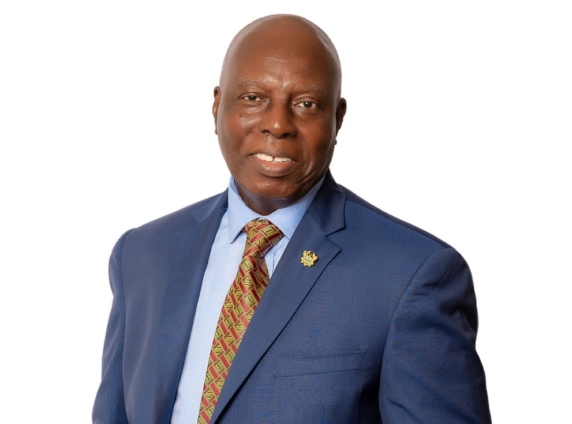
A former Ambassador of Ghana to the United States, Dr. Barfour Adjei-Barwuah, has advised public universities to adopt new and effective strategies for managing the schools without overburdening students.
His call comes amidst government’s decision to wean them from its subvention.
According to him, with creative initiatives, universities can raise funds to operate without necessarily asking students to pay so much for fees.
Speaking in an interview with JoyNews at the sidelines of the launch of the Worcester Polytechnic Institute’s Applied STEM Project in Accra, he said “If the government wants to wean off the universities, then the universities in that case will strive like universities elsewhere, to get support from other sources.
"The other sources where are they; business and industry. And the universities themselves would be enterprising in the sense that you don’t overcharge anybody.
“And most universities are supported by their alumni; they give endowments and all that. The universities are going to have to take decisions with regards to the subjects that they can handle. Because those subjects, even if they are charging so much, the students know that when I get out of this door, I’m going to be able to pay this or what have you.”
Dr. Barwuah, who is the Distinguished Statesman in Residence at Worcester Polytechnic Institute, USA, said universities and government must find a way of getting banks to come on board to support students with their educational funding once universities are successfully weaned off.
“It also means that you have to have a relationship with the banks for the banks to take a decision that a student loan will attract such a margin, and that you will have such a space that you can pay the student loan.
"In some parts of America, students leave universities with a degree and they owe student loans of about 20,000 dollars which they pay off gradually,” he stated.
He, however, advised government to be strategic with the idea of weaning off the universities.
“We cannot take a decision where we decide that as from tomorrow, the universities should do this and do that because the government is no longer whatever.
"We have to pace it because we don’t want to punish anybody for the fact that we want to make changes; the changes ought to be meaningful; they ought to be practicable and they ought to be feasible over a period of time,” he said.
Latest Stories
-
Ghana eyes stronger trade ties as Australia hosts multicultural trade and investment forum
3 minutes -
Margaret-Marie Krakue
6 minutes -
Ayariga announces plans for live broadcast of MMDAs’ meetings on local radio stations
9 minutes -
Mrs Anna Tackie
11 minutes -
Ghana links Afghan heroin and Brazilian cocaine to global drug markets – Global Organised Crime Index
18 minutes -
NHIA launches nationwide inter-school quiz to deepen students’ knowledge of NHIS
25 minutes -
Political protection could be masking Ghana’s cocaine trade – Global Organised Crime Index
30 minutes -
AFCON 2027Q: ‘We have to dissolve the GFA’ – Effia MP after Black Stars lose to Gambia
32 minutes -
NPP announces voting schedule and ID requirements for October 3 national elections
34 minutes -
Lupus can mimic HIV symptoms and damage kidneys if untreated – KNUST expert
37 minutes -
Focus on Sickle Cell Foundation seeks to introduce sickle cell education through comics in Ghanaian schools
42 minutes -
NPP rewrites the campaign playbok as opposition reality shapes National Executive contest
44 minutes -
Road safety education will fail without enforcement – NRSA boss
45 minutes -
Daily Insight for CEOs: Finishing Q3 strong and entering Q4 with purpose
46 minutes -
National Ambulance Service begins ‘Operation Restore Fleet’ to restore grounded ambulances
47 minutes