

Audio By Carbonatix
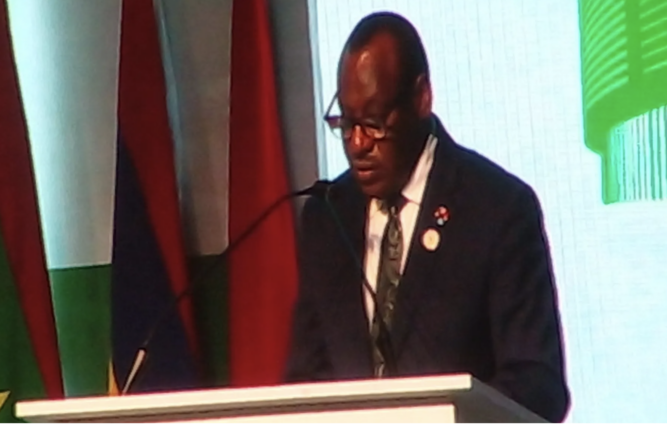
Mr Claver Gatete, the Executive Secretary of the United Nations Economic Commission for Africa (UNECA), has called on African leaders to secure adequate financing to educate African youth in science, technology, and innovation to create skilled manpower personnel for the future.
That, he said, would enable African countries to be resilient and prepare themselves to compete globally.
Therefore, African countries should make deliberate efforts to ensure that three-quarters of the African youth without digital skills are equipped to participate fully in Africa’s future workforce, he said.
To that end, Mr Gatete said Africa needed to create the right incentives for the private sector to invest in education systems.
Mr Gatete made the call during the opening of the 45th Ordinary Session of the Executive Council of the African Union in Accra on Thursday.
The meeting focused on the African Union’s theme for the year 2024, “Educate an African Fit for the 21st Century: Building Resilient Education Systems for Increased Access to Inclusive, Lifelong, Quality and Relevant Learning in Africa”.
It aimed at accelerating Africa’s integration agenda and promoting continental unity.
Mr Gatete said to rescue the UN Sustainable Development Goals (SDGs) and achieve AU’s Agenda 2063, it was imperative to put education, science, technology, and innovation at the forefront of the continent’s efforts.
“Unfortunately, Africa faces significant challenges, primarily due to inadequate financing and high indebtedness.
“Governments struggle to access long-term concessional finance whilst assistance and foreign direct investment are dwindling. Our limited tax-to-GDP ratios further constrain domestic resource mobilization,” he observed.
These financial challenges, he noted, had exacerbated the rising food and energy costs, fueled by increasing and unpredictable extreme weather events, which reduce the fiscal space for countries to operate.
In addition, he said, the global level playing field remained uneven, with Africa’s borrowing costs being over 10 times higher than Germany's and nearly four times higher than the United States of America.
“We must, therefore, persist in advocating for the reform of a global financial architecture that is fit for purpose,” he added.
Despite these obstacles, Mr Gatete noted that Africa had immense potential: significant arable land, coveted natural and critical mineral resources, major energy renewable potential, a youthful population, and a sizeable market.
“We must translate this potential into action, starting with transforming our education systems,” he pointed out.
“Education must be integrated into our industrial policy. We must not shy away from this approach, as other countries do the same to mitigate external shocks.
“It should also go without saying that science, technology and innovation (STI) must be at the core of our development agenda.
“They are the foundation to building strong, competitive, resilient, and prosperous societies.
“Without STI, we cannot avoid the middle-income trap, neither can we claim the 21st Century.
“As such, we must make a deliberate effort to ensure that the three-quarters of Africa’s youth without digital skills are equipped to meaningfully participate in the workforce of the future.
“We may not be able to play catch up to the USD 370 billion spent on research and development in 2023 by Amazon, Alphabet, Apple, Meta, Microsoft, Nvidia and Tesla alone,” he noted.
He called for deliberate investments in Africa’s research and development, which currently stood at 0.45 per cent of GDP, and STEM courses are fundamental to reap the benefits of smart technologies and artificial intelligence.
He said it just required political will and smart allocation of resources and making smart choices.
“This is a sine qua non condition if we do not want to leave more people behind,” he added.
“The current connectivity levels of 40 per cent of primary schools and 50 per cent of lower-secondary schools will not be enough”.
He called for innovative solutions such as the Giga Initiative, when scaled up can make a real difference, in connecting all schools to the Internet.
Latest Stories
-
UPSA uncovers mass results manipulation involving 178 students, over 500 results compromised
16 minutes -
ECG announces planned power outages in parts of Tema from Sept. 29 to October 1
37 minutes -
Sylvester Mensah urges Latenu FM to promote trade, export opportunities in Ga
51 minutes -
Ga language under threat of decline as children shy away from speaking it – Sylvester Mensah
56 minutes -
‘Let every Ga child you raise know the Ga language and story’ – Sylvester Mensah
1 hour -
‘We are not deterred’ – Ablakwa responds to backlash over South Africa evacuation
1 hour -
NCA announces major voice and data disruption across Northern Ghana due to fibre cuts
2 hours -
Photos: Housing solutions take centre stage at Day 2 of the 3rd Republic Bank-JoyNews Habitat Fair
2 hours -
Ghana Air Force passes out 293 recruits after six months of intensive training
3 hours -
EOCO vrs Baffour Awuah: EOCO should have secured warrant before arrest attempt at court – Inusah Fuseini
3 hours -
Triple fibre cuts disrupt telecom services across Northern, Oti regions – Sam George
3 hours -
Politicisation could undermine parliamentary probe into cocaine seizures – Dr Osae-Kwapong
3 hours -
EOCO chases MP: Can Section 41 cure lacuna in EOCO Act? – Inusah Fuseini asks
3 hours -
GNFS, GWL inspect fire hydrants in Ministries enclave; 23 found faulty
3 hours -
Gov’t directs release of 50,000 bags of grain to ECOWAS
3 hours