

Audio By Carbonatix
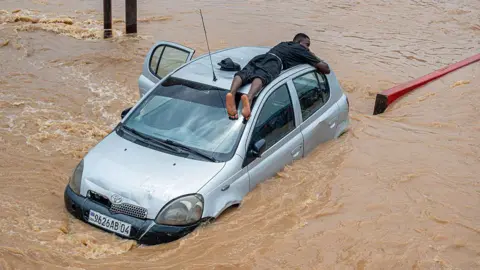
Torrential rains and floods have killed at least 33 people in Kinshasa - the capital of the Democratic Republic of Congo - according to officials.
Desperate residents are trying to flee the floodwaters by wading, swimming or paddling to safety in homemade canoes.
The city is home to 17 million people, and sits on the Congo river, which is one of the biggest in the world and stretches across the country.
Flooding is common - the river recently reached its highest level in six decades.
Parts of the capital are prone to soil erosion and in recent years the Congolese president has warned that the climate crisis is making flooding worse.
Many homes in west Kinshasa were swept away following flooding overnight from Friday into Saturday.
About half of the city's 26 districts are affected in total, according to the capital's mayor, who says search and rescue teams have been sent out.
Worst affected are the city's outskirts as well as some of its poorest neighbourhoods.
"The water has reached 1.5 metres high. We have just managed to save ourselves, the rest is trapped in our homes," Christophe Bola who lives in the Ndanu area told the AFP news agency.
Other local residents have told reporters they are angry with the authorities, accusing them of being too slow to react and not sending enough help.
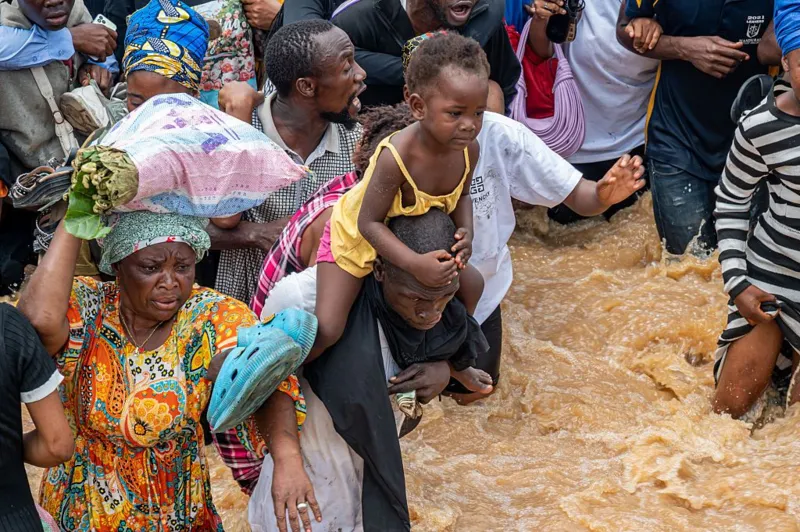
The floods have also left people across much of Kinshasa struggling with water shortages, after water treatment pumps in the city were themselves inundated.
The city's busiest road, which connects the centre with the international airport, is impassable, as is some of the motorway that connects the capital to the country's main port, Matadi.
At least one tributary leading off the Congo river - the N'djili river - has burst its banks, trapping many residents there, said Deputy President Jacquemain Shabani in a statement on Sunday.
It is said to be one of the more polluted rivers which Congolese scientists say contains high levels of fecal matter and other waste.
Sewage maintenance is poor in many areas of Kinshasa, and there is little evidence of town planning.
Last year the government announced plans to tackle this long-standing problem.
Heavy downpours are also expected to affect north and north-eastern DR Congo in coming days.
Latest Stories
-
Ga Adangbe traditional priests petition Mahama over McDan aviation licence revocation
11 minutes -
Anti-LGBTQ Bill: NDC’s arrogance is worrying – Hassan Tampuli
21 minutes -
Let’s give OSP time to mature, not to scrap it – Hassan Tampuli
25 minutes -
Nigeria convicts 386 Islamist militants in mass trials
30 minutes -
Djibouti president wins election with 97.8% of vote, state media says
35 minutes -
We don’t have mandate to deduct tax from rent allowance of security services personnel – Interior Ministry clarifies
49 minutes -
Ablakwa receives Presidential Special Envoy on Reparations to advance global agenda
1 hour -
Christina Koch becomes first woman to travel around the moon on Artemis II
1 hour -
Epstein survivors’ calls to meet King Charles and Queen harder to ignore as US visit approaches
1 hour -
UN Secretary-General names Ghana’s Anita Kiki Gbeho as South Sudan envoy
1 hour -
Mali withdraws recognition of Sahrawi Republic, backs Morocco’s autonomy plan
1 hour -
Gov’t distributes over 8,500 laptops to One Million Coders project
1 hour -
Julius Debrah, ‘man to beat’ as NDC’s James Agbey dismisses Musah Dankwah’s polls
2 hours -
GPRTU in Savannah Region to protest alleged eviction in Damongo
2 hours -
Re: Reinsurance does not replace process — A response to the SIGA–SIC defence
2 hours