

Audio By Carbonatix
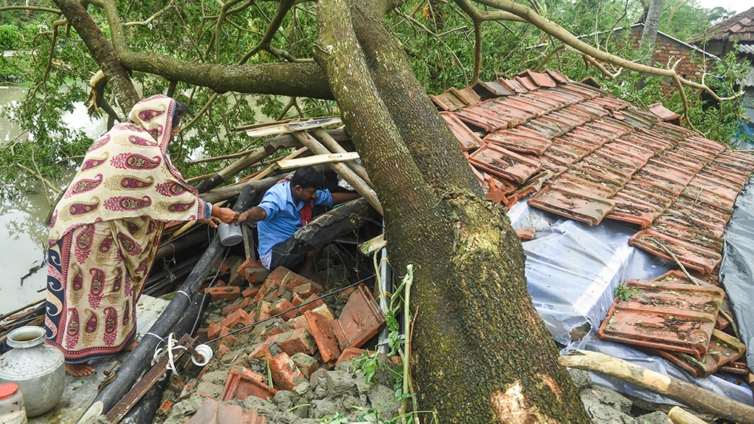
The most powerful cyclone to strike eastern India and Bangladesh in about 20 years has killed at least 84 people, officials said, as rescue teams scoured devastated coastal villages, hampered by torn down power lines and flooding over large tracts of land.
In the Indian state of West Bengal, Chief Minister Mamata Banerjee said on Thursday that at least 72 people had perished - most of them either electrocuted or killed by trees uprooted by winds that gusted up to 185km per hour (115 miles/h). In neighbouring Bangladesh, the official toll was put at 12.
Mass evacuations organised by authorities before Cyclone Amphan made landfall undoubtedly saved countless lives, but the full extent of the casualties and damage to property would only be known once communications were restored, officials said.
Millions across India and Bangladesh were left without power.
Residents in the Indian city of Kolkata, the capital of the hard-hit West Bengal state, awoke to flooded streets with some cars window-deep in water. Television footage showed the airport inundated.
"The impact of Amphan is worse than coronavirus," Banerjee told local media.
'Everything is destroyed'
In neighbouring Bangladesh, officials said 12 people had died, including a five-year-old boy and a 75-year-old man who were hit by falling trees, and a cyclone emergency volunteer who drowned.
The United Nations office in Bangladesh estimates 10 million people were affected, and some 500,000 people may have lost their homes.
"I have never seen such a cyclone in my life. It seemed like the end of the world. All I could do was to pray ... Almighty Allah saved us," Azgar Ali, 49, a resident of Satkhira district on the Bangladesh coast told Reuters news agency.
Al Jazeera's Tanvir Chowdhury, reporting from the capital Dhaka, said the cyclone "was one of the most intense in a decade" to hit Bangladesh, with authorities expecting losses of more than $1bn.
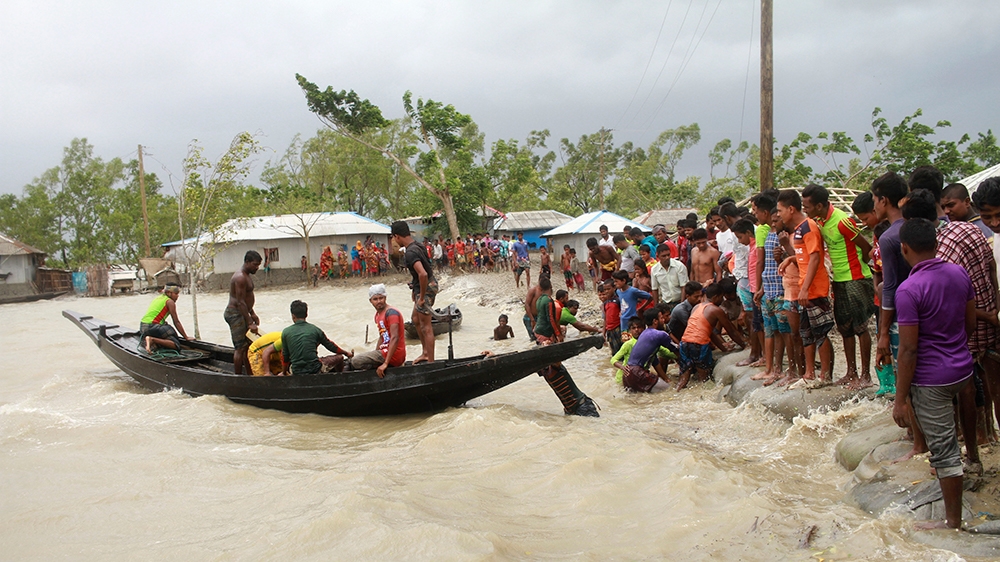
"Five million people are without power. There has been heavy damage, especially in southwestern Bangladesh in the Sundarbans mangrove forest which got the direct hit ... thousands of houses have been washed away due to the tidal surge," Chowdhury said.
"People are definitely going to lose croplands and fisheries. That area is known for shrimp culture and other aquaculture, so these people are going to lose their livelihood."
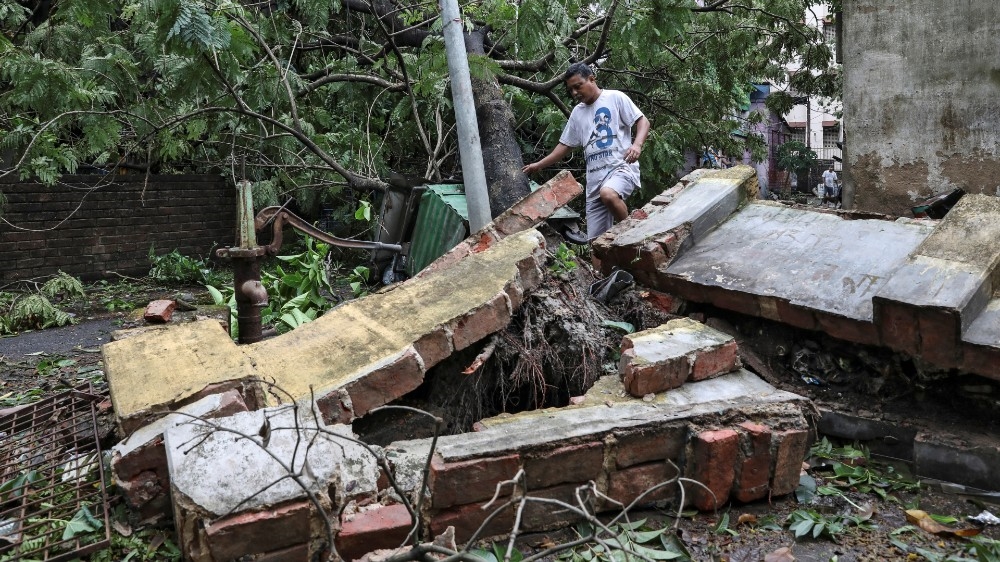
Bangladesh officials said they were waiting for reports from the Sundarbans, a UNESCO World Heritage Site famed for its mangrove forest and population of endangered Bengal tigers.
The ecologically fragile region straddling the Indian-Bangladesh border is best known for thick mangrove forests that are a critical tiger habitat.
Houses "look like they have been run over by a bulldozer", said Babul Mondal, 35, a villager on the edge of the Indian side of the Sundarbans, which is home to approximately four million people.
"Everything is destroyed," he said.
Widespread relief that the evacuation of more than three million people from coastal villages had averted the horrific death tolls of past storms was tempered by fears of the coronavirus pandemic spreading in crowded shelters.
Authorities in both countries sent masks and sanitiser to the shelters, but physical distancing was virtually impossible as families packed into reinforced schools, government buildings and community halls.
Azmat Ulla, head of the International Federation of Red Cross and Red Crescent Societies' Bangladesh office, said a national disaster response team of 200 people on the ground was carrying out relief efforts.
"The coronavirus restrictions have obviously made things much more difficult, especially with regards to evacuation to cyclone shelters," he told Al Jazeera from Dhaka.
Heavy rains and fierce winds
The cyclone weakened as it moved along the Bangladesh coast but still unleashed heavy rains and fierce winds in Cox's Bazar, the district which houses about one million Rohingya refugees from Myanmar.
The cyclone brought a storm surge - a wall of ocean water that is often one of the main killers in large weather systems - that roared inland.
In southwest Bangladesh, a 1.5-metre-high (five-feet) surge broke an embankment and swamped farmland, police told AFP news agency.
Cyclones are an annual hazard along the Bay of Bengal coast. Amphan was the first "super cyclone" to form over the Bay of Bengal since 1999.
In 2007, Cyclone Sidr killed more than 3,500 people in Bangladesh.
Bangladesh's low-lying coast, home to 30 million people, and India's east are regularly battered by cyclones that have killed hundreds of thousands of people in recent decades.
A 1999 super cyclone killed nearly 10,000 people in India's Odisha state, eight years after a typhoon, tornadoes and flooding killed 139,000 in Bangladesh.
In 1970, half a million perished in Bangladesh - a nation of 160 million.
Faster evacuations, better technology
While the frequency and intensity of storms have increased - blamed partly on climate change - casualties have fallen, thanks to faster evacuations, better technology and more shelters.
Enamur Rahman, Bangladesh's junior minister for disaster management, told AFP 2.4 million people and more than half a million livestock were brought to shelters.
India evacuated more than 650,000 people in West Bengal and Odisha states.
Because of the coronavirus, authorities used extra shelter space to reduce crowding, while making face masks compulsory and setting aside isolation rooms.
Infection numbers are still soaring in both countries.
Latest Stories
-
Power restoration fault suspected in Kumasi Central Market fire
5 hours -
The 7-foot giant of Ngleshie Amanfro: Seven-foot Ghanaian Ephraim Saawa dreams of joining the national basketball team
6 hours -
Government promises support for Kumasi Central Market fire victims
6 hours -
Vibes The Movie: Big Ghun’s Ghanaian film earns five nominations at 2026 REFFA
6 hours -
‘I’m a fulfilled man’—Justice Korbieh on missing out on Supreme Court despite two nominations
6 hours -
MamaCare CEO warns unresolved conflicts among health workers could undermine maternal and neonatal care
7 hours -
Health professionals urged to translate medical knowledge into practice to save mothers
7 hours -
Retired judge Justice Francis Korbieh charges 1,568 new lawyers to uphold integrity
8 hours -
Conflicts among care providers linked to maternal, neonatal deaths – Expert
8 hours -
GIS marks 10th TIME conference, champions improved teaching practices
9 hours -
BRICS Or Balance? What Ghana’s bid really means
9 hours -
GPRTU wants full TRAFFITECH-GH implementation to start in 2027
9 hours -
How 10-mile walks for basic education birthed a 50-year legal career for Justice Korbieh
9 hours -
Mahama announces plans to import electric wheelchairs for PWDs
9 hours -
KGL U17 Colts 2026: Western beat Prempeh Elite Academy to set up final final with Greater Accra Region
10 hours