

Audio By Carbonatix
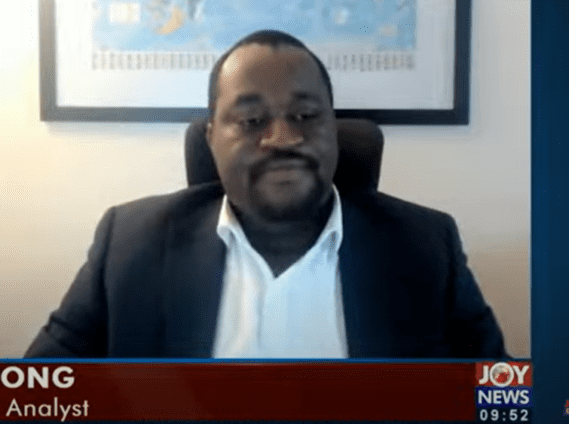
An Economist, Theo Acheampong, has decried the introduction of the electronic transaction levy presented in the 2022 budget.
According to the Political Risk Analyst, the electronic transaction levy, also known as the E-levy, is not the best tax decision by government.
He said this was because of the current state of Ghana’s economy, “especially given the time that we are talking about financial inclusion.”
“The evidence base shows even when we implement these taxes, the so-called informal sector in the country are paying a lot in terms of other indirect prices, talk of petrol, talk of fuel prices, talk of general good and services, VAT, National Health Insurance, Tourism levy.
“If you go and eat right now, let’s say you spent about ¢200 to buy a plate of food on that 200, you would have paid VAT, NHIS, Tourism levy you name it cumulatively you are talking between 17 and 20 % and then on top of that you are saying that if I make a transfer, now to pay for that service that I have procured then you are going to take an extra 1.75 % on top of that is where I challenge the bit of the premise,” he stressed.
His assertion comes after the Finance Minister on Wednesday announced the introduction of the levy in the 2022 budget statement to increase tax revenue for the country.
“The government will charge an applicable rate of 1.75% on all electronic transactions covering mobile money payments, bank transfers, merchant payments, and inward remittances, which shall be borne by the sender except inward remittances, which will be borne by the recipient,” Ken Ofori-Atta announced.
Speaking on Joy News’ Newsfile on Saturday, Mr Acheampong called for an exemption in some service of the E-levy tax.
One of the areas he called for the exemption is transfers from bank services to mobile services and vice versa.
He also listed the payment of essential services like water, electricity, medicines, etc. According to him, means should be devised to cover up E-levy charges.
He again called for the reduction of the applicable rate of the E-levy since the 1.75% is too high.
“We should reduce the rate down. I think 1.75% is too high…the rate, in my view, has to come down, possibly 0.5%. Left for me alone, I wouldn’t implement it, but if government wants to go ahead with it, then perhaps we need to look at which services you exclude, the rate and then the trigger point," he said.
Latest Stories
-
Ghana’s recovery supported by gold strength despite global oil price pressures – Standard Bank Research
5 minutes -
Kwaku Azar writes: A-G vs OSP
38 minutes -
Mfantsipim–Adisadel rivalry built excellence, not division – Sam Jonah
1 hour -
Vice President launches Mfantsipim’s 150 years of shaping Ghana’s greatest mind
1 hour -
I assure Otumfuo, Mahama will join him to commission KNUST Teaching Hospital by end of this year – Haruna Iddrisu
2 hours -
Barcelona dominate derby to extend La Liga lead
2 hours -
Gov’t to roll out free special education for persons with disabilities from July 1 – Education Minister
2 hours -
Importers and Exporters Association declares full support for Publican AI port system
3 hours -
“We used it to test our officiating officials’ readiness” – Bawah Fuseini after CAA Athletics event
3 hours -
Volleyball emerges as Ghana’s fastest rising sport
3 hours -
National Sports Fund needs strong leadership from the top – Administrator David Wuaku
3 hours -
JoySports Exclusive: Steve McLaren in talks with GFA after expressing interest in Black Stars job
3 hours -
Fire guts auto parts warehouse at Bubuashie, one fire officer injured
3 hours -
I owe my victory to coach Ofori Asare – Allotey after winning WBA Africa Gold Super Flyweight belt
4 hours -
Church of Pentecost supports over 2,000 BECE candidates in Obuasi with career guidance seminar
5 hours