

Audio By Carbonatix
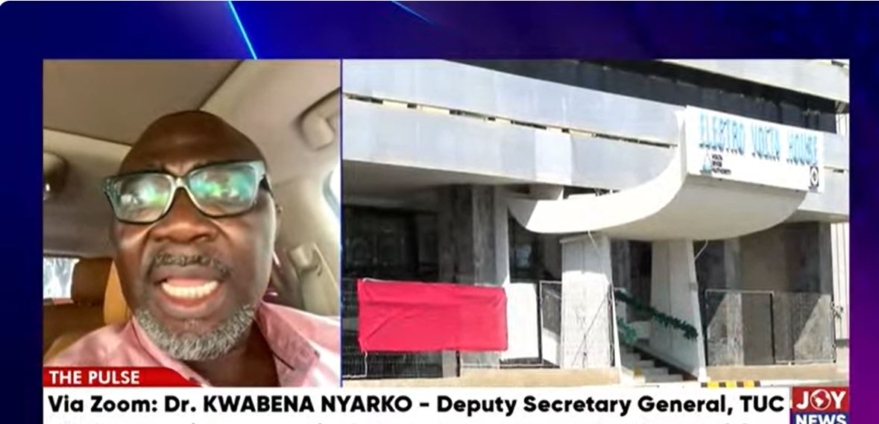
The Deputy Secretary-General of the Trade Union Congress (TUC), Dr Kwabenya Nyarko, has rejected claims that private or foreign capital is necessary to revive the Electricity Company of Ghana (ECG).
He insists that workers, in partnership with government, can turn the company around without privatisation.
This follows a disclosure by the International Monetary Fund (IMF) that the ECG is expected to be taken over by a private sector operator as part of ongoing reforms in the country’s energy sector.
Speaking on JoyNews’ The Pulse on Monday, December 29, he revealed that workers of the Public Utilities Workers’ Union (PUWU) and ECG are prepared to “go the extra mile” to rescue the power distributor, describing ongoing efforts as only the beginning.
According to him, recent collaboration between workers and government has already yielded significant revenue gains within a short period, demonstrating ECG’s potential to recover without private sector participation.
“If in five months, by working together as a team with government, we have been able to raise revenue to such a significant level, then it means we have shown that we can do it,” he stated.
Dr Nyarko assured that labour unions are ready to adopt additional measures, alongside government, to salvage ECG and preserve it as a strategic national asset, stressing that privatisation is neither inevitable nor necessary.
“There are other measures that government and workers must take, and we will do our part to ensure ECG does not require any private sector involvement,” he added.
Dr Nyarko said the argument that foreign investors bring much-needed capital has repeatedly been used to push Ghana into privatisation deals that ultimately fail to deliver on their promises.
He cited the privatisation of Ghana Telecom, which later became Vodafone and now Telecel, as a clear example. According to him, the deal was sold to Ghanaians on assurances of fresh capital injection, technology transfer, and job creation, but instead resulted in the loss of about 4,000 jobs.
“In this country, we have too many examples of private foreign companies coming with promises to invest, but at the end of the day, they come up with nothing,” he said.
Dr Nyarko argued that such promises often serve as bait to force the country into privatisation, while the expected capital injections “never materialise.”
Latest Stories
-
I have supported highway authority financially to fix roads in my constituency – A Plus
58 minutes -
US, Iran fail to reach peace agreement after marathon talks in Pakistan
1 hour -
ECG kicks off Phase Two of transformer upgrades at Lashibi; brief outages expected
2 hours -
Port crises loom as 11,000 drivers threaten four-day strike
3 hours -
A source of excellence across generations – Vice President Opoku-Agyemang lauds Mfantsipim
4 hours -
(Photos) Mfantsipim School launches historic 150th anniversary
4 hours -
Knights and Ladies of Marshall group backs Catholic Bishops’ stance on anti-LGBTQ+
5 hours -
Bright Simons writes: All the Filla in the Ibrahim Mahama/E&P – Gold Fields Saga
5 hours -
Monetise Idiocy In Ghana
5 hours -
The Ghanaian prophet and the mysterious death of his scottish wife Charmain Speirs
6 hours -
Nearly 400 sentenced in Nigeria for links to militant Islamists
7 hours -
Ghana’s recovery supported by gold strength despite global oil price pressures – Standard Bank Research
7 hours -
Methodist Church hails Mfantsipim@150; calls for “fresh consecration” to excellence
7 hours -
‘Excellence is our inheritance’ – Nana Sam Brew-Butler hails Mfantsipim’s 150-year reign in leadership
7 hours -
Kwaku Azar writes: A-G vs OSP
7 hours