

Audio By Carbonatix
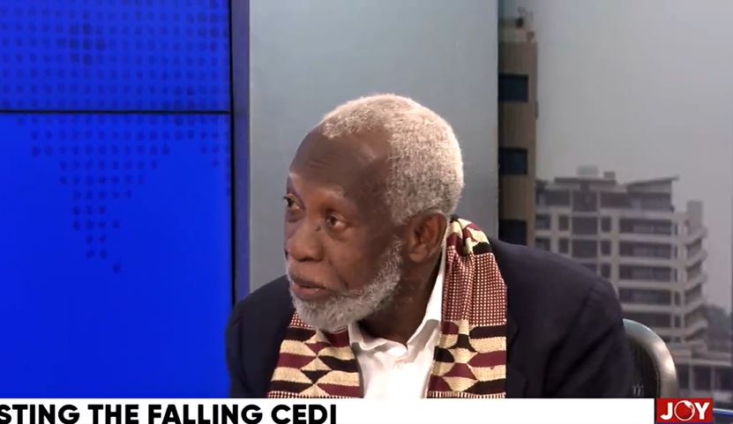
An Economist and former Board Chairman of the Ghana Revenue Authority (GRA), Professor Stephen Adei has refuted claims that Ghana’s economy is on the verge of collapse.
Speaking in an interview on JoyNews’ Upfront, he said the economy is not collapsing but “we are in difficult times.”
According to him, the country’s economy is stronger “than the word broke.”
His comment comes after an economist with the University of Ghana Business School (UGBS), Prof. Godfred Alufar Bokpin, warned of possible collapse of Ghana’s economy.
Speaking on the Super Morning Show, Prof. Bokpin reiterated that as the country’s debt stock hits high distress levels, the current debt situation could get worse by the end of September if proper interventions are not implemented.
Meanwhile, Ghana’s current public debt stock stands at a staggering 341.8 billion Ghana cedis with a corresponding debt to GDP ratio of more than 77% as of September ending 2021.
This means if the country should share this amount across the country’s 30.8 million population, everyone will owe approximately 11,000 Ghana cedis.
In terms of interest payments on our borrowings, Ghana has spent on average 147 billion Ghana cedis, which is 47 billion Ghana cedis more than our projected revenue plus grants for 2022.
In the first quarter of 2022, the government has indicated that it will borrow a total of GHS24.5 billion from the domestic market of which GHS20.7 billion will be used to service existing debt in the local market, leaving the government with just GHS3.8 billion to finance other expenses.
Commenting on the country's debt stock, Prof Adei proposed that the country's expenditure be reduced.
“If you are exceeding your income, then you must accept to live below your income, which is the easy way, otherwise if you are earning GHC3,000 and you are in debt of GHC10,000 you cannot day to day spend GHC3,000. For you to get out of the rag you will have to cut your expenditure to GHC2,000 because you must service your debt. So we are in that situation as a country,” he said.
He explained that although cutting of expenditure might be difficult for the government, especially nearing an election period, that is the right way to go.
“…And they [government] must thank God that this crisis has come now and not 2023, because if they don’t go for the hard one now, which normally will take about 18 months to go over this type of hunch, then they have a good chance by the middle of 2023 to see some good results in 2024. If not, things would get worse and they want to prevent being thrown out of government, they would be thrown out anyway,” he said
Latest Stories
-
Prudential Life settles GH¢100,000 medical bills under its PRUCares Valentine Experience Initiative
3 hours -
Wa West Picnic: Peter Lanchene Toobu champions peace, health and unity in landmark celebration
3 hours -
Dr Mensah Market flooded after downpour in Kumasi
3 hours -
Armed men reportedly storm Adjen Kotoku Onion Market amid tensions
4 hours -
Tecco Mensah writes: Why football fans must look beyond statistics
5 hours -
Police recover stolen Honda CR-V in Kumasi within 48 hours
6 hours -
Apetorku Gbodzi 2026 Festival opens in Dagbamete with development focus
6 hours -
President Mahama arrives in Lyon to co-chair One Health Summit
6 hours -
Beverly View Plus Hotel draws crowds amid coastal Easter rush in Volta
6 hours -
Maiden Zongo Festival held in Wa amid calls to tackle drug abuse among the youth
6 hours -
FDA warns of fake HIV test kits on Ghanaian market
7 hours -
Africa urged to build resilient health systems as donor support tightens
7 hours -
Easter gesture: Ablakwa settles medical bills for 85 North Tongu constituents
9 hours -
Africa must harness its population strength—Titus-Glover
9 hours -
Visa-free access doesn’t mean unlimited stay – Lom Ahlijah
9 hours