

Audio By Carbonatix
Maritime Law Consultant and Legal Practitioner, Dr Emmanuel Kofi Mbiah, has called for continued collaboration among the Economic Community of West Africa States (ECOWAS) regional partners to remain vigilant against piracy in the sub-region.
Dr Mbiah says this requires a collective approach by these countries to reduce the rate of piracy in the region.
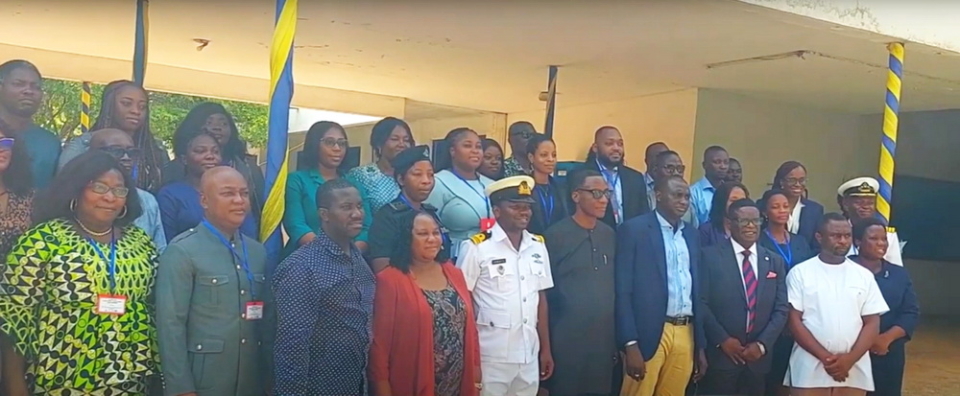
He was speaking at the opening of a six-week operational training course at the Regional Maritime University (RMU) under the European Union-sponsored Support to the ECOWAS Integrated Maritime Strategy (SWAIMS) project.
The training is the fourth and final edition of the programme that commenced in 2016 for sea actors, naval officers, and law enforcement officers across West Africa.
Dr Mbiah said that even though there has been some reduction in piracy attacks, the region is not out of the woods, as the pirates still hover around its waters.
He explained that due to the poor economic conditions in these countries, they consequently act as fertile grounds for engaging and recruiting people who want to get involved in nefarious activities.
Dr Mbiah said the challenges are still there and there is a need to be vigilant, keep an open mind, and ensure that there is collaboration between the various partners.
He expressed optimism that once the knowledge and information sharing go on, ECOWAS can deal with it in large proportions and measures.
Dr Baboucarr Njie, the RMU’s Registrar, representing the Acting Vice Chancellor, Dr Jethro Brooks Jr. reminded participants at the opening ceremony of the severity of maritime insecurities in the region in recent years.
Dr Njie said, “According to the ECOWAS Multi-National Maritime Coronation Centre (EMMCC) Zone F 2020 annual report, 136 crew members were abducted in 27 kidnapping incidents for the year.
“This accounted for about 95 per cent of global kidnappings for ransom.
“Comparatively, the Indian Ocean recorded only 36 incidents, of which none were classified as piracy,” he said.
He said this made the Gulf of Guinea the most dangerous waters for seafarers worldwide, adding that the growing maritime insecurity had affected the legitimate uses of the sea, impaired the exploitation of coastal resources, and continued to undermine regional security as well as the realisation of the blue economy potential of the region.
Engineer Augustus Addy-Lamptey, the SWAIMS Project Coordinator, said the importance of continuous maritime domain awareness and training could not be overemphasised, as recent events demonstrated the persistence of the enemy at hand.
He said the main objectives for the SWAIMS project cover governance and law enforcement frameworks, prosecution and adjudication of maritime crimes, law enforcement and operational capacities and responses, and others.
He disclosed that this year’s training edition would have an interaction session with a survivor of a maritime kidnapping incident.
The project coordinator said maritime incidents were now reducing.
Latest Stories
-
Journalists look back on a decade of breast cancer reporting in Ghana
23 minutes -
President Mahama ends Resetting Ghana tour of Ahafo Region
2 hours -
African negotiators seek delivery of climate commitments at COP31
2 hours -
BoG develops AI rules for financial sector
2 hours -
‘Big Push’: Government assures contractors of prompt payments
2 hours -
Court fines miner for breaking into gold buying shop
3 hours -
Tarkwa court jails labourer for three years over GH¢123,000 theft
3 hours -
GAEC must retain nuclear scientists for Ghana’s nuclear ambitions – Minister
4 hours -
Man reportedly mistaken for game and shot by hunter dead in forest
4 hours -
19-year-old mason jailed 15 years for defiling seven-year-old pupil
4 hours -
Ghana’s banking sector assets rise 20.47% to GH¢500.2bn – BoG Governor
4 hours -
22 injured as Sprinter bus overturns at Sege after tyre burst
4 hours -
UN housing expert urges Ghana to strengthen Rent Control Department amid housing affordability concerns
4 hours -
Delta-BCI partnership reaches 166,000 people with breast cancer education
5 hours -
Power restoration fault suspected in Kumasi Central Market fire
10 hours