


Audio By Carbonatix
At least 235 people have been confirmed dead and over 1,500 people injured after Ecuador was hit by its most powerful earthquake in decades.
Some 10,000 troops and 3,500 police are being deployed in the affected areas, as rescue operations got under way.
The magnitude-7.8 quake struck early on Saturday evening.
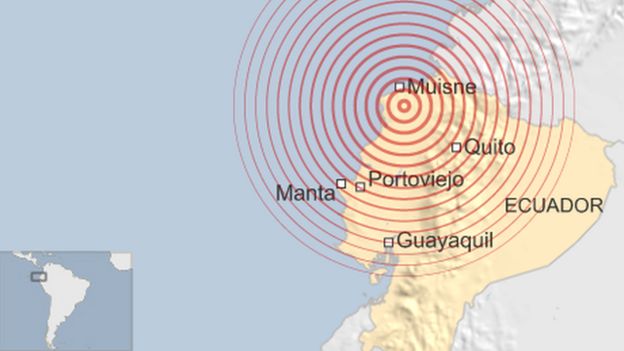
Coastal areas in the north-west were closest to the epicentre and officials say the death toll is likely to rise as information begins to come in.
Ecuador's President Rafael Correa has cut short a visit to Italy to fly back and deal with the crisis.
He has declared a state of emergency and said the priority is finding survivors.
"Everything can be rebuilt, but lives cannot be recovered, and that's what hurts the most," he said.
Ecuador's Vice-President Jorge Glas, visiting one of the worst hit cities, Manta, met a resident who pleaded for people trapped under rubble.
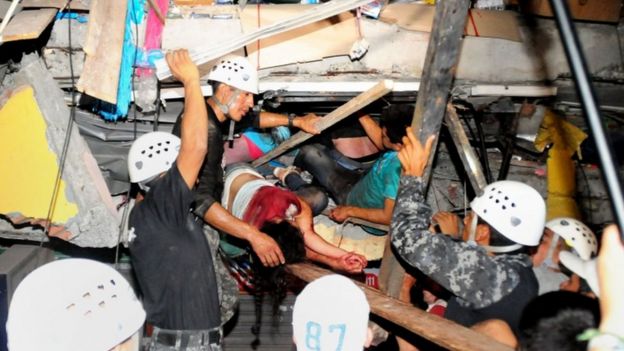
"We have to be quiet so that rescuers can listen [for survivors]," Mr Glas told him. "We cannot go in with heavy machinery because it can be tragic for the wounded."
Helicopters and buses are ferrying troops north but have been hampered by landslides.
In some areas, people are using their bare hands to try to dig out survivors.
Food and other essentials have been handed out and international aid was also beginning, with the first coming from Venezuela and Mexico.
”‹
Carla Peralto, a resident of Boyaca, one of the worst-affected areas, told the BBC: "I never felt something like that in my life. It was so strong. I was feeling very, very scared... I was thinking 'God, please stop that because maybe I die today'."
Serious damage was also reported in the city of Manta, with an airport tower among the buildings destroyed.
Manta resident Ramon Solorzano told Reuters: "Most people are out in the streets with backpacks on, heading for higher ground. The streets are cracked. The power is out and phones are down."
The US Geological Survey said the earthquake struck at a fairly shallow depth of 19.2km (11.9 miles), about 27km from Muisne in a sparsely populated area.
There have been a number of aftershocks, the biggest at 5.4.
The Pacific Tsunami Warning Centre has now issued a message saying that the threat of a tsunami has now mostly passed and that any remaining risk should be evaluated by local authorities.
However, it earlier said tsunami waves reaching 0.3 to one metre above the tide level were possible for some coasts of Ecuador. Any damage that had occurred might not be visible until daylight.
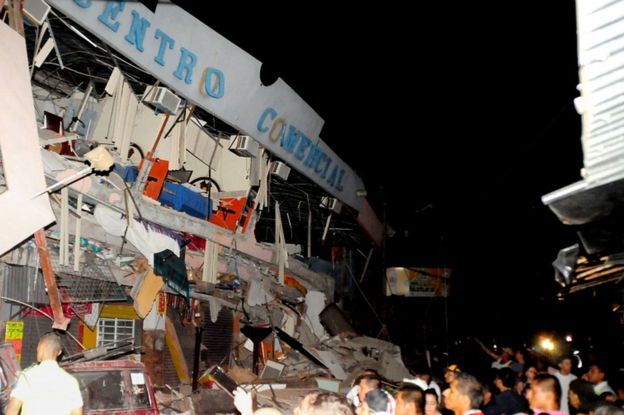
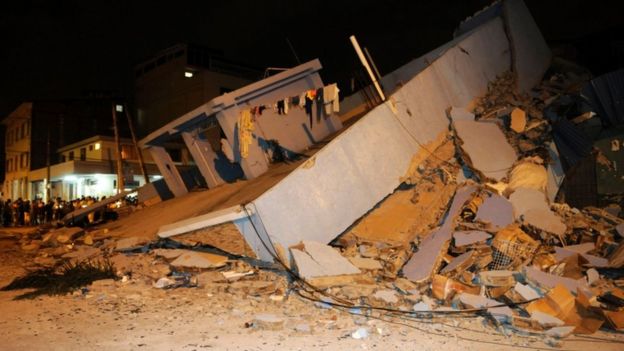
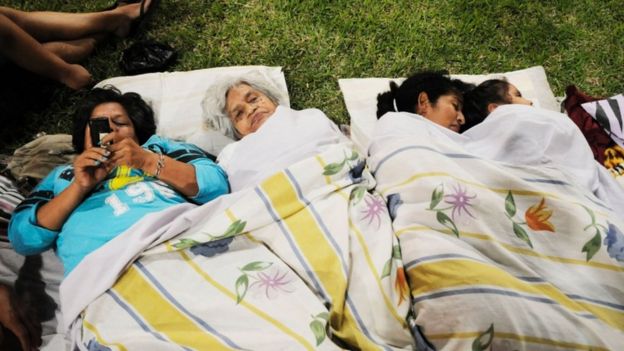
Quito resident Cristian Ibarra Santillan told the BBC he grabbed his dog and hid under a table, but when he realised the quake "wasn't going away and that I might be found here if the worst happened" he ran out into the street.
"We could see the electricity lines shaking - in other parts of the city, they've collapsed."
Reports say a big oil refinery has been temporarily shut as a precautionary measure.
Many regional leaders, including the presidents of Peru, Colombia and Venezuela, have expressed solidarity with Ecuador.
The quake was also felt in Colombia, where patients in a clinic in the city of Cali were evacuated from the building.
Analysis: Jonathan Amos, BBC science correspondent
Ecuador is well used to earthquakes. There have been seven 7.0 magnitude or greater events within 250km of this latest tremor since 1900. And some of these have resulted in very considerable loss of life, not just from the shaking but also from tsunami waves.
The country sits on the so-called "Ring of Fire" - the arc of high seismic activity that extends right around the Pacific basin. At its location, Ecuador fronts the boundary between the Nazca and South American tectonic plates.
These are vast slabs of the Earth's surface that grind past each other at a rate of about 65mm per year. The Nazca plate, which makes up the Pacific Ocean floor in this region, is being pulled down (subducted) and under the South American coast.
It is a process that has helped build the Andes and Ecuador's many volcanoes, including the mighty Chimborazo.
Models that try to forecast the likely casualty numbers from the nature of the quake and local building construction methods indicate this event could be very serious, with the number of deaths running into the hundreds.
Latest Stories
-
GPL 2025/26: Dreams hold Hearts as Phobians record 8th draw
2 minutes -
If you attempt to bribe a police officer now, he will disgrace you; he wants a promotion – IGP Yohuno
6 minutes -
This Saturday on Newsfile: NPP Presidential primaries, Ofori-Atta, Sedina detention and LGBTQ-tainted manual
11 minutes -
BoG to deepen media engagement and reward quality economic reporting – Governor
17 minutes -
Photos: The Multimedia Group thanksgiving service 2026
38 minutes -
BoG declares 2025 ‘Year of Restoration’ as inflation crashes and reserves hit 27-year high
45 minutes -
2026 is the ‘Year of Action’ for Petroleum Hub project – Dr Toni Aubynn
1 hour -
Sedina Tamakloe set for January 21 US court hearing – Victor Smith
2 hours -
‘Ministerial signature is not ceremonial ink’ – CDM questions Education Minister’s role in curriculum saga
2 hours -
Multimedia Group Kumasi staff gathers to celebrate 31 years of broadcasting and community service
2 hours -
Bryan Acheampong is our ‘Kivo gari’, a ready leader for NPP – Pious Hadzie insists
2 hours -
I dismissed the former ‘Ayalolo’ boss for failing to expand fleet – Local Gov’t Minister
2 hours -
“Our PC candidates beat our presidential candidate” – Bryan Acheampong calls for unifying candidate to lead NPP
2 hours -
Gov’t seeks €1m spanish grant to expand ‘Ayalolo’ bus fleet – Local Gov’t Minister
2 hours -
Little Angels Trust donates to children admitted at Cape Coast Metropolitan Hospital
2 hours