


Audio By Carbonatix
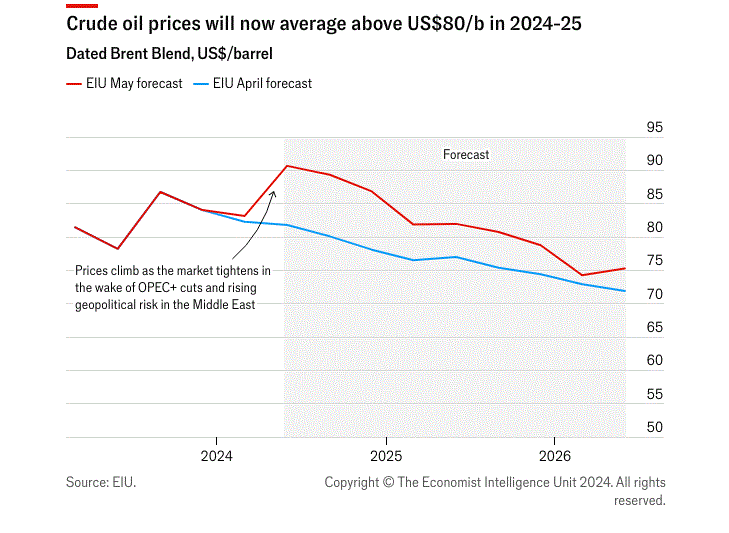
The Economist Intelligence Unit is forecasting that oil prices will remain above $80 per barrel until late 2025.
This, it said, will lift inflationary pressures in many countries at a time when their currencies are losing ground against the dollar.
Based on recent data from the International Energy Agency, the global oil market fell into deficit (with demand outstripping production) in the first quarter of 2024. Due to this evolving supply-demand dynamic and rising geopolitical pressures, we revised up our oil price forecasts, with dated Brent Blend to remain above US$80/barrel until late 2025. This will lift inflationary pressures in many countries at a time when their currencies are losing ground against the dollar.
EIU also projected that oil prices will continue to trade at nearly $90 per barrel for at least the next few months. Besides the market deficit, higher prices will also be supported by rising tensions in the Middle East as the Israel-Hamas war threatens to widen into a broader regional conflict.
“Even if disruption to oil shipments from the region remains minimal and traders shrug off concerns about military escalation, prices are set to remain high as the global market remains in deficit until late in the year [2024]. We expect that OPEC+ will strictly observe reduced output quotas and that Saudi Arabia will continue to adhere to additional, sharp voluntary cuts until at least mid-2024 and only slowly lift production towards the end of 2024 at the earliest”, it pointed out.
The EIU added that “We continue to expect US production to increase moderately in 2024 before stabilising in 2025, but the recent rise in prices is not enough to elicit a stronger supply response. The US oil rig count, at 508, is actually down by 14% from a year ago, according to Baker Hughes, an oilfield services firm, as US oil companies continue to prioritise dividends for shareholders”.
It still forecasted that global oil demand will hit record highs in 2024 and 2025, adding, demand in developed economies will decline, although North America will remain an exception to this trend.
Latest Stories
-
Walter Mosley visits W.E.B. Du Bois Centre in Accra: A New York Secretary’s homecoming story on where Du Bois spent his final years.
24 minutes -
MTN set to deploy 5G services after winning spectrum licenses worth US$202m
3 hours -
NPP national elections: 3,000–4,000 police to handle security, traffic in Kumasi – Karbo
5 hours -
Atta Akyea fumes as Manhyia MP is to spend another night in EOCO custody
5 hours -
SSNIT says La Beach clearance was to protect hotel investments, beaches to remain public
6 hours -
APSU congratulates St Augustine’s College after back-to-back National Investment Quiz wins
6 hours -
Renewed flood intervention at Mallam Junction raises hopes among residents, businesses
7 hours -
St Augustine’s College retain National Investment Quiz title after nail-biting grand finale
7 hours -
Education infrastructure investment will drive Banda’s development – Ahmed Ibrahim
7 hours -
Teacher unions strike: Gov’t presents fresh proposals as talks end inconclusively
8 hours -
51,000 teachers’ promotion arrears to be validated for October payment – Education Minister
8 hours -
Kwabena Boamah appointed Board Chair for Impact Investing Ghana
8 hours -
Striking teacher unions to meet Fair Wages and Salaries Commission on October 6
9 hours -
EOCO working with AG to arraign Nana Baffour Awuah before weekend court
9 hours -
Duraplast reassures customers after fire, announces October 5 reopening
9 hours