

Audio By Carbonatix
A comprehensive draft document on technical regulations and policy framework that tackles all technical issues on the mass deployment of electric vehicles in Ghana is expected to be ready by the end of this year.
The draft is being spearheaded by the Energy Commission in collaboration with relevant sectors such as Public Utilities Regulatory Commission (PURC).
While Energy Commission works on the technical regulations, PURC would come up with the tariffs.
Electricity consumption for charging the car and the rates to be paid is where PURC which is responsible for economic regulation would negotiate effective rate of charging.
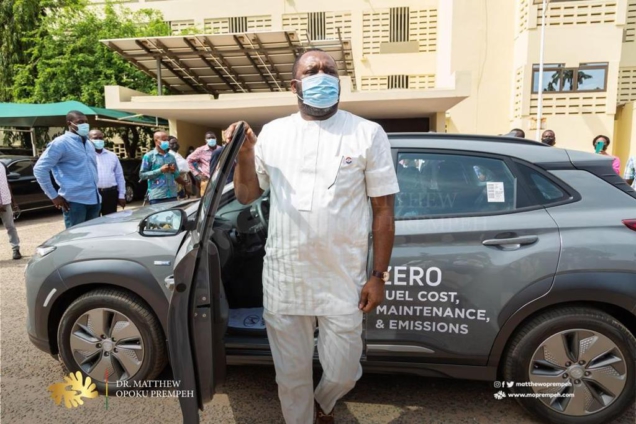
Energy Minister, Dr Matthew Opoku Prempeh said when the draft is ready, it would be subjected to further scrutiny after which it would be submitted for cabinet approval.
He explained that the approved regulation and policies would outline the rollout plan for the country.
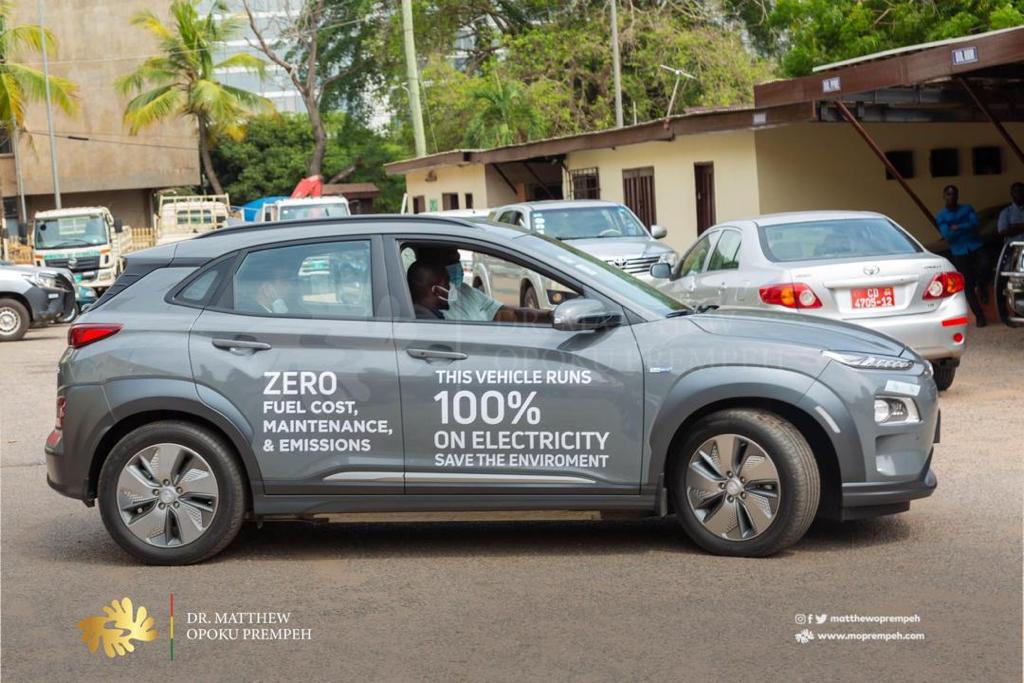
He announced that Ghana would adopt and adapt in the mass deployment to fit into the country’s system.
The Minister stated that the mass adoption would be done through the public transport system with more commercial electric vehicles.
To him, electric vehicles offer enormous benefits including health, economic social and more importantly drastically cutting carbon emissions and clearing the way for significant climate progress.
The Energy Minister noted that mass deployment of electric vehicles is good for Ghana, but the resources needed for it is constrained by the country’s circumstances.
Though some Ghanaians are already using electric vehicles, the Minister is keen on sorting out the policy conundrum, adding the Ghana would use phased in approach.
He noted that the easiest way was to bring in the vehicles.
Dr. Opoku Prempeh explained that it was not just about bringing the cars, adding that, even ancillary systems and accessories around it must be specified.
This he said was to avoid a situation where different companies bring in different vehicles with different types of chargers, and if the charging systems do not communicate with each other would result in huge problems.
Dr Opoku Prempeh said the clean energy agenda would help address the climate crisis and help Ghana achieve its target of an energy mix that includes 10% renewable
He urged richer countries pushing for speedy energy transition from fossil fuels to cleaner energy to provide financial support to poorer countries.
While the integration of small fleets of EVs into distribution grids does not cause any considerable impacts, their broad adoption could be really challenging for the adequacy and the secure operation of the electric system, as well as for the quality of power supply.
The generation and transmission system, could experience several problems related to grid loading, unpredictability of power flows, lack of installed and operational reserve, and changes in marginal generating units and, consequently, in energy prices.
It is easy to foresee major congestion problems in already heavily loaded grids, low voltage problems in predominantly radial networks and increase of peak load and energy losses and, probably, large load imbalances between phases in LV networks.
In this regard, Dr Opoku Prempeh said before Ghana can undertake mass adoption of electric vehicles, the impact on the national grid has to be critically taken into consideration.
As a result, he said a study on the impact on the national grid would have to be conducted to determine the level of investment needed to make the national grid robust to support mass deployment of electric vehicles.
He stated that the Energy Ministry holds the key to mass deployment in the sense that it has to look at the impact of migrating from liquid based fuels to gas based fuels and advice government regarding how much generation should increase.
“When you move out of fossil fuels into clean cars, the most dependable power is one generated using gas,” he stated.
Charging times, charger compatibility, availability of charging infrastructure, charging station financing and ownership, pricing, charging behavior, grid capacity, renewable energy and climate mitigation are all key issues to be address.
Latest Stories
-
The Ghanaian prophet and the mysterious death of his scottish wife Charmain Speirs
37 minutes -
Nearly 400 sentenced in Nigeria for links to militant Islamists
58 minutes -
Ghana’s recovery supported by gold strength despite global oil price pressures – Standard Bank Research
1 hour -
Kwaku Azar writes: A-G vs OSP
2 hours -
Mfantsipim–Adisadel rivalry built excellence, not division – Sam Jonah
2 hours -
Vice President launches Mfantsipim’s 150 years of shaping Ghana’s greatest mind
2 hours -
I assure Otumfuo, Mahama will join him to commission KNUST Teaching Hospital by end of this year – Haruna Iddrisu
3 hours -
Barcelona dominate derby to extend La Liga lead
3 hours -
Gov’t to roll out free special education for persons with disabilities from July 1 – Education Minister
3 hours -
Importers and Exporters Association declares full support for Publican AI port system
4 hours -
“We used it to test our officiating officials’ readiness” – Bawah Fuseini after CAA Athletics event
4 hours -
Volleyball emerges as Ghana’s fastest rising sport
4 hours -
National Sports Fund needs strong leadership from the top – Administrator David Wuaku
4 hours -
JoySports Exclusive: Steve McLaren in talks with GFA after expressing interest in Black Stars job
4 hours -
Fire guts auto parts warehouse at Bubuashie, one fire officer injured
4 hours