

Audio By Carbonatix
I am still continuing with my exercise of searching for Ghanaian values.
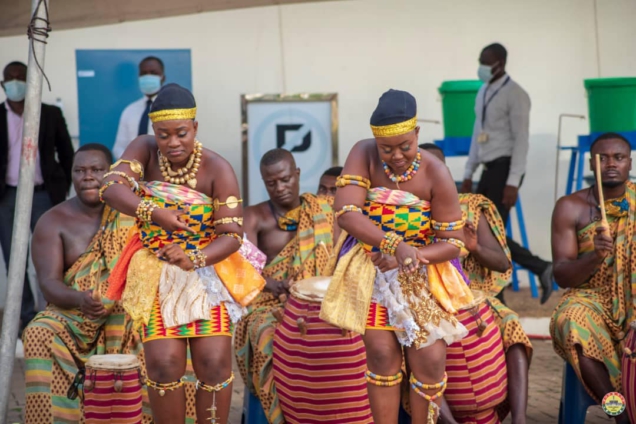
Drumming and dancing are an integral part of our lives. We drum and we dance at the slightest provocation.
We drum and dance when we are happy, to celebrate births, outdoorings, marriages, birthdays, and festivals. We drum and dance when we are sad, and when there is a death, all the rites are accompanied with drumming and dancing.
I confess that sometimes I can’t quite see the point of drumming and dancing but I accept that it is a distinguishing factor in being Ghanaian.
I also accept that according to customary practice, when you are moved by the performance of a dancer or drummer, you are expected to demonstrate your appreciation by giving some money.
You would plaster on the forehead of the dancer or drummer, a cedi note of whatever denomination, there would be a few more intricate dance steps and complicated drumbeats to acknowledge the donation.
It is a ritualised procedure, not quite on the scale of the “spraying” our Nigerian cousins do, but it is Ghanaian and sets us apart.
Now I notice that the dancers don’t wait to be appreciated, they demand that you give them money. The next time you are at a function where there are Adowa or Kete dancers, just take a careful look, especially at funerals.
As the guests walk in and are being announced, the dancer glides toward the new arrival as he tries to make his way to greet them.
The dance moves are saying: do the right thing, give me some money and get on with it.
If you try to ignore the dancer, he becomes insistent and tries to block your way. People are often forced to part with some money and it is interesting that as soon as the cedi note gets into the dancer’s hands, the dancing stops and he positions himself to accost the next arrival.
I was at a recent funeral; the male dancer made no attempt to give the impression he was welcoming you, it was a case of you are going to give me some money or you are not moving forward and I will make sure the entire gathering notice you are a mean, chisel-handed person.
The dancer pulled faces at the back of the few brave people who resisted the obligatory money donation and then laid in wait for the next unsuspecting mourner to arrive.
There was a beautifully dressed, five-year-old, Adowa-dancing girl. She was no less mercenary in outlook than the man. She only danced in front of arriving guests and physically tried to prevent them from moving on unless and until they gave her money.
I am afraid I couldn’t really appreciate her dancing skills, nor what should have been the undoubted charm of a five-year-old bedecked girl because she did not even try to dance unless it was to extract money out of someone and she was dancing only to the give-me-money-beat.
When you see such things at our most sacred customary functions, you wonder about these vaunted Ghanaian values that we tout so much.
What do I tell a non-Ghanaian visitor who comes along with me to such a function? This is Ghana at its traditional best?
Latest Stories
-
Barcelona hit Real Madrid for six in last-eight tie
1 hour -
UN calls on Libyan authorities to release political activist
4 hours -
Houston airport wait times reach over four hours amid US travel chaos
4 hours -
Trump confirms May meeting with Xi Jinping as Iran war forces postponement
4 hours -
Singer Duffy to share sex assault ordeal in documentary
4 hours -
OpenAI closes Sora video-making app and cancels $1bn Disney deal
4 hours -
Oil prices volatile as Trump talks up Iran negotiations
4 hours -
Rocket stocks soar on report Musk’s SpaceX to file for share sale
5 hours -
Ex-Google boss confirmed as new BBC director general
5 hours -
Dogs became man’s best friend far earlier than thought, scientists find
5 hours -
Trader’s murder: Police exhume remains, await autopsy
5 hours -
Alleged Tetegu taxi driver murder: Policewoman’s case adjourned
5 hours -
Heath Goldfields rolls out $135m first-year plan as new mining fleet arrives for Bogoso–Prestea revival
5 hours -
Africa Senior Athletics Championships launched in Accra
6 hours -
Four in 10 paternity tests in Ghana exclude alleged fathers – Report
6 hours