

Audio By Carbonatix
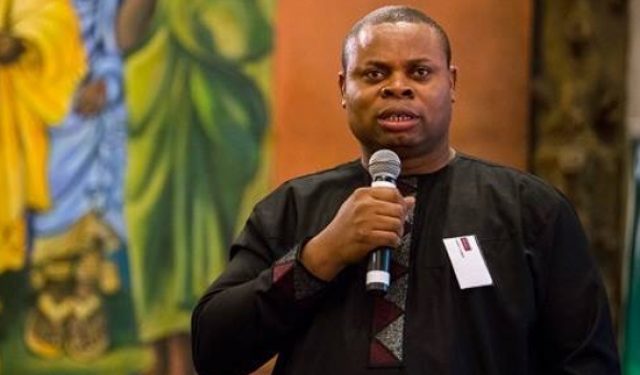
The President of IMANI-Africa, Franklin Cudjoe, has called on the Minister for Energy and Green Transition, John Abdulai Jinapor, to reintroduce private sector participation in the energy industry.
He argued that allowing greater private sector involvement would reduce government interference and political influence and thus engender a more efficient and sustainable sector.
Speaking on Channel One TV, Mr Cudjoe highlighted the controversial Power Distribution Services (PDS) agreement, asserting that its failure was not due to operational inefficiencies but rather corruption-related activities by individuals within the government.
He stressed that political actors had sought personal financial benefits from the deal, which ultimately led to its collapse.
He criticised the frequent changes in management whenever a new government assumes office, stating that such decisions rarely result in meaningful improvements.
“The belief that simply replacing management will enhance performance is flawed. Among all the State-Owned Enterprises (SOEs), I am yet to see one that has significantly improved solely because its management was changed. The core issue is that those in charge are not granted the autonomy to operate independently, which hinders progress,” he remarked.
Mr Cudjoe urged the Energy Minister to examine the performance data of PDS objectively and consider reviving private sector involvement in the industry.
He maintained that PDS had effectively fulfilled its mandate, and any evaluation of its tenure should be based on measurable data rather than political narratives.
“The PDS agreement encountered problems due to corruption-related matters, not operational inefficiency. PDS performed its duties well, and I encourage the Minister to review the data from that period to determine whether a similar approach could once again yield positive outcomes,” he advised.
Furthermore, he suggested that the government explore alternative public-private partnerships rather than relying solely on state-led energy management.
He argued that energy sector policies should prioritise efficiency and long-term sustainability rather than being influenced by political cycles.
“Every time a new government takes over, a fresh project is introduced to serve political or personal interests, which undermines stability in the sector. Our approach to governance is problematic, and without structural changes, political interference will persist,” he cautioned.
Mr Cudjoe reaffirmed his belief that private sector participation remains the most viable solution for achieving a stable and efficient energy sector.
However, he advised against starting afresh and instead recommended a thorough assessment of past initiatives such as PDS.
The government could make informed decisions to improve the industry’s future trajectory by comparing previous performance data with current conditions.
Latest Stories
-
Edmond Boateng takes up secretary role at Honorary Consular Corps of Ghana
3 hours -
Gambia appoints British barrister to prosecute gruesome Jammeh-era crimes
3 hours -
Girl group Flo on entering into their ‘bombastic, confident, strong’ era
4 hours -
Germany suspends military approval for long stays abroad for men under 45
4 hours -
Liverpool face uphill Champions League task after PSG thrashing in Paris
4 hours -
‘Ketamine Queen’ sentenced to 15 years in Matthew Perry overdose death
4 hours -
Nigeria begins mass trial of 500 terrorism suspects
4 hours -
Atletico Madrid stun 10-man Barcelona to seize Champions League semi-final advantage
5 hours -
Black Stars coach to be announced by next week – Sports Minister
5 hours -
Chiefs, queen mothers and principal elders of Odau group denounce ‘rebellious Etweresohene’, pledges allegiance to Okyenhene
5 hours -
KNUST library dress code sparks online backlash over strict rules
5 hours -
Cultural Diplomacy in Action: Ghanaian youth leaders present symbolic smock to U.S. Chargé d’Affaires
5 hours -
Ghana Card payment activation under review – NIA breaks silence on financial integration
6 hours -
Ofori-Atta’s ICE release on bail positive; he poses no risk – Amanda Clinton
6 hours -
Ken Ofori-Atta’s passport seized after bail, set to reappear in US Court on April 27
6 hours