

Audio By Carbonatix
Dr Cassiel Ato Forson, the Finance Minister, says Ghana’s energy sector is facing a critical financial crisis, described as a “ticking time bomb,” largely due to non-cost reflective tariffs and unsustainable energy subsidies.
He highlighted the sector’s dire financial state, noting that the projected cumulative financial shortfalls were expected to exceed nine billion dollars by 2026, even with government’s interventions.
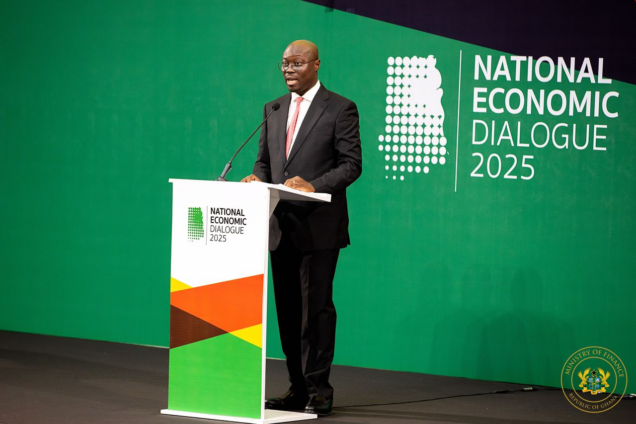
Dr Forson said this on the first leg of the two-day National Economic Dialogue ongoing at the Accra International Conference Centre.
“The energy sector in Ghana has become a ticking time bomb. More than two per cent of GDP every year. Every year, the profits of the energy sector will probably fall back on the legal side. For citizens, we require radical measures,” he said.
He pointed to the Electricity Company of Ghana (ECG) as a key area of concern, highlighting significant distribution and collection losses.
“Currently, only 62 per cent of total energy purchase by ECG is collected, leaving out probably 62 per cent. 65 per cent of that amount is used to pay for supplies through the cash quarter for mechanism,” Dr Forson said.
“Unfortunately, 35 per cent of ECG’s revenue is used to take care of ECG themselves over times that they don’t actually work,” he said.
Dr Forson expressed concern over the non- reflective tariffs on the true cost of service provision.
“In most reflective tariffs, about 50 per cent of cost of service provision is not for us to expect. However, I still maintain that tariffs should not be used to reward ECG’s inefficiencies and other inefficiencies in the system,” he said.
He revealed that unpaid legacy arrears in the energy sector stood at $1.3 billion at the end of 2022, with annual cumulative sector shortfalls reaching $2.2 billion in 2024, despite substantial government transfers.
The Finance Minister attributed the sector’s woes to a combination of factors, including the lack of political will to implement cost-reflective tariffs, limited renewable energy capacity, and inefficiencies within ECG.
He called for urgent and radical measures to address the crisis and prevent further financial strain on the economy.
“Having generational costs due to lack of politicians and limited renewable capacity in the energy mix is a problem. Having distribution and collection losses at ECG is also a problem,” he said.
Dr Forson stressed the need for a comprehensive approach to reform the energy sector, including addressing inefficiencies, promoting renewable energy, and implementing sustainable tariff policies.
He warned that without immediate action, the sector’s financial challenges would continue to escalate, posing a significant risk to Ghana’s economic stability.
Latest Stories
-
NPP revises internal election guidelines to strengthen transparency and inclusiveness
46 minutes -
NACOC set to issue licences to qualified applicants for cannabis cultivation – Deputy Director-General
54 minutes -
Easter Outreach: Victory Bible Church offers free healthcare, NHIS support to hundreds
57 minutes -
NPP cannot pressure Mahama to sign a bill not yet received—Solomon Owusu
1 hour -
MPs, institutions deepen support for Ghana Sports Fund with fresh contributions
1 hour -
Four people die trying to board boat in Channel crossing attempt
1 hour -
Abirem MP announces GH₵500,000 education fund to support needy students
1 hour -
African stakeholders call for stronger ‘One Health’ action on climate and health crises
1 hour -
DVLA to commission 5 new service centres in Greater Accra
1 hour -
Agenda 111 and the right to health: A broken social contract
2 hours -
Bawa-Rock Ltd funds GH¢400,000 free surgeries for 102 vulnerable patients
2 hours -
Lambussie MP awards over GH¢200,000 in scholarships to students
2 hours -
Vice President expresses gratitude after double enstoolment in Volta Region
2 hours -
Beyond the Noise: Rebuilding trust in journalism in a digital age
2 hours -
I have to follow the law – CAF president tells Senegal regarding AFCON saga
2 hours