

Audio By Carbonatix
The European Union (EU) has agreed to sign a security and defence partnership with Ghana, the Union’s first such arrangement with an African country.
The partnership seeks to strengthen Ghana’s national and sub-national early warning and response systems, as well as community-led conflict prevention and resolution mechanisms.
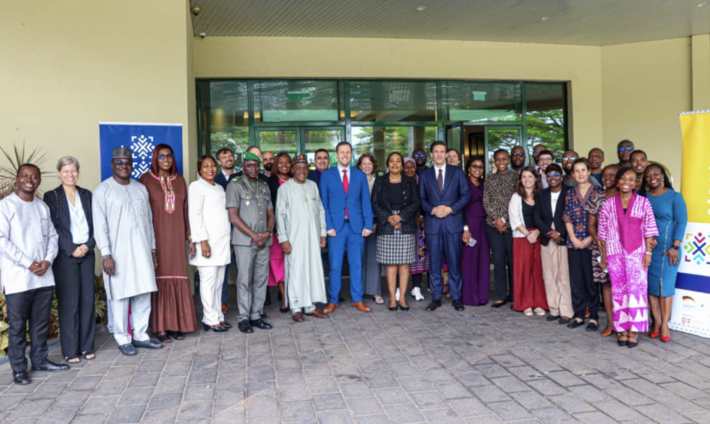
Mr Jonas Claes, Charge d’Affaires of the EU Delegation to Ghana, announced this at a Steering Committee meeting of the EU Support to ECOWAS in Peace, Security and Governance (EPSG) Project in Accra, stressing the need to reinforce mechanisms that enhance regional stability.
Launched in 2024, the EPSG Project supports the Economic Community of West African States (ECOWAS) in addressing security and governance challenges by enhancing early conflict detection, security sector reform, electoral support and inclusive peace processes.
A concept note copied to the Ghana News Agency (GNA) explained that through these efforts, the Project contributes to a more stable, democratic and resilient region.
Ghana, regarded as an oasis of peace in a sub-region facing rising terrorism and violent extremism, has long been a key pillar of regional integration.
The country is currently co-implementing several EU security-related initiatives aimed at raising awareness of the interconnections between security, governance and broader regional dynamics for sustainable development.
“The EU remains fully committed to this partnership and we look forward to its continuation in the years ahead,” Mr. Claes assured.
He emphasised that violent extremism, political instability and disinformation could not be addressed by any country acting alone.
“They require coordination, solidarity and collective action,” he stated
The EU Charge d’Affaires lauded Ghana’s President John Mahama for leading efforts to bring back the three seceded countries (Burkina Faso, Niger and Mali) to ECOWAS to enhance regional integration.
Highlighting emerging global security challenges, Mr Claes said contemporary developments posed difficult times for principles the EU upheld, including the rule of law, respect for human rights and the peaceful resolution of conflicts.
“Times are also tough for ECOWAS, and regional integration in West Africa, but we look at the future of regional integration in Europe and Africa with courage and conviction.
“After all, we have numerous shared interests that drive our continents together. Peace, security and democratic governance is but one of them,” he said.
Mr Frederik Landshöft, the German Ambassador to Ghana, said Germany supported efforts to build a strong regional peace and security architecture.
He noted that long-term stability depended primarily on strong local institutions and sustainable local solutions.
“For more than twenty years, Germany has supported the Ghana Armed Forces and other security institutions, enabling the country to play an important role within ECOWAS, in West Africa, and within the African Union.
“At the same time, guided by the broader understanding of human-centred security, we work closely together to improve economic opportunities and strengthen basic services for local populations, especially in border communities,” the Ambassador noted.
The EPSG Project works with a range of regional and national stakeholders to ensure a comprehensive approach to peace and security.
Commissioned by Germany and co-financed by the EU, the Project is being implemented through a Team Europe approach by international non-governmental organisations GIZ, EF and FIAP in partnership with ECOWAS.
The Steering Committee serves as the Project’s main governance and oversight body, bringing together key stakeholders to review progress, discuss strategic direction and provide guidance for the upcoming implementation period.
Latest Stories
-
China approves ‘ethnic unity’ law requiring minorities to learn Mandarin
4 minutes -
Health Ministry suspends Nkanchina Nursing College principal over alleged admissions irregularities
9 minutes -
Iran’s strategy of attacking Gulf states is wrong- Solomon Owusu
10 minutes -
‘Fingers on the trigger’: Deadly warnings for Iranians being urged to take action.
15 minutes -
President Mahama commissions Sahara LPG Vessel in South Korea
18 minutes -
Photos: Mahama commissions Ghana-named Vessel in South Korea
18 minutes -
I didn’t take any government land as Interior Minister—Henry Quartey
23 minutes -
I feel sorry for Muntaka over recruitment pressure – Henry Quartey
30 minutes -
The Copper Nano-Remediation Strategy: Evaluating the risks for Ghana’s galamsey-impacted rivers
41 minutes -
Africa Policy Lens demands answers from Bank of Ghana over sale of nearly 20 tonnes of gold reserves
1 hour -
Oil above $100 could trigger fuel price shocks in Ghana and West Africa as market transparency gaps persist
1 hour -
‘One million coders’ approach lacks strategy for jobs – Franklin Cudjoe
1 hour -
Decades of ‘lip service’ to private sector hurting job creation – Franklin Cudjoe
1 hour -
High oil prices may benefit West African crude exporters but not consumers, Argus analyst says
1 hour -
‘National security time bomb’ looming as youth unemployment surges – Franklin Cudjoe warns
2 hours