

Audio By Carbonatix
China has approved a sweeping new law which claims to help promote "ethnic unity" - but critics say it will further erode the rights of minority groups.
On paper, it aims to promote integration among the 56 officially recognised ethnic groups, dominated by the Han Chinese, through education and housing. But critics say it cuts people off from their language and culture.
It mandates that all children should be taught Mandarin before kindergarten and up until the end of high school. Previously students could study most of the curriculum in their native language such as Tibetan, Uyghur or Mongolian.
The law was approved on Thursday as the annual rubber-stamp parliamentary session drew to an end.
"The law is consistent with a dramatic recent policy shift, to suppress the ethnic diversity formally recognised since 1949," Magnus Fiskesjö, an associate professor of anthropology at Cornell University said in a university report.
"The children of the next generation are now isolated and brutally forced to forget their own language and culture."
However, Beijing argues that teaching the next generation Mandarin will help their job prospects.
It also says the law for "Promoting Ethnic Unity and Progress" is crucial for promoting "modernisation through greater unity".
The law was voted and passed on Thursday at the National People's Congress in Beijing, which has never rejected an item on its agenda.
The law also provides a legal basis to prosecute parents or guardians who may instil what it described as "detrimental" views in children which would affect ethnic harmony and it calls for "mutually embedded community environments" which some analysts believe could result in the break up of minority-heavy neighbourhoods.
The Chinese government started to push for what it describes as the "sinicisation" of minority groups in the late 2000s and create a more unified national identity by assimilating ethnic groups into the dominant Han culture.
Han Chinese make up more than 90% of the country's 1.4 billion people.
Beijing has long been accused of restricting the rights of minority ethnic groups in regions like Tibet, Xinjiang and Inner Mongolia.
Critics say assimilation has often been forced on people in these places - a state-led policy that has accelerated under Chinese leader Xi Jinping who has taken a harder line on dissent and protests, especially in areas home to minority ethnic groups,
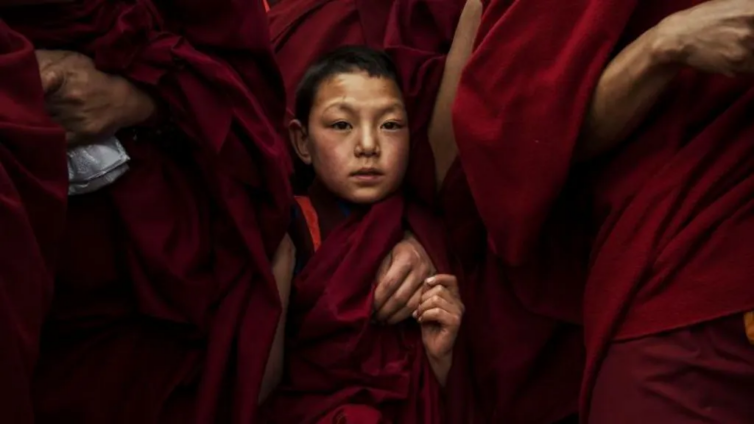
In Tibet, the authorities have arrested monks, and taken control of monasteries to ensure they do not worship the Dalai Lama.
When the BBC visited a monastery that had been at heart of Tibetan resistance in July last year, monks spoke of living under fear and intimidation.
"We Tibetans are denied basic human rights. The Chinese government continues to oppress and persecute us. It is not a government that serves the people," one of them told us.

In Xinjiang, human rights groups have documented the detention of a million Uyghur Muslims in what the Chinese government calls camps for "re-education", while the UN has accused Beijing of grave human rights violations.
The BBC's reporting from 2021 and 2022 found evidence supporting the existence of detention camps, and allegations of sexual abuse and forced sterilisation, which Beijing denies.
In 2020, ethnic Mongolians in northern China staged rare rallies against measures to reduce teaching in the Mongolian language in favour of Mandarin.
Parents even held children back in protest at the policy as some ethnic Mongolians viewed the move as a threat to their cultural identity. Authorities moved quickly to crackdown on what it saw as dissent.
The Communist Party says it embraces different ethnicities. The country's constitution states that "each ethnicity has the right to use and develop their own language" and "have the right to self-rule".
But critics believe this new law will cement Xi's push toward assimilation.
"The law makes it clearer than ever that in Xi Jinping's PRC non-Han peoples must do more to integrate themselves with the Han majority, and above all else be loyal to Beijing," Allen Carlson, an associate professor of government at Cornell University said, referencing China by the initials of its official name.
This focus on development and prosperity is "telling", Professor Ian Chong of the National University of Singapore told the BBC.
"It is easy to read this language as meaning that minority languages and cultures are backward and impediments to advancement."
Xi's approach towards minorities is "consistent with his idea of creating a great and strong Chinese nation with a northern Han core... minorities are seen as branching off from that core, and hence in some ways derivative," he adds.
"In practice, this has prompted concerns about further rounds of increasing control, diminution, and even crackdowns on minority cultures and languages."
Latest Stories
-
Two Invitations, Three Interrogations: Did Baffour Awuah tell the whole story?
5 minutes -
Drug cartels may be seeing Ghana as easy route – Lenin Anane Agyei
58 minutes -
Ghana risks gaining notoriety as drug-trafficking hub – Bobby Banson
1 hour -
Government dismissed my drug trafficking warning, then tried to arrest me – Ntim Fordjour
1 hour -
Day Two: 3rd Republic Bank-JoyNews Habitat Fair Clinic underway at Junction Mall
1 hour -
NACOC addressing inherited gaps in fight against drug trafficking – Deputy Director-General
1 hour -
Taekwondo goes to school as GTF launches five-region youth campaign
1 hour -
The issues Mourinho is struggling to fix at Real Madrid
2 hours -
Hundreds throng EducationUSA College Fair in Kumasi in pursuit of abroad studies
2 hours -
Drug bust: NACOC should be part of port inspection team – Twum-Barimah
2 hours -
Ward appointed Liverpool’s sporting director
2 hours -
This isn’t the first cocaine bust; NPP must stop the politicisation – NACOC deputy boss
2 hours -
Drug bust case: Only Customs officers, MPS officials in scanning room – NACOC
3 hours -
I don’t mind being insulted; I have a crocodile skin – President Mahama
3 hours -
Samson’s Take: Verify the badge – and verify the story
3 hours